
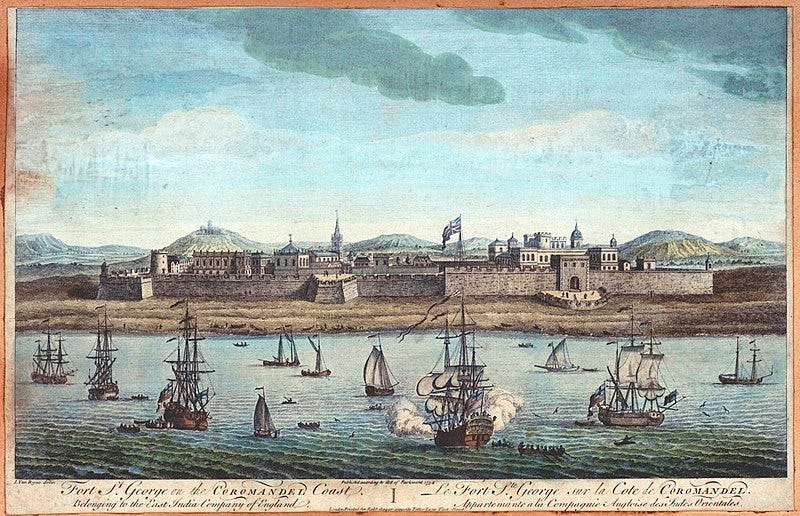
Child’s War: The First Anglo-Indian Confrontation
A conflict between the East India Company and the Mughals from 1686 to 1690 that has nothing to do with children.
After Vasco da Gama discovered a new sea route to the East in 1498, European countries started setting up trading companies — an occupation long dominated by the Arabs and the Italians. The British also wanted to grab a share of this trade. When Thomas Roe, an emissary for King James I of England, was granted trading rights from the Mughal Emperor Jahangir, the English East India Company (EEIC) was born. The EEIC soon established factories¹ in Surat, Ahmedabad, Agra, Broach (Bharuch), Madras (Chennai) and Masulipatnam and Bombay (Mumbai).
Gradually, the British had gained control over much of the trade in the Indian subcontinent and were becoming more ambitious. In 1681, Sir Josiah Child, a reckless and aggressive administrator and economist, became the director of the EEIC. Child was a staunch believer in mercantilism. Mercantilism, simply put, was an economic concept that looting unsuspecting individuals or entities was the only way to get rich. In Child’s view, Mughal officials were the biggest hindrance in the EEIC’s goal to make maximum profit. Rival European trading guilds also created problems for him. Adding to his woes was Shaista Khan, the governor of Bengal whose dislike for the EEIC was no secret.
For five years he had tolerated Khan, but now enough was enough and he plotted to capture Bengal. In 1686, a fleet of nineteen warships carrying two hundred soldiers and six hundred cannons were dispatched to Bengal from London, and when they arrived, what modern historians call Child’s war, began.
Admiral Nicholson, the commander of these troops, agitated Khan. He offered Nicholson a chance to negotiate, but the Admiral refused. Aurangzeb, the reigning Mughal Emperor was now infuriated. The Mughal army which had just emerged victorious from a war with the Marathas, retaliated with full force, rattling the English troops.
Child had highly underestimated the Mughal’s prowess and his Bengal campaign toppled like a tower of cards. The EEIC factories spread across the subcontinent were attacked and occupied and the English had been ousted from Bengal. Yakut Khan, a general of African origin, besieged Bombay in 1690, the EEIC’s prime possession on the western coast, a humiliating defeat for the English. This siege raised doubts about the feasibility of the EEIC’s strategy and the adeptness of its employees. Josiah Child had failed miserably.
The EEIC had no choice but to apologize and its representatives pleaded before Emperor Aurangzeb for the restoration of their trading rights and factories. The Emperor pardoned the EEIC and agreed to restore their former allowances.
This action by Aurangzeb was one of the biggest blunders of Indian history because Josiah Child’s dream of annexing Bengal would be fulfilled sixty-seven years later by a clerk-turned-general named Robert Clive. The EEIC would subsequently pillage every bit of India’s wealth and glory and turn her people into slaves.
¹ These factories were not manufacturing facilities, rather they were trading posts and settlements
Works Cited
Think Africa. n.d. Yakut Khan: The Indian Admiral of African Ancestry, Story Of The 1690 CE Defeat Of The East India Company. https://thinkafrica.net/yakut-khan-the-indian-admiral-of-african-ancestry-story-of-the-1690-ce-defeat-of-the-east-india-company/.
Gokhale, Aneesh. 2018. Aurangzeb versus the East India Company. September 9. https://www.dnaindia.com/analysis/column-aurangzeb-versus-the-east-india-company-2660916.
Dalrymple, William. 2019. The Anarchy. London: Bloomsbury.
Basu, Sucharita. 2019. Frank Modern Certificate History and Civics. Chennai: Frank Bros. & Co.
Margaret R Hunt, The 1689 Mughal Siege of East India Company Bombay: Crisis and Historical Erasure, History Workshop Journal, Volume 84, Autumn 2017, Pages 149–169, https://doi.org/10.1093/hwj/dbx034
Prakash, Om (1987). European Commercial Enterprise in Pre-colonial India. Cambridge University Press. ISBN 978–0–521–25758–9.


