Children With Down Syndrome Are Mythical
A personal experience in the world of disability
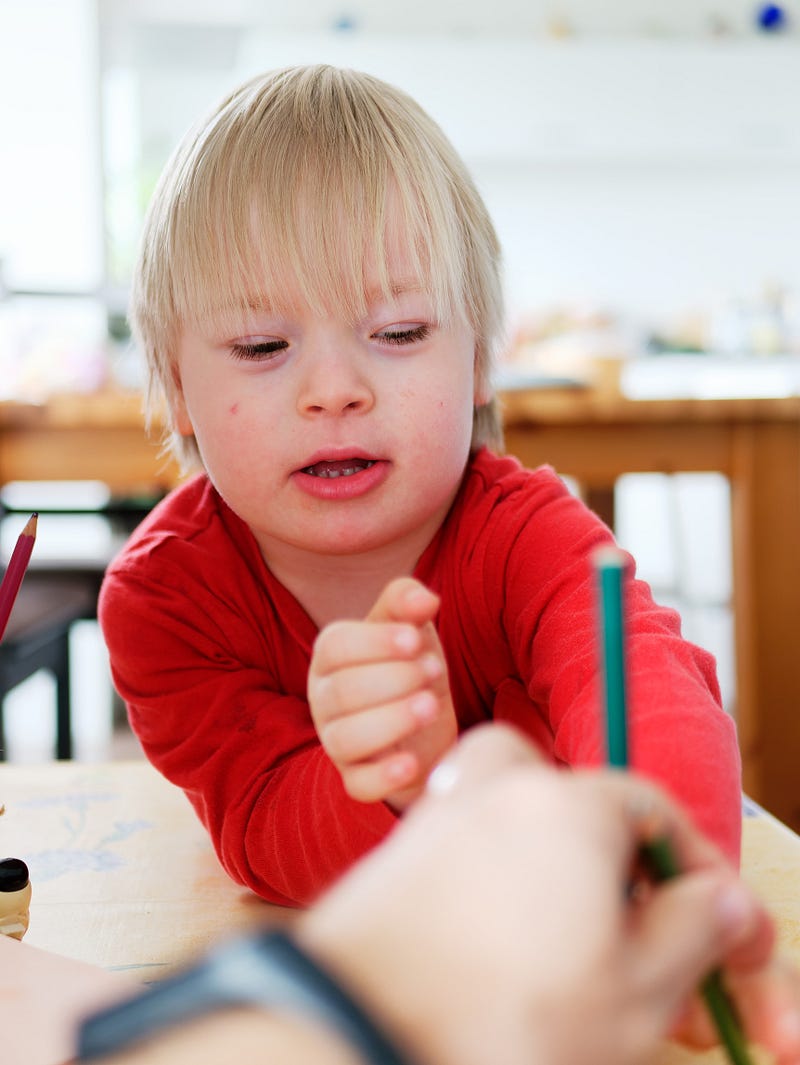
Before starting my job as an educator in the primary school I had no exact idea about what children disability actually was.
I had theoretical knowledge, but I lacked any practical experience because I had always worked as a psychologist-psychotherapist with adults.
This adventure of mine lasted nine years and it’s been the most important, incredible, fulfilling, growth chance I’ve had the honor of living thanks to a child with Down syndrome.
Through the relationship with Leonard (not his actual name) I started going over a series of prejudices and resistances that showed up while trying to build a real, deep, human and professional connection with him.
I know how much effort has been made to create acceptance and inclusion of people with this disability in the whole world. Yet, according to my personal journey and personal difficulties, I guess there are still many blocks in our society in the way everyone deals with these special humans.
This is my attempt to let you know how incredibly valuable they can be.
What’s the Down syndrome
Down syndrome is a condition in which a person has an extra chromosome. It is usually caused by an error in cell division called “nondisjunction”.
There are three types of this syndrome.
- Trisomy 21, the most common type, where there are three copies of chromosome 21 in each cell, instead of two.
- Translocation Down syndrome. Each cell has part of an extra chromosome 21, or an entirely extra one.
- Mosaic Down syndrome, where an extra copy of chromosome 21 is present only in some of the body’s cells.
Due to this particular genetic map, there are typical physical and mental characteristics expressing in people with this syndrome.
First obstacle: no common language
If you have even a remote idea of how children function, you may agree that the absence of a common language is a really big issue during their first years of life. It is, indeed, in most cases. It is, more than ever, with children who have other disabilities and can’t express themselves clearly.
Leonard, by the way, was diabetic since he was born. And at four years of age his lexical properties were a total of five recognizable words. That made the challenge of communicating with each other extremely difficult, especially when I had to translate his state of health to the nurse who was in charge of his insulin injections.
An incredible runner
Besides not having a common language, Leonard had another incredible ability. He was able to run away in a fraction of a second and elude my surveillance.
Whenever he found an interest in something, let’s say a toy he had seen in another classroom, he would try to go there whatever the situation he was in. If we were in the garden and he was playing with his friends, he could suddenly disappear and I had to play involuntary hide and seek to get to find him…obviously he had reached the dreamed toy that wasn’t in his classroom.
So many times he did this to me that I thought I was going to have a heart attack one day or the other. I mean, do you understand the responsibility I had? I can tell you my eyes and ears were always alerted on him, but he was a very capable Houdini.
The dark side of obsession
Some days I would have banged my head against the wall. Like most people with this syndrome, Leonard would repeat words, behaviours and questions endlessly.
An infinite repetition of the same word for hours can drive anybody crazy.
That’s why I had to find little tricks to change the focus of his attention when the tension was at the top limit of my bearance.
People with Down syndrome needs a routine in their life, to feel secure and not to get lost. It means a rather repetitive way of doing things which can become difficult to face for their caregivers.
But one thing is a routine, and something different is an obsession. Some of them can get hard on obsessions, and you may have a hard time avoiding them.
Depending on the level of mental development, there can be some really hard situations to manage as regards repetitiveness. On the other hand this issue is professionally challenging. In my case I tried to see all the different variants I could act in the contest of obsessive repetitions, and I developed a variety of distractions to get to change the main “theme”of the moment, of the day, of the week.
At the end it resolved in many funny micro comedies I still laugh about when remembering them.
Leonard’s peculiarity
Each one of us has a peculiar talent, or more than one. Some are hidden, also to yourself. Some are evident, and play at the sun light.
Leo’s abilities, apart from his running speed, were in the social relationships he could build.
Even if his language wasn’t clear and many times people won’t understand exactly what he was saying, he always had an addictive personal charme which led people to adore him.
He became the mascot of every place he was introduced to in a very short period of time. The school, the swimming pool, the church, the supermarket, the hospital, his neighbourhood… Everybody wanted to engage with him because of his sympathy.
You would never imagine such a social success when reading the diagnosis of a very low I.Q.
Anyway, there were people adversing this nice soul thinking he was a freak. Somebody even suggested he shouldn’t be born.
Conclusion
I know that people with Down syndrome can present a big challenge to the ones in charge of them and to our narcissistic society.
But what I can tell you is that I personally had one of the most incredible life experiences by getting to know Leonard.
I’ve grown with him as a human being in a way I wouldn’t think possible. He enriched me, he made me cope with things from different perspectives.
I am grateful to him and I really hope everybody could be open to the mysteries and miracles that life can bring through a relationship with people who have this syndrome, despite all the problems that may arise from it.


