avatarM. J. Carson

Free AI web copilot to create summaries, insights and extended knowledge, download it at here

2230

Abstract

    <div>
            <img class="ratio" src="http://placehold.it/16x9">
            <iframe class="" src="https://cdn.embedly.com/widgets/media.html?src=https%3A%2F%2Fw.soundcloud.com%2Fplayer%2F%3Furl%3Dhttps%253A%252F%252Fapi.soundcloud.com%252Ftracks%252F1654979640%26show_artwork%3Dtrue&amp;display_name=SoundCloud&amp;url=https%3A%2F%2Fsoundcloud.com%2Fmina-carson%2Fchildren-at-the-border%3Fsi%3D1d1016a9629b4c6ea1313d8e8ee225b2%26utm_source%3Dclipboard%26utm_medium%3Dtext%26utm_campaign%3Dsocial_sharing&amp;image=https%3A%2F%2Fsoundcloud.com%2Fimages%2Ffb_placeholder.png&amp;key=a19fcc184b9711e1b4764040d3dc5c07&amp;type=text%2Fhtml&amp;schema=soundcloud" allowfullscreen="" frameborder="0" height="166" width="800">
          </div>
        </div>
    </figure></iframe></div></div></figure><p id="46fc">The lyrics:</p><blockquote id="0ab1"><p>Children at the border, frightened and hungry

Children at the border, fainting in the sun Children at the border, send in the army Children at the border, ready the guns</p></blockquote><blockquote id="4893"><p>Who are we? What have we become? Building up a wall to the beat of a drum Once again, demons loosed in the land of the gun</p></blockquote><blockquote id="cd3e"><p>Children in the forest, running for their lives Children born in bondage, brown skin and brown eyes …By the campfires, cavalry will come Women screaming, crying, but if they live they have won</p></blockquote><blockquote id="982c"><p>Who are we? What have we become? Slaughtering the babes to the beat of a drum Once again, demons loosed in the land of the gun</p></blockquote><blockquote id="1895"><p>Children in the factories, sweating out their lives Children weaving cloth on machines sharp as knives Children in the coal mines, picking out the stones Soot in their lungs and despair in their bones</p></blockquote><blockquote id="21d3"><p>Who are we? What have we become? Stealing children’s lives to the beat of a drum Once again, demons loosed in the land of the gun</p></blockquote><blockquote id="0c03"><p>Children in the classrooms, learning how to hide Pile up the chairs, lock the doors against the bullets outside</p></blockquote><blockquote id="cf60"><p>Who are

Options

we? What have we become? Killing our own kids to the beat of a drum Once again, demons loosed in the land of the gun.</p></blockquote><p id="cf9d">— Mina Carson, 2019-ish</p><p id="5190">When I started writing the song, I thought it would be important to signal that I was moving back in time to recognize earlier atrocities. Then I decided that the listener could pick that up without my help. It is possible to be too pedantic.</p><p id="17c5">And then, in the last year or two (this is 2023), the third verse, about using child labor in factories and mines, leaped right out of the past and back into the present. Yes, this has occurred throughout the world since the ‘building’ of empires (impressing native populations into a global workforce), but the US has brought it home again in explicit policies in several states (Arkansas, Iowa, New Jersey, and New Hampshire leading the way).</p><p id="98e2">The second verse merges enslaved people fleeing for freedom with Native American victims of US military slaughter. I could’ve separated those episodes, but instead I decided to merge them, again, to signal the continuity of official actions and policies in United States history and politics.</p><p id="e87b">The final verse, about ‘children in the classroom,’ is missing two lines, and usually when I perform this I leave a blank space, just guitar chords sliding up and down. This time I rolled right into the last chorus. If you cover it, there’s an idea.☺️</p><p id="c110">Please do feel free to cover and share this song, and let me know if you do.</p><p id="7f65">Another in this collection of songwriting narratives:</p><div id="c2b2" class="link-block"> <a href="https://readmedium.com/this-old-guitar-knew-me-best-8c0306b710c6"> <div> <div> <h2>‘This old guitar knew me best’</h2> <div><h3>Revisiting adolescent fears in a song</h3></div> <div><p>medium.com</p></div> </div> <div> <div style="background-image: url(https://miro.readmedium.com/v2/resize:fit:320/1*qhzW32b7e-mewwMCHsYn7Q.jpeg)"></div> </div> </div> </a> </div></article></body>

‘Children at the Border’

A sung response to our refusal to protect our kids

(One in a personal series of songwriting narratives: simple recordings, lyrics, and origin stories.)
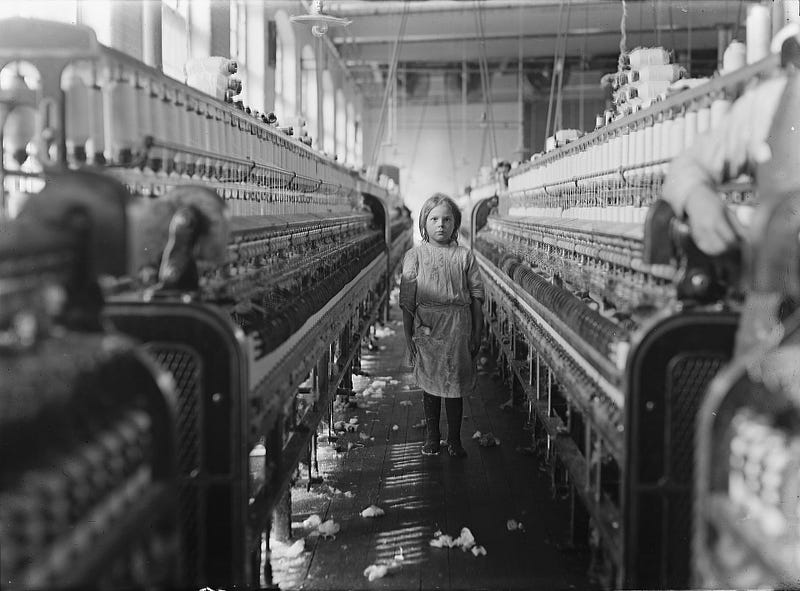
By Lewis W. Hine for the National Child Labor Committee — This image is available from the United States Library of Congress Prints and Photographs division under the digital ID nclc.01451. See Commons:Licensing., Public Domain, https://commons.wikimedia.org/w/index.php?curid=253058

When Trump began separating families at the US southern border, tearing children from their parents and caging them or shipping them god knows where, I thought we had reached the most brutal depths of our collective ability to wreak harm on the world.
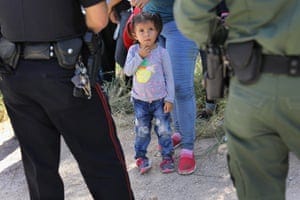
McAllen, Texas. John Moore, Getty Images.

Then I remembered that the border policy was merely a continuation of our longstanding collective approach to childhood: if it is not convenient to protect children, we do not. Children have been at the core of our ethnic cleansing policies for centuries.
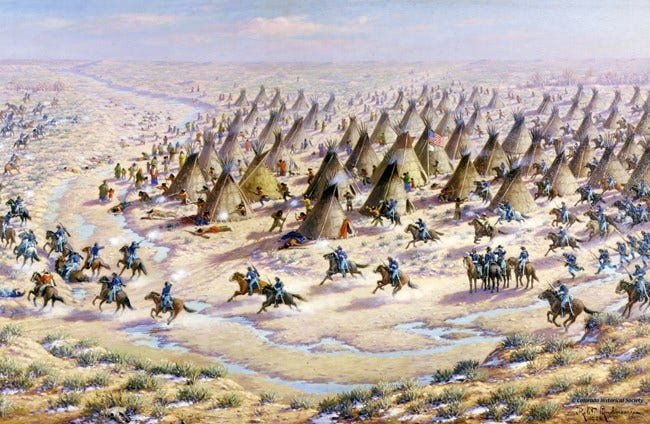
“The Sand Creek Massacre” by Robert Lindneaux portrays the deadly 1864 attack by the US military on a peaceful encampment of Arapahoe and Cheyenne people. “Kill ’em all, big and small, nits make lice,” Colonel Chivington commanded his soldiers.

So I wrote this song. A minor seemed the appropriate key. The accompaniment moves up and down the fingerboard throughout the verses, and then uses an Am-G-F sequence in a different voicing for the chorus.

Here’s a simple recording of “Children at the Border.” The lyrics and more context are below.

The lyrics:

Children at the border, frightened and hungry Children at the border, fainting in the sun Children at the border, send in the army Children at the border, ready the guns

Who are we? What have we become? Building up a wall to the beat of a drum Once again, demons loosed in the land of the gun

Children in the forest, running for their lives Children born in bondage, brown skin and brown eyes …By the campfires, cavalry will come Women screaming, crying, but if they live they have won

Who are we? What have we become? Slaughtering the babes to the beat of a drum Once again, demons loosed in the land of the gun

Children in the factories, sweating out their lives Children weaving cloth on machines sharp as knives Children in the coal mines, picking out the stones Soot in their lungs and despair in their bones

Who are we? What have we become? Stealing children’s lives to the beat of a drum Once again, demons loosed in the land of the gun

Children in the classrooms, learning how to hide Pile up the chairs, lock the doors against the bullets outside

Who are we? What have we become? Killing our own kids to the beat of a drum Once again, demons loosed in the land of the gun.

— Mina Carson, 2019-ish

When I started writing the song, I thought it would be important to signal that I was moving back in time to recognize earlier atrocities. Then I decided that the listener could pick that up without my help. It is possible to be too pedantic.

And then, in the last year or two (this is 2023), the third verse, about using child labor in factories and mines, leaped right out of the past and back into the present. Yes, this has occurred throughout the world since the ‘building’ of empires (impressing native populations into a global workforce), but the US has brought it home again in explicit policies in several states (Arkansas, Iowa, New Jersey, and New Hampshire leading the way).

The second verse merges enslaved people fleeing for freedom with Native American victims of US military slaughter. I could’ve separated those episodes, but instead I decided to merge them, again, to signal the continuity of official actions and policies in United States history and politics.

The final verse, about ‘children in the classroom,’ is missing two lines, and usually when I perform this I leave a blank space, just guitar chords sliding up and down. This time I rolled right into the last chorus. If you cover it, there’s an idea.☺️

Please do feel free to cover and share this song, and let me know if you do.

Another in this collection of songwriting narratives:

Counter Arts
Songwriting
Equality
Creative Process
Protest Songs
Recommended from ReadMedium