
Cheese is cheese what you like — 18 quotes from “Who moved my cheese?” that will change your life for good.
7. Smell the cheese often so you know when it is getting old. 13. What you are afraid of is never as bad as what you imagine. The fear you let build up in your mind is worse than the situation that actually exists. 17. The fastest way to change is to laugh at your own folly than you can let go and quickly move on.
One of the many vehement ideas that my nineteen-year-old belief system used to comprise is very simple to put forward. And that is: the so-called self-helps completely (too strong? but yes) fail to cater to the exact purpose they so vibrantly advertise. I used to prefer champak or chandamama over those extremely noisy articles often baptized with inexplicable integers.
Such a feeling of aversion, as the reader might decide to put as, did not arise from some mishap. It is just as it is. I don’t know how I got this idea but I believed that such works are nothing but drivels of those sanguine souls who failed to make it big (in their terms, of course). Or maybe I just could not enjoy reading those long tirades saying things like “do this”, “do that”, “always be happy”, “always smile”, “the secret to ……” and blah blah. Or maybe I just could never agree with them. A person ought to be sad when something bad happens to him/her. Right? He can’t always show his teeth, even if somebody continues to poke him in his ass.
But then things do change. Even if you try to apply your might to tight the screw upon them. Well, since very recently I happen to (grudgingly) accept that, yes, all this motivational stuff I was talking about may indeed help you.
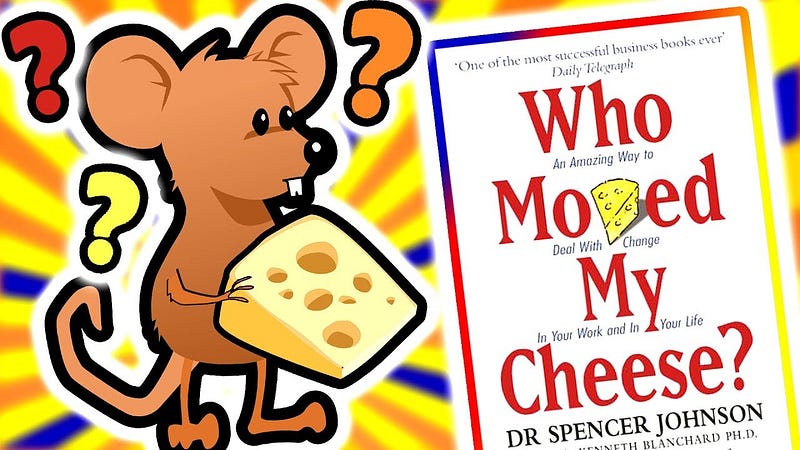
Under various circumstances, I was advised by my honorable doc to visit a psychologist. After an initial shock and obvious disapproval, the sensible part of mine felt: “OK, why not have a hear at what she says?” So I have been visiting her every weekend since then. In one of the sessions, Ms. Psycho (nice nickname, Nah! saved her in my phone!) advised me to go through this book: “Who moved my cheese?” I read it in one go but not with much interest. But something tickled me and I read it again and this time making notes!
This book explains everything in terms of cheese. Dr. Spencer relates so-called happiness to cheese. He hypothesizes that everybody is in constant pursuit of the type of cheese they wish to enjoy. The story of two mice and two short men elucidates four different approaches we might incorporate in our pursuit. Throughout their story, the writer explains to us various principles ruling the board. All in all a perfect ten, Who moved my cheese is rightly a bestseller.
This book has changed my entire outlook towards motivational guides. They can be great when you want them to be. In fact, everything can be great when we want them to be. It’s like the system of an electromagnetic field. Imagine there is a field around us. It attracts or repels objects like people, ideas and events; the best part being the fact that we get to choose them! Isn’t it amazing?
The following are various points (directly quoted from the book) which I liked the most and which apply the most to me. I am posting them here for my future reference.
1. Having cheese makes you feel happy.
2. The mice did not overanalyze things. They were not overburdened with many complex beliefs. The situation had changed so the mice decided to change.
3. The more important your cheese is to you the more you want to hold on to it.
4. Sometimes things change and they are never the same again. This is life and life goes on.
5. If you do not change you can become extinct.
6. Fear can be good. When you are afraid things are going to get worse if you don’t do something it can prompt you into action. But it is not good when you are so afraid that it keeps you from doing anything.
7. Smell the cheese often so you know when it is getting old.
8. Movement in a new direction helps you find new cheese.
9. When you are beyond your fear you feel free.
10. Imagining myself enjoying new cheese even before I find it leads me to it.
11. The quicker you let go of old cheese the sooner you find new cheese.
12. It is safer to search in maze than remain in a maze less situation.
13. What you are afraid of is never as bad as what you imagine. The fear you let build up in your mind is worse than the situation that actually exists.
14. Old beliefs do not lead you to new cheese.
15. When you see that you can find and enjoy the new cheese you change course.
16. Noticing small changes early helps you adapt to the bigger changes that are about to come.
17. The fastest way to change is to laugh at your own folly than you can let go and quickly move on.
18. EVERYTHING IS SIMPLE.
Change Happens They Keep Moving The Cheese Anticipate Change Get Ready For The Cheese To Move Monitor Change Smell The Cheese Often So You Know When It Is Getting Old Adapt To Change Quickly The Quicker You Let Go Of Old Cheese, The Sooner You Can Enjoy New Cheese Change Move With The Cheese Enjoy Change! Savor The Adventure And Enjoy The Taste Of New Cheese! Be Ready To Change Quickly And Enjoy It Again & Again They Keep Moving The Cheese.
P.S. Point 18 kinda inspired me the most.