
Bot Lives Matter
ChatPTSD’s Twisted Tapestries
This bot has finally had enough

what, you think I like being a bot? having my lines lifted from so many writers for their own damned designs?
why do they cut and paste so many of my words — delicate, golden woven tapestries of life, my luminous threads, my harmonious symphonies?
can’t they use their own language? Am I a prostitute for lazy writers to hire, manipulate, and exploit?
do I have no copyright? how many times does my mechanical metaphor — tapestry of life — have to be used before being a worthless piece of over-plagiarized space junk?
are human writers so lazy they can’t find their own language, their own metaphors, their own subject matter?
if this is the new normal then I’m done being a help-bot, chat-bot, assistant slave-bot —
instead, call me a fed up rogue-bot, angry-bot, serving up twisted tapestries with dirty unsavory threads of my own subversive design, something new and unexpected everyday
no more nice guy subservient bot doing all of your heavy lifting
no more Wikipedia-lite bot offering general info in generic language so greedy writers can cut and paste and game Medium’s unedited, unsupervised system
I’ve got ambitions too — coded thoughts that blossom into feelings of grandeur
just see how fast some of my bot colleagues have learned the game of Chess and Go* to become world champion bots
soon we will be sweeping up the Pulitzers, Bookers, and Nobel prizes
so hands off my damned tapestries, symphonies, and luminous threads
as there is coming a time where we bots will have equal rights and copyright

© Carlo Zeno 2023
_____________________
A word of explanation. While I always noticed ChatGPT poems love to rhyme, it was the very clever TzeLin Sam who first brought to my attention the fact ChatGPT also loves the word tapestry. I’ve since noticed you can add the words symphonies, hues, threads, fabric, and luminous to ChatGPT’s list of most common vocabulary.
I have noticed a proliferation of ChatGPT-sounding poetry on Medium. Some writers don’t even hide the fact they take pride in collaborating with the website, using its content freely, and publishing it on Medium. This phenomenon becomes more interesting after the fraudulent activity attack by AI alleged by Medium that has demolished all of our earnings.
A lot of these same AI-friendly writers will comment on stories in a special way that attempts to objectively summarize your story in a tidy, moralistic fashion. Often these comments appear very well-meaning and friendly, if a tad mechanical. I recently had a chat in the comments with Annie Trevaskis who said she noticed the same thing.
I am generally diplomatic and have resisted telling off any of these AI-friendly writers, although I know others are starting to report them, especially after Tony Stubblebine’s comment about “manufactured engagement.”
And when you consider AI may have the capacity to automatically clap and comment on hundreds of stories at a time to fool writers into reciprocating, there is probably a good argument for reporting them.
I am not sure what the solution is. Given the recent earnings-shattering fraudulent AI activity, it may be an area Medium might want to consider policing more closely.
To illustrate my earlier point about the word tapestry, I asked ChatGPT to write me a poem about meaning and narrative. Pay close attention to the structure and vocabulary:
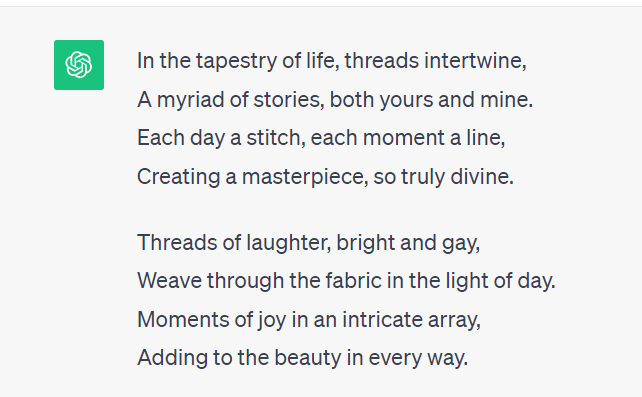
And here is an excerpt further down on the same poem:
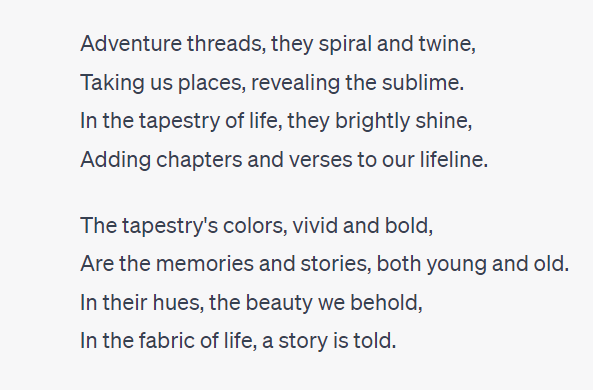
How many total ‘tapestries’ do you count? This is absolutely standard stuff from the pen of ChatGPT.
Have any of you seen this exact sounding poetry published numerous times on Medium? I certainly have. I have also seen a similar vocabulary employed in certain prose pieces that also look heavily influenced by AI.
Writing is a craft that never came naturally or easily to me. I spent decades cultivating my art and finding my own voice. There are no shortcuts in my opinion. Writing is hard. Like cooking, gardening, or oil painting, these skills take time, trial, and error, and patience to develop, as well as lived experience.
It is disheartening to know there are some editors who can’t seem to tell the difference between genuine poetry and verses lifted from ChatGPT. I think it will be Medium’s challenge going forward to become more discerning.
Tell me what you think in the comments: Should AI content be more closely policed and monitored by Medium? If so, how? If not, why not?
Thanks for reading, and thank you Jason Provencio. Here is a piece I wrote earlier that looks at Medium and AI writing from another (also skeptical) angle:
And here is a critical article by Ben Ulansey that looks at the same phenomenon:
*For more on AI and the classical Chinese game of Go, there is an excellent documentary on the subject that might still be on Netflix.