
Chat GPT — More risks than benefits?
The Eureka moment
Its no denying that ChatGPT has been talk of the town ever since it was enabled for public access and use. Artificial Intelligence has been a known topic to everyone now, especially in tech community. It has been part of school and university curriculums and the topic has found its own place in educational degrees and courses. There have been several Open AI apps that have existed in some form quite a while however hasn’t been quite popular with masses. However, ChatGPT within a week of its launch, had over 1 million users and has been praised by many stalwarts including Elon Musk calling it “Scary good”.
There are a few things that have caught attention and has mesmerized many
- Its human like response with lightening speed.
- Its ability to share information on diverse range of topics.
- Especially in content creation, it astonished everyone with its ability to write essays, blogs, poems and other literature forms within minutes. It certainly defeats humans hands down when it comes to sheer pace of work in this area.
- Tech community was especially excited to know ChatGPT’s ability to write programs and provide solutions to technical challenges. Cyber community especially explored many use cases from writing ready-to-go phishing emails within 30 seconds to creating possibly malware scripts that can lead to potential data breaches and leakages.
- Its rapid learning mechanisms, flexible integrations have caught attention Tech Giants like Google and Microsoft.
Traditional adoption of technology and its risks
Usually every new innovation in technology goes through its own due diligence before its adopted in organizations or for public use. Be it new operating systems, programming languages, databases or other innovative solutions, organizations make considerable efforts to know its risks and vulnerabilities before they are integrated into their systems. The technologies become part of risk assessments and information security programs. Most importantly, technologies have ownership and accountability (through its manufacturer) so you know who do you approach when you need help.
Now the question is, before its mainstream adoption and use, will organizations conduct a thorough risk assessment and due diligence. It’s crucial before Open AI systems are integrated into your system, are assigned tasks and key businesses have dependency on its functions.
Is ChatGPT being adopted without Risk assessment ?
Today threats exists in multiple forms and the risks doesn’t have to be necessarily technology risks. A tech innovation solution can lead to several risks — people risks, reputational risks, legal risks and so on.
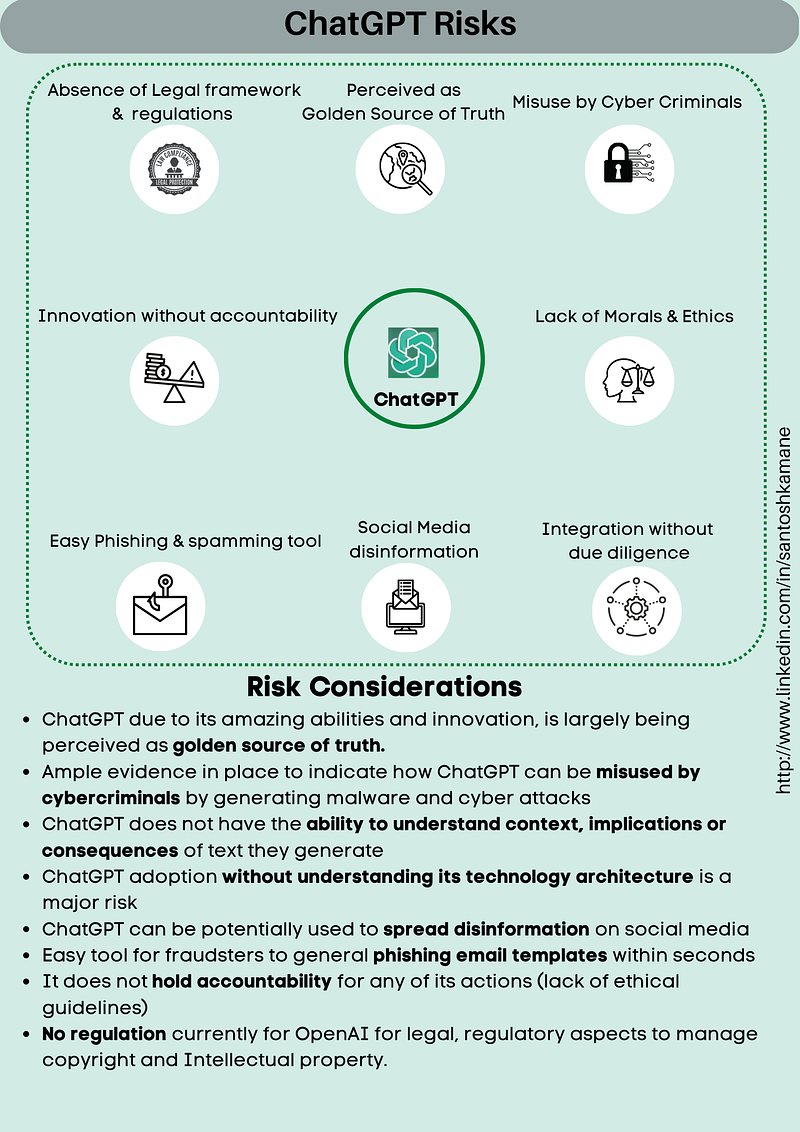
lets look at some of the potential risks posed by ChatGPT or similar Open AI systems
- Absence of legal framework — We can’t deny the AI capabilities, its influence and coexistence with human race and potential implications. Soon or later, it would be widely accepted by everybody, all industries across all sectors due to its rapid response and creative value (both constructive and destructive) . Is there a need for immediate legal and regulatory framework to ensure its accountability and appropriate use?
- Golden source of truth — No doubt, its unbelievably superfast in responses and holds tons of information with its own human like creative output and ability to perform tasks. Does it mean all the information it provides is reliable, true and can be your golden source?
- Misuse by Cyber criminals — This has been discussed several times in multiple forums and articles. Cyber criminals are exploring its capabilities like writing scripts for data extraction, phishing email drafts and building malware capabilities.
- Lack of morals and ethics — ChatGPT does not have ability to understand the context, implications or consequences of its output text. It lacks emotions, it doesn't understand social construct and structure. It won’t distinguish between intent of honest and malicious actors.
- Integration without due diligence — Its an important piece of technology that has impact on business processes, data integrity etc. Can you adapt it without conducting due diligence on its security aspects?
- Social Media disinformation — ChatGPT will have ability to respond to likes and comments on social media platforms. Can it further be manipulated as a tool to spread inaccurate information?
- Easy phishing and spamming tool — Phishing can’t get easier than this. You ask for the any template for phishing email draft, and chatGPT will make it ready for you in seconds. (without any spelling mistakes) :)
- Innovation without accountability — There are multiple questions to be asked,
- Who is accountable for open AI’s decision making abilities and output?
- Who hold copyright on its content?
- Who would you reach out if you think its not working in line with your values and ethics?
Final Words
Innovation can be exciting, it can bring convenience and comfort. It’s important to take a step back and thoroughly analyze impact of it on our daily lives, the risks it brings to us, our organizations and our societies. Reformative technologies, such as ChatGPT, can have a long last influence on our next generations.
Make sure ChatGPT is part of your risk assessment.