
Charters: Public Schools or Private Businesses?
The charter industry claims to operate public schools but opposes attempts to make them accountable to those who fund their operations.
“It is the intent of the Legislature in enacting this act to do both of the following: (a) Ensure that charter school governance is transparent. (b) Ensure that monitoring and oversight of charter schools are conducted to protect the public interest.”
-California AB 1478
As recipients of public funding, one would expect that organizations running charter schools would be subjected to the same open government regulations that other government entities, including elected school boards, must follow. While it is not always convenient to conform to the Brown Act, the California Public Records Act (PRA), or the Political Reform Act of 1974, these provisions of California law help ensure transparency to the taxpayers. Unfortunately, under the state Education Code, the charter industry is currently exempt from following these requirements, leaving parents of students in these schools blind to their operations.
In Los Angeles, the District Required Language ensures that compliance with many of these rules are written into charters that are approved by the LAUSD Board of Education. It is only because of these requirements that I was able to request copies of the bank statements for Granada Hills Charter High School’s Associated Student Body account and found that illegal loans had been made to cover the schools operating expenses. As a result, the LAUSD’s Charter School Division issued a Notice to Cure. Another PRA resulted in uncovering a Notice of Violation issued to the school as a result of unsafe construction projects that had been undertaken on the LAUSD owned campus without the knowledge of the District. Documents from still another request are currently being analyzed to determine how much these missteps cost taxpayers.
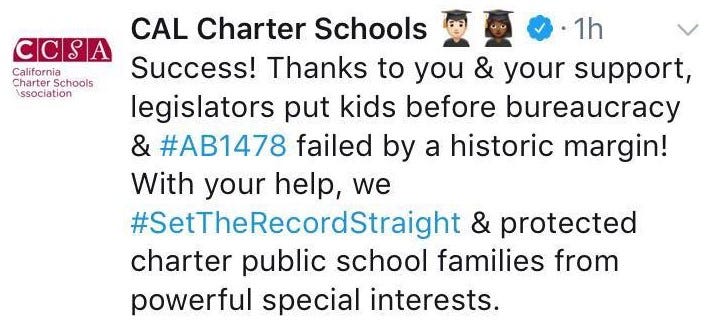
These examples prove that open government laws help to protect students and ensure that public funds are spent correctly. However, the California Charter School Association considers them to be part of a “bureaucracy” from which families need to be “protected” as if having access to information harms students and their parents. This is a rather ironic statement coming from an organization that is supposed to represent institutions of learning. After the takeover of the LAUSD Board by pro-charter Board members, one of the first actions of the CCSA was to coordinate a direct attack on the District Required Language. While they were unsuccessful in removing these requirements, the compromise with the District set the stage for Board members to directly vote on removing these important protections.
If California State AB 1478 had passed, parents and students in Los Angeles and across the state would have had the same protections enshrined into the education code that are found in the LAUSD’s District Required Language. This bill expressly stated that charter schools and entities managing charter schools are subject to the Ralph M. Brown Act, the California Public Records Act, and the Political Reform Act of 1974. Unfortunately, the CCSA was able to use its vast lobbying power and campaign donations in Sacramento to ensure that the business interests involved in running charter schools can receive public funds without any public oversight. AB 1478 failed by what the CCSA called “a historic margin”. You can thank those who voted “no” and those who lacked the courage to take a stand (and whose abstention counted as a “no”) for impending charter school scandals that will not see the light of day until children have been harmed:
____________________________________________
Carl Petersen is a parent and special education advocate, elected member of the Northridge East Neighborhood Council and was a Green Party candidate in LAUSD’s District 2 School Board race. During the campaign, he was endorsed by Network for Public Education (NPE) Action and Dr. Diane Ravitch called him a “strong supporter of public schools.” His past blogs can be found at www.ChangeTheLAUSD.com.


