avatarLinda Caroll

Free AI web copilot to create summaries, insights and extended knowledge, download it at here

4754

Abstract

en hired to act in a play he had a part in. He was 45. She was 18. Same age as one of his daughters.</p><p id="3256">He fell head over heels. Stopped sharing a bedroom with his wife and set Ellen up in a little house where they could meet discreetly.</p><p id="4452">The following spring, he bought a very expensive bracelet for Ellen. The jeweler accidentally delivered it to his home. Ouch.</p><h1 id="9521">Divorce wasn’t enough. He tried to commit his wife to an insane asylum…</h1><figure id="4522"><img src="https://cdn-images-1.readmedium.com/v2/resize:fit:800/1*FjgDw6cG_FNiwTriADeuYQ.jpeg"><figcaption>Dickens with his wife and two of his daughters, circa 1850. Photo from <a href="https://www.smithsonianmag.com/smart-news/newly-analyzed-trove-letters-charles-dickens-180971545/">Smithsonian</a></figcaption></figure><p id="f3af">When he wanted out of the marriage, he tried to put Catherine in an asylum but Thomas Harrington Tuke, the asylum superintendent and onetime friend of Charles, <a href="https://www.smithsonianmag.com/smart-news/newly-analyzed-trove-letters-charles-dickens-180971545/">refused</a> to admit her.</p><p id="e9b4">So he bought her a small house and sent her packing.</p><p id="91e7">Know what his biggest concern was?</p><p id="8b51">What his readers would think.</p><p id="ada5">By then, he’d pretty much attained celebrity status. He was a prominent and beloved public figure. So he wrote a letter to his adoring public. Published it in multiple newspapers.</p><p id="0b72">Told his readers he had to end the marriage because his wife was a bad mother, a bad cook, a bad wife, insolent, opinionated, overweight and didn’t love her children.</p><p id="347b">He said — publicly— that she was possibly afflicted with some mental disorder nevermind that a Victorian asylum said she was not.</p><p id="7190">It was a <a href="https://www.smithsonianmag.com/smart-news/newly-analyzed-trove-letters-charles-dickens-180971545/">disgraceful document</a>.</p><p id="06be" type="7">“He even tried to shut her up in a lunatic asylum, poor thing!” — Edward Dutton Cook, from the New Yorker</p><h1 id="8677">Worse? He kept the kids…</h1><figure id="abd5"><img src="https://cdn-images-1.readmedium.com/v2/resize:fit:800/1*_lGfkYCfMb82HgCWNucgAg.jpeg"><figcaption></figcaption></figure><figure id="a317"><img src="https://cdn-images-1.readmedium.com/v2/resize:fit:800/1*GKcUy9wnPQMURUFF-_e-dA.jpeg"><figcaption></figcaption></figure><figure id="3c3f"><img src="https://cdn-images-1.readmedium.com/v2/resize:fit:800/1*Baz-uaOt5bI4_1VLyIIUSg.jpeg"><figcaption>Three of Dickens’ children, Kate (left), Walter (center) and Francis (right). (<a href="https://www.charlesdickensinfo.com/life/dickens-children/">photo source</a>)</figcaption></figure><p id="2d08">Not because he wanted them, but because <i>she did</i>. Legally, they were his property. The youngest was only six.</p><p id="6940">He didn’t like his kids, really. Called them unflattering nicknames based on traits he didn’t like. Called his daughter “Lucifer Box” because he didn’t like the opinions coming out of her mouth.</p><p id="a728">Of course he wouldn’t like her opinions — she was the same age as his mistress. When his two eldest kids hit 21, they fled to their mother.</p><p id="6e95">He wrote letters lamenting how horrible it is to look around the dinner table and be disappointed. Sent most of the boys away once they became teens. To Austria or the navy. One son became a Mountie in Canada.</p><p id="d26d">Years later, his kids would say their father cared more about the children in his books than he cared about them.</p><p id="a459" type="7">“My father was like a madman when my mother left home. This affair brought out all that was worst — all that was weakest in him. He did not care a damn what happened to any of us. Nothing could surpass the misery and unhappiness of our home.” — Kate Dickens</p><h1 id="9626">He was cruel to friends, too.</h1><figure id="0f67"><img src="https://cdn-images-1.readmedium.com/v2/resize:fit:800/1*yelw8YDUmspt4WWcUYGD3Q.jpeg"><figcaption>Hans Christian Andersen and Charles Dickens (<a href="http://www.didyouknow.it/2018/05/15/dickens-andersen-true-tale-admiration-intolerance/">photo source</a>)</figcaption></figure><p id="73ad">Dickens and Hans Christian Andersen were mutual admirers of each other’s work. So, Andersen was delighted when Dickens invited him to visit.</p><p id="1cac">They’d planned for him to stay a week or two, but after that time passed, Dickens invited Andersen to stay longer. I can’t help but wonder if the Dickens children were enjoying Andersen’s storytelling.</p><p id="4a8b">One day, Hans woke to find a message written on the bathroom mirror in the guest suite where he was staying.

Options

It said, “<i>Hans Andersen slept in this room for five weeks — which seemed to the family AGES!</i></p><p id="9909">Horrified and ashamed, Andersen packed and left immediately.</p><p id="8e27">Andersen sent heartfelt apologies, but they never saw each other again and Dickens stopped replying to Andersen’s letters.</p><h1 id="718d">On top of it all, he had strange obsessions…</h1><p id="ffce">Charles Dickens had obsessive compulsive disorder and the documentation of his obsessions is staggering. Here’s a few of them.</p><ul><li>He was so obsessed with magnetic fields that every bed in the house had to face north/south, regardless of the layout of the room.</li><li>All furniture had to be in the exactly correct spot or he couldn’t concentrate. Heaven forbid a child bump a table!</li><li>He was obsessed with cleanliness and would tidy other people’s homes if he visited and their home didn’t meet his standards of cleanliness.</li><li>He was obsessed with mesmerism and hypnotized his wife, children and friends to “cure” them of what he thought was wrong with them.</li><li>He was obsessed with prisons and had to go see the prison in every city he travelled to.</li><li>He was obsessed with dead bodies and spent so much time at the morgue staring at bodies that it gave him nightmares.</li><li>He was obsessed with cannibalism. Later, historians collected 300 passages from Dickens’ writing that talked about cannibalism.</li></ul><h2 id="849c">One of his obsessions had a good ending…</h2><p id="4b57">In 1856, there was a public scandal when people realized how the dead were treated, bodies piled in a heap. The public appealed to Dickens and his involvement and stature brought about changes to how the deceased were treated while awaiting burial.</p><h1 id="6b9e">The irony of his last Christmas dinner…</h1><figure id="20a9"><img src="https://cdn-images-1.readmedium.com/v2/resize:fit:800/1*N6jchIjiAGQ3JBolD_EldA.jpeg"><figcaption>Letter from Charles Dickens to the railroad manager // <a href="https://www.cnn.com/2019/12/19/world/charles-dickens-christmas-turkey-trnd/index.html">photo source</a></figcaption></figure><p id="0894">We all know the story of Scrooge learning kindness and caring through the ghosts of Christmas past, present and future. The story ends with Tiny Tim and a lovely turkey dinner thanks to a reformed Ebenezer Scrooge.</p><p id="bc20">In December, 1869, Dickens was awaiting delivery of a 30 pound turkey for Christmas Dinner with his mistress Ellen. When it didn’t arrive, he sent a frantic message to the railroad, handwritten in all caps.</p><p id="3d82">“WHERE IS THAT TURKEY? IT HAS NOT ARRIVED!!!!!!!!!!!”</p><p id="b7e9">The shipment with the turkey and other packages had burned in a fire. The railroad wrote a letter of apology to Dickens and other customers affected by the fire. He died of a stroke the following June.</p><p id="5d05">The last Christmas of his life, there was no turkey on the table. The charred remains of the bird had been sold for sixpence per serving to people who could not afford to buy a whole turkey.</p><p id="1cc4">The irony is staggering.</p><p id="3051" type="7">“It was the best of times, it was the worst of times.” ― Charles Dickens</p><h2 id="0404">References and more reading</h2><p id="a5f7"><a href="https://www.bbc.co.uk/history/historic_figures/dickens_charles.shtml">History of Charles Dickens</a><a href="https://www.newyorker.com/books/page-turner/charles-dickens-the-writer-who-saw-lockdown-everywhere"> Charles Dickens, the writer who saw lockdown everywhere</a><a href="https://www.britannica.com/biography/Charles-Dickens-British-novelist/Novels-from-Bleak-House-to-Little-Dorrit">Charles Dickens, Britannica</a><a href="https://www.cnn.com/2019/12/19/world/charles-dickens-christmas-turkey-trnd/index.html">Dickens’ last Christmas turkey lost in a freak accident</a><a href="https://www.dailymail.co.uk/femail/article-1280319/Ellen-Ternan-Teenage-mistress-mesmerised-Charles-Dickens.html">The teenage mistress who mesmerized Charles Dickens</a><a href="https://www.discoverwalks.com/blog/london/top-10-facts-about-charles-dickens/">Ten Facts about Charles Dickens</a><a href="https://www.famousauthors.org/charles-dickens">Charles Dickens History</a><a href="https://www.neatorama.com/2008/05/26/8-odd-facts-about-charles-dickens/">Odd Facts About Charles Dickens</a><a href="https://www.smithsonianmag.com/smart-news/newly-analyzed-trove-letters-charles-dickens-180971545/">Trove of Letters Reveal Dickens Tried to Lock His Wife in an Asylum</a></p><figure id="9e95"><img src="https://cdn-images-1.readmedium.com/v2/resize:fit:800/1*SE_grPJwEUEPV9ICZUko-A.jpeg"><figcaption></figcaption></figure></article></body>

Charles Dickens Was A Cruel Man With Bizarre Obsessions

The irony of his last Christmas dinner is stunning
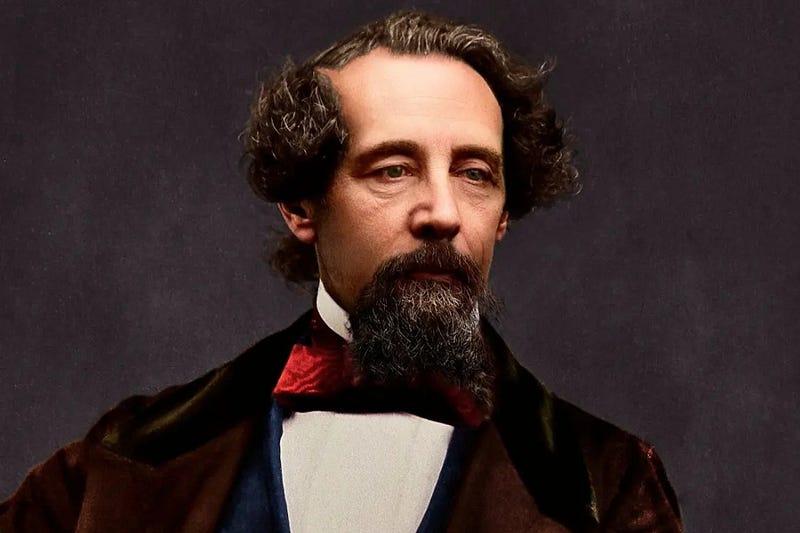
Colorized photograph of Charles Dickens. Photograph: Charles Dickens Museum // source

You’d think Dickens would have been a nice guy, based on his writing. The ghosts, with chains and lessons to scare old Ebenezer into being a decent human being. Oliver Twist, too. Poor little orphan boy saved from the underworld of poverty and crime in Victorian England by the goodness of his heart.

Dickens did so much to expose the ugly working conditions suffered by the poor because of the rich, I wanted to like him. I wanted him to be a nice guy But he really wasn’t. Maybe to strangers.

Not to his family, that’s for sure.

He didn’t grow up with an empty belly and a full heart, like Tiny Tim or Oliver Twist…

Dickens’ father worked in the Naval Pay Office and made good income, but was inept at managing it. The big house, the bigger house, two servants and pretty soon living large caught up with Dickens senior.

When Charles was twelve, his father was sent to debtor’s prison. Because women and children were property of the man, his wife and kids were sentenced along with him.

All except Charles. At twelve, he was old enough to work so he was sent to work at a shoe-blacking factory pasting labels on boxes of shoe polish.

Long hours, bad conditions, and he was sleeping in a poor peoples’ boarding house along with others who worked factory jobs.

His dad wasn’t in debtor’s prison long. A few months, but the experience of working among the poor colored Dickens’ writing for the rest of his life.

He wrote magnificent works. Don’t get me wrong there. But that’s about where the goodness ended, it seems.

He resented his wife for having too many kids…
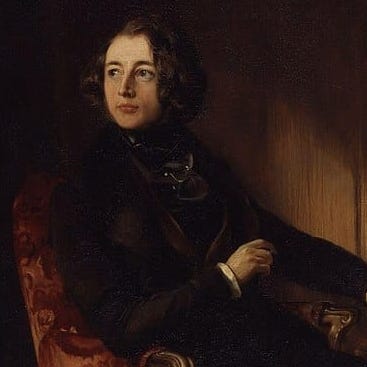
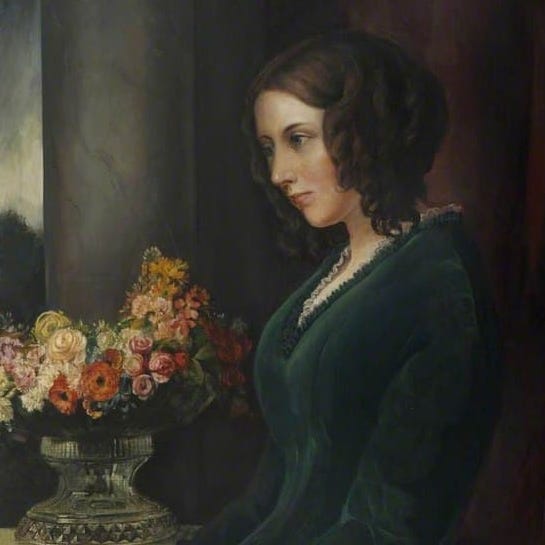
Right, young Charles Dickens (photo from Wikipedia) // Left, Catherine Dickens, his wife. (photo from Wikipedia)

At 24, Dickens married the 21 year old daughter of his editor. They were happy, at first. Catherine was also a published writer.

A year later, the first baby arrived. Oh, he was happy. Such a good father. Bragged up that little boy to everyone.

But the babies kept arriving. Twelve pregnancies in 15 years. Two were stillborn. But still, ten children, one after the other.

Charles was terribly unhappy about it, as if he had nothing to do with it.

Thing is, he didn’t think he did. Catherine was one of 10 children herself, so he thought it was “her” fault that she had so many children.

He said it was financial pressure he didn’t need.

They weren’t poor. He was the most prominent writer in Victorian England and quite wealthy. But he could never shake off the memory of debtor’s prison and what happens if people don’t have enough money.

As the kids grew, he became critical of them, too. Called them lazy and unaccomplished. He wished they’d stopped after the fourth. He didn’t want ten kids and made no secret of that.

And her? Too busy. Too depressed. Gained weight. And the food she cooked was making him gain weight. She could do nothing right.

We didn’t have the word gaslighting back then but years later, that’s what historians said he was doing to her. I could write an entire story just about the documented cruelty.

What happens when an expensive gift for the mistress gets accidentally delivered to the wife? Nothing good…
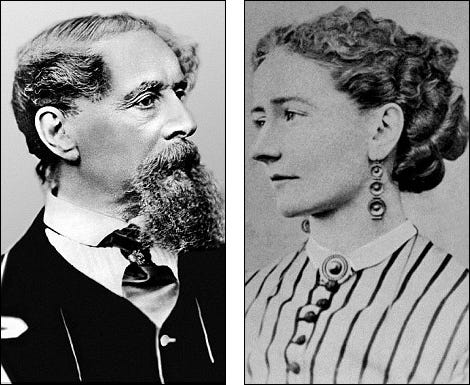
Charles Dickens and Ellen Ternan. Photo source

Then Dickens met Ellen Ternan. She’d been hired to act in a play he had a part in. He was 45. She was 18. Same age as one of his daughters.

He fell head over heels. Stopped sharing a bedroom with his wife and set Ellen up in a little house where they could meet discreetly.

The following spring, he bought a very expensive bracelet for Ellen. The jeweler accidentally delivered it to his home. Ouch.

Divorce wasn’t enough. He tried to commit his wife to an insane asylum…
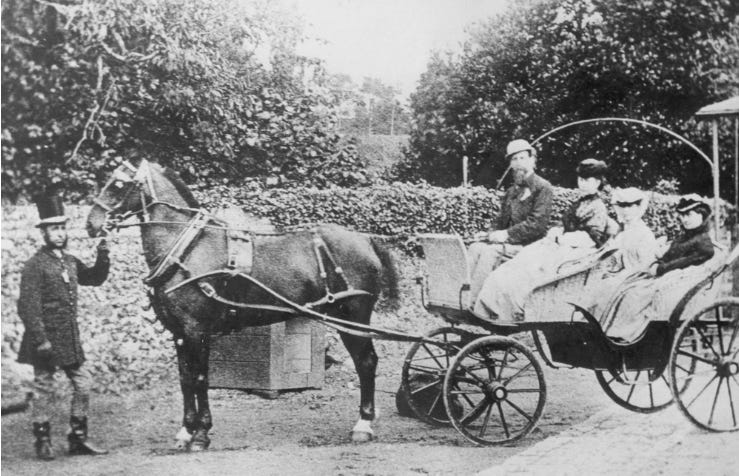
Dickens with his wife and two of his daughters, circa 1850. Photo from Smithsonian

When he wanted out of the marriage, he tried to put Catherine in an asylum but Thomas Harrington Tuke, the asylum superintendent and onetime friend of Charles, refused to admit her.

So he bought her a small house and sent her packing.

Know what his biggest concern was?

What his readers would think.

By then, he’d pretty much attained celebrity status. He was a prominent and beloved public figure. So he wrote a letter to his adoring public. Published it in multiple newspapers.

Told his readers he had to end the marriage because his wife was a bad mother, a bad cook, a bad wife, insolent, opinionated, overweight and didn’t love her children.

He said — publicly— that she was possibly afflicted with some mental disorder nevermind that a Victorian asylum said she was not.

It was a disgraceful document.

“He even tried to shut her up in a lunatic asylum, poor thing!” — Edward Dutton Cook, from the New Yorker

Worse? He kept the kids…
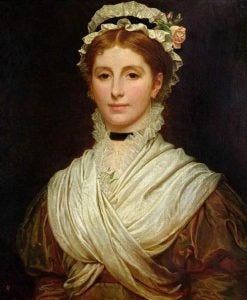
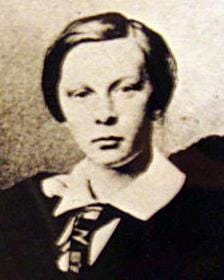
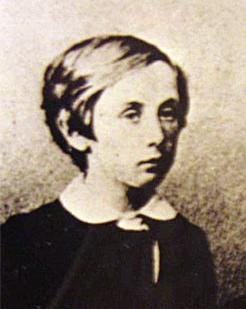
Three of Dickens’ children, Kate (left), Walter (center) and Francis (right). (photo source)

Not because he wanted them, but because she did. Legally, they were his property. The youngest was only six.

He didn’t like his kids, really. Called them unflattering nicknames based on traits he didn’t like. Called his daughter “Lucifer Box” because he didn’t like the opinions coming out of her mouth.

Of course he wouldn’t like her opinions — she was the same age as his mistress. When his two eldest kids hit 21, they fled to their mother.

He wrote letters lamenting how horrible it is to look around the dinner table and be disappointed. Sent most of the boys away once they became teens. To Austria or the navy. One son became a Mountie in Canada.

Years later, his kids would say their father cared more about the children in his books than he cared about them.

“My father was like a madman when my mother left home. This affair brought out all that was worst — all that was weakest in him. He did not care a damn what happened to any of us. Nothing could surpass the misery and unhappiness of our home.” — Kate Dickens

He was cruel to friends, too.
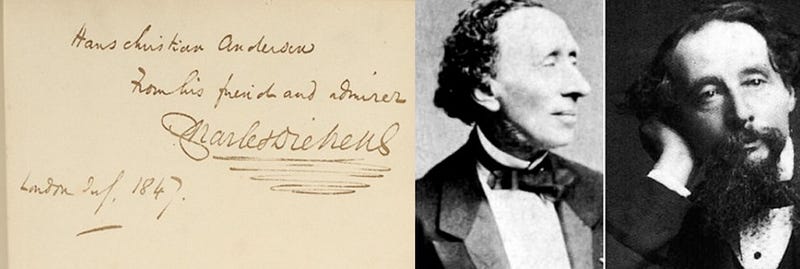
Hans Christian Andersen and Charles Dickens (photo source)

Dickens and Hans Christian Andersen were mutual admirers of each other’s work. So, Andersen was delighted when Dickens invited him to visit.

They’d planned for him to stay a week or two, but after that time passed, Dickens invited Andersen to stay longer. I can’t help but wonder if the Dickens children were enjoying Andersen’s storytelling.

One day, Hans woke to find a message written on the bathroom mirror in the guest suite where he was staying. It said, “Hans Andersen slept in this room for five weeks — which seemed to the family AGES!

Horrified and ashamed, Andersen packed and left immediately.

Andersen sent heartfelt apologies, but they never saw each other again and Dickens stopped replying to Andersen’s letters.

On top of it all, he had strange obsessions…

Charles Dickens had obsessive compulsive disorder and the documentation of his obsessions is staggering. Here’s a few of them.

  • He was so obsessed with magnetic fields that every bed in the house had to face north/south, regardless of the layout of the room.
  • All furniture had to be in the exactly correct spot or he couldn’t concentrate. Heaven forbid a child bump a table!
  • He was obsessed with cleanliness and would tidy other people’s homes if he visited and their home didn’t meet his standards of cleanliness.
  • He was obsessed with mesmerism and hypnotized his wife, children and friends to “cure” them of what he thought was wrong with them.
  • He was obsessed with prisons and had to go see the prison in every city he travelled to.
  • He was obsessed with dead bodies and spent so much time at the morgue staring at bodies that it gave him nightmares.
  • He was obsessed with cannibalism. Later, historians collected 300 passages from Dickens’ writing that talked about cannibalism.

One of his obsessions had a good ending…

In 1856, there was a public scandal when people realized how the dead were treated, bodies piled in a heap. The public appealed to Dickens and his involvement and stature brought about changes to how the deceased were treated while awaiting burial.

The irony of his last Christmas dinner…
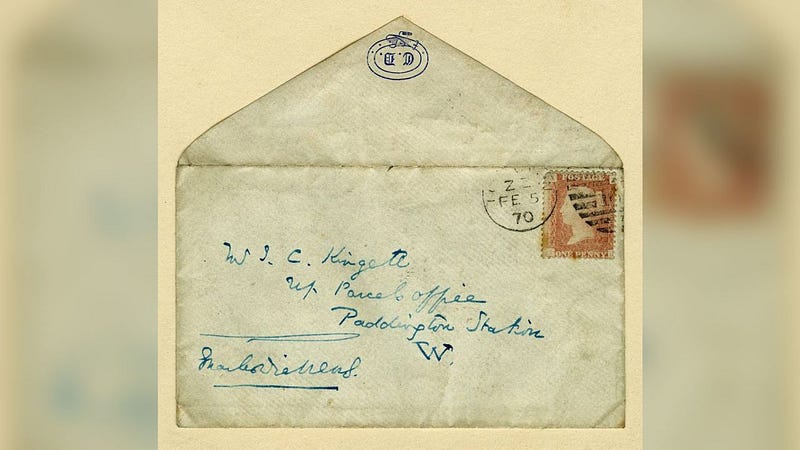
Letter from Charles Dickens to the railroad manager // photo source

We all know the story of Scrooge learning kindness and caring through the ghosts of Christmas past, present and future. The story ends with Tiny Tim and a lovely turkey dinner thanks to a reformed Ebenezer Scrooge.

In December, 1869, Dickens was awaiting delivery of a 30 pound turkey for Christmas Dinner with his mistress Ellen. When it didn’t arrive, he sent a frantic message to the railroad, handwritten in all caps.

“WHERE IS THAT TURKEY? IT HAS NOT ARRIVED!!!!!!!!!!!”

The shipment with the turkey and other packages had burned in a fire. The railroad wrote a letter of apology to Dickens and other customers affected by the fire. He died of a stroke the following June.

The last Christmas of his life, there was no turkey on the table. The charred remains of the bird had been sold for sixpence per serving to people who could not afford to buy a whole turkey.

The irony is staggering.

“It was the best of times, it was the worst of times.” ― Charles Dickens

References and more reading

History of Charles Dickens Charles Dickens, the writer who saw lockdown everywhereCharles Dickens, BritannicaDickens’ last Christmas turkey lost in a freak accidentThe teenage mistress who mesmerized Charles DickensTen Facts about Charles DickensCharles Dickens HistoryOdd Facts About Charles DickensTrove of Letters Reveal Dickens Tried to Lock His Wife in an Asylum

History
Charles Dickens
Abuse
Truth
Nonfiction
Recommended from ReadMedium