avatarJunliang.Deng

Free AI web copilot to create summaries, insights and extended knowledge, download it at here

1773

Abstract

troubled times and the chancellor at the end of the Han Dynasty, once commanded a troop known as the “Qingzhou Army” during his campaigns. This army was formed as the main force from the “<a href="https://en.wikipedia.org/wiki/Yellow_Turban_Rebellion">Yellow Turban Rebellion</a>,” who surrendered unconditionally to Cao Cao.</p><p id="235d">Cao Cao led this troop to numerous victories, and their brave deeds became renowned.</p><p id="ab5e">However, in one particular battle, while defending his own city, Cao Cao led this troop to engage with the enemy within their own city walls. To everyone’s surprise, this once glorious troop chose to scatter in all directions as soon as the battle commenced.</p><p id="ce4c"><b><i>Why did this brave and valiant troop choose to scatter in that battle?</i></b></p><figure id="dbc8"><img src="https://cdn-images-1.readmedium.com/v2/resize:fit:800/0*ovkJE4WQ7WO_nnxc"><figcaption>Photo by <a href="https://unsplash.com/@mitchorr?utm_source=medium&amp;utm_medium=referral">Mitchell Orr</a> on <a href="https://unsplash.com?utm_source=medium&amp;utm_medium=referral">Unsplash</a></figcaption></figure><p id="7832">The book review points out that war is cruel. When soldiers fight away from home, unfamiliar with the terrain and having no escape routes, and desertion during battle could lead to military punishment. Therefore, they must fight desperately forward at all costs to have a chance of winning the war and surviving.</p><p id="4bb0">Conversely, when fighting in their own city, familiar with the terrain and knowing escape routes, some soldiers, considering their families, would choose to flee the war together with their loved ones. The defending side often lacks the energy to deal with these deserting soldiers, putting

Options

them in a passive position.</p><p id="0282">History is already in the past, and we cannot ascertain the specific truth from the texts left behind. But one undeniable fact is that war is cruel. Those soldiers who bravely charged forward in war might have had no other choice.</p><p id="43cf">May the world be at peace, free from war.</p><p id="e9d9">That is the answer to the prompt word of “<i>a book review of the latest book you read</i>” from <a href="https://readmedium.com/spring-into-creativity-dad2bbd054ee">March prompt from the Challenged</a>.</p><div id="8a17" class="link-block"> <a href="https://readmedium.com/spring-into-creativity-dad2bbd054ee"> <div> <div> <h2>Spring Into Creativity!</h2> <div><h3>Embrace your muse</h3></div> <div><p>medium.com</p></div> </div> <div> <div style="background-image: url(https://miro.readmedium.com/v2/resize:fit:320/1*cz7PKTmSpNkD7WSIsz4rvg.png)"></div> </div> </div> </a> </div><div id="cc2d" class="link-block"> <a href="https://en.wikipedia.org/wiki/Romance_of_the_Three_Kingdoms"> <div> <div> <h2>Romance of the Three Kingdoms - Wikipedia</h2> <div><h3>Romance of the Three Kingdoms ( traditional Chinese: 三國演義; simplified Chinese: 三国演义; pinyin: Sānguó Yǎnyì ) is a…</h3></div> <div><p>en.wikipedia.org</p></div> </div> <div> <div style="background-image: url(https://miro.readmedium.com/v2/resize:fit:320/0*wrWm6nmhr2poTzXP)"></div> </div> </div> </a> </div></article></body>

Charging Forward Bravely? Perhaps It’s Merely Fleeing With No Escape

The myth of warfare in the age of melee weapons
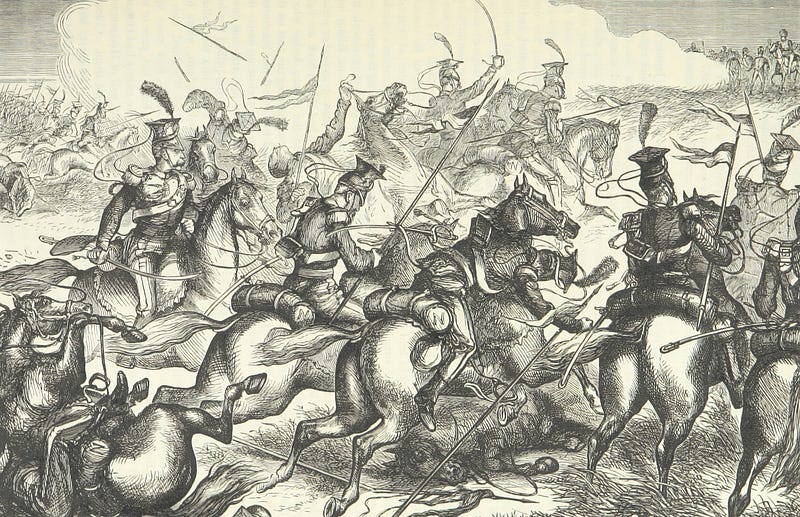
Photo by British Library on Unsplash

The terrifying nature of modern warfare must surely be familiar to all of you. Various new weapons wield immense power, and with just a few clicks in front of a screen, one might seemingly win a war without deploying a single soldier

But what about warfare in ancient times with melee weapons?

Are we only able to experience the grand scenes of battle formations, flag-waving, and the thunderous roar of armies charging across vast plains through limited written works?

Romance of the Three Kingdoms,” one of China’s Four Great Classical Novels, narrates the magnificent history from the late Eastern Han Dynasty to the unification of the Three Kingdoms between 184 AD and 280 AD.

What I admire most about it is the depiction of war scenes. The author often describes how the main generals of both sides engage in combat on the battlefield, followed by the shouts of encouragement from their respective soldiers.

However, recently I came across a book review about “Romance of the Three Kingdoms” that recounted a story reconstructed from real history.

Cao Cao, the hero of troubled times and the chancellor at the end of the Han Dynasty, once commanded a troop known as the “Qingzhou Army” during his campaigns. This army was formed as the main force from the “Yellow Turban Rebellion,” who surrendered unconditionally to Cao Cao.

Cao Cao led this troop to numerous victories, and their brave deeds became renowned.

However, in one particular battle, while defending his own city, Cao Cao led this troop to engage with the enemy within their own city walls. To everyone’s surprise, this once glorious troop chose to scatter in all directions as soon as the battle commenced.

Why did this brave and valiant troop choose to scatter in that battle?

Photo by Mitchell Orr on Unsplash

The book review points out that war is cruel. When soldiers fight away from home, unfamiliar with the terrain and having no escape routes, and desertion during battle could lead to military punishment. Therefore, they must fight desperately forward at all costs to have a chance of winning the war and surviving.

Conversely, when fighting in their own city, familiar with the terrain and knowing escape routes, some soldiers, considering their families, would choose to flee the war together with their loved ones. The defending side often lacks the energy to deal with these deserting soldiers, putting them in a passive position.

History is already in the past, and we cannot ascertain the specific truth from the texts left behind. But one undeniable fact is that war is cruel. Those soldiers who bravely charged forward in war might have had no other choice.

May the world be at peace, free from war.

That is the answer to the prompt word of “a book review of the latest book you read” from March prompt from the Challenged.

History
Battle
The Challenged
Books
Recommended from ReadMedium