
Personal Development
Researchers Reveal Surprising Truths about Successful Teams
Why do some work groups thrive, and others falter?
“I’m sorry, I didn’t know that you are so sensitive.”
“You are an emotional person, I’m a focused guy.”
During my professional career, I heard such comments from people I’ve worked with. Whether it’s bad or wrong to be sensitive or emotional, I didn’t know the exact answer, but what I do know is that my work environment is very important to me and has a decisive role in making me succeed or fail at my job.
As I get older, the source of my motivation as a software engineer has changed. Technology is still important, but getting more money is no longer the factor that can push me to accept a job opportunity. Indeed, I can opt for an offer where I’ll earn less and refuse another one where I can get much more. The work environment is the major factor that I’m more and more interested in. How the workplace is looking, the team size, the impression that I get about my potential team members — all those parameters contribute to how I feel about my work.
While this is a personal recipe of how I check my ideal team and workplace, the subject of how to build the perfect team has puzzled me for a long time. Mixing people is not easy. Putting a group of persons in the same place and giving them tasks and goals to achieve together will not generate the expected result each time. So what are the characteristics that we should consider to create an effective team that succeeds and gets work done? Why are some workgroups so much more productive than others?
To find out, I rolled up my sleeves and started investigating. Here, some insights I’ve discovered from a study done by Google and another one done by Harvard Business School professor Amy Edmondson.
Google’s Aristotle Project
In 2012, Google embarked on an initiative — named Project Aristotle — to study Google’s teams and figure out why some stumbled while others soared. The data analysis and interviewing over 180 teams across the company have revealed that the individual personalities in a team are not so relevant and the following list is not significantly related to team effectiveness at Google:
- Sitting together in the same office
- Consensus-driven decision making
- Extroversion of team members
- Individual performance of team members
- Workload size
- Seniority
- Team size
- Tenure
After finding that who was on a team actually didn’t matter at all, researchers started looking at how a team interacts and checked group norms. Norms are the traditions, behavioral standards, and unwritten rules that govern how we function when a team gathers.
Psychological safety
Researchers noticed two behaviors that all the good teams generally shared:
1. Conversational turn-taking
On the good teams, they noticed an ‘‘equality in distribution of conversational turn-taking’’ which means members spoke in roughly the same proportion.
‘‘As long as everyone got a chance to talk, the team did well,’’ Woolley said. ‘‘But if only one person or a small group spoke all the time, the collective intelligence declined.’’
2. Average social sensitivity
Effective teams were skilled at intuiting how others felt based on their tone of voice, their expressions, and other nonverbal cues. People on those teams have high sensitivity toward their colleagues.
So, if you are given a choice between a serious-minded team A — filled with smart people, all optimized for peak individual efficiency, and few exchanges of personal information that lets teammates pick up on what people are feeling or leaving unsaid — and a free-flowing team B, you should probably opt for the second one. In team B, people may speak over one another and socialize instead of remaining focused on the agenda. This may seem inefficient but all the team members are sensitive to one another’s moods and share personal stories and emotions. As result, the team might not contain as many individual stars, but the sum will be greater than its parts.
Within psychology, researchers refer to traits like ‘‘conversational turn-taking’’ and ‘‘average social sensitivity’’ as aspects of what’s known as psychological safety — a group culture or a team climate that the Harvard Business School professor Amy Edmondson defines as:
“Psychological safety is a belief that one will not be punished or humiliated for speaking up with ideas, questions, concerns, or mistakes.”
“No one wakes up in the morning to go to the work to look ignorant (don’t ask questions), incompetent (don’t admit weakness or mistakes), intrusive (don’t offer details), negative (don’t critique the status quo). This strategy works for self-protection.” Edmondson said.
5 key characteristics of perfect teams
To achieve successful teamwork, Google’s data has indicated that different parameters are important, but psychological safety was critical.
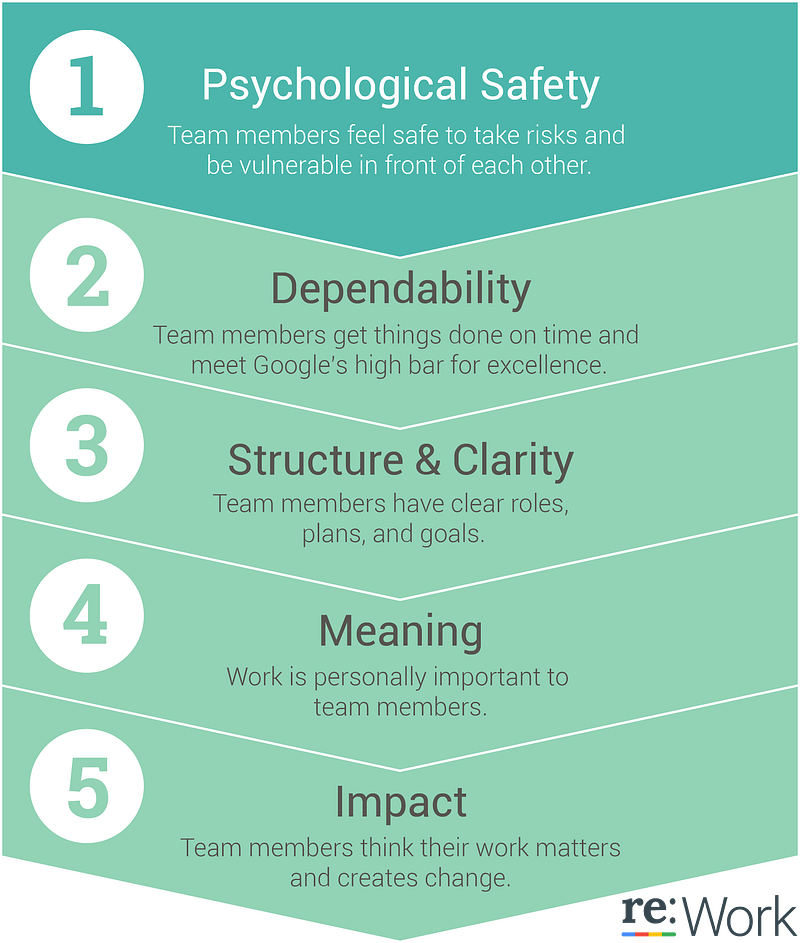
- Psychological safety: to feel safe in taking risks and be vulnerable in front of other team members.
- Dependability: to get things done on time with quality.
- Structure and clarity: to have clear roles, plans, and goals.
- Meaning: to have a sense of purpose and feel that your work is personally important (financial security, supporting family, helping the team succeed, etc).
- Impact: to see that your work matters and creates change.
Establishing psychological safety
Establishing psychological safety is somewhat messy and difficult to implement. The recipe of Harvard Business School professor Amy Edmondson to build a psychologically safe workplace includes three points:
- Frame the work as a learning problem, not an execution problem. And recognize that there’s enormous uncertainty ahead and enormous interdependence. That creates the rationale for speaking up.
- Acknowledge your own fallibility. That creates more safety for speaking up.
- Model curiosity and ask a lot of questions. That creates a necessity for voice.
Edmondson insists that to succeed, team members must be humble in the face of the challenge ahead, curious about what others bring, and willing to take risks to learn quickly.
In his post in the New York Times, Charles Duhigg has shown a real case of implementing psychological safety and changing the stereotype of tech people often known for being more comfortable working with computers than with people.
After seeing the published result of Project Aristotle and the output of a survey indicating that his team is not as strong as he thought, Matt Sakaguchi — a manager at Google — gathered his tech guys and began asking everyone to share something personal about themselves. He went first and told the group that he has Stage 4 cancer which was surprising and shocking for them. Then, teammates stood one by one and shared their own struggles about health issues, difficult breakup, and other small frictions, and everyday annoyances. They found it easier to speak honestly about the things that had been bothering them and agreed to adopt some new norms and try harder to notice when someone on the team was feeling excluded or down.
To Sakaguchi, it made sense that psychological safety and emotional conversations were related. They belong to the same unwritten rules we often use as individuals to bond with each other:
“… to be fully present at work, to feel ‘psychologically safe,’ we must know that we can be free enough, sometimes, to share the things that scare us without fear of recriminations. We must be able to talk about what is messy or sad, to have hard conversations with colleagues who are driving us crazy. We can’t be focused just on efficiency… We want to know that work is more than just labor …
… it’s not only Google that loves numbers, or Silicon Valley that shies away from emotional conversations. Most work-places do. ‘By putting things like empathy and sensitivity into charts and data reports, it makes them easier to talk about,’ Sakaguchi told me.” — Charles Duhigg
Final thoughts
In our try to optimize everything, we forget sometimes that success is often built on human experiences. Experiences that could make people bring their full selves for the challenging job ahead if we understand the usefulness of imperfection and figure out how to create psychological safety in a more productive way.
“In our silos, we can get things done. But when we step back and reach out and reach across, miracles can happen.” — Amy Edmondson
🧠💡 I write about engineering, technology, and leadership for a community of smart, curious people. Join my free email newsletter for exclusive access or sign up for Medium here.
You can check my video course on Udemy: How to Identify, Diagnose, and Fix Memory Leaks in Web Apps.


