
How to spot good UX
Good user experience can be easy to spot, but difficult to define. These characteristics can help you evaluate products to determine whether or not they employ good UX.
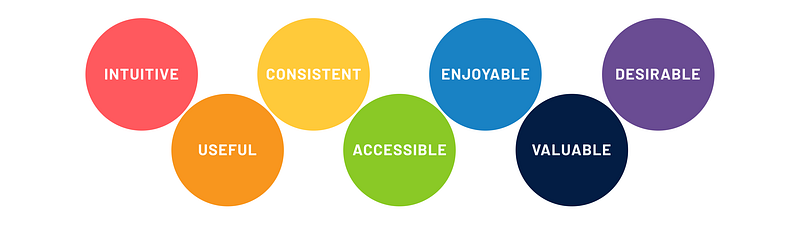
Good UX is, first and foremost, user-centered. User-centered designs are clear, efficient, and solve the actual, fundamental issues faced by their users. Good UX can be hard to pin down. The biggest indicator of good UX is when users don’t notice it at all. On the other hand, users recognize bad UX almost instantly. But how can that be qualified? How can we recognize good and bad design more objectively?
The following is a list of characteristics that can be used to identify good UX. This is not an exhaustive list of characteristics that can be attributed to good UX, but it does provide a big-picture model that can help you evaluate products and spot good (and not-so-good) UX.
Good UX is intuitive, useful, consistent, accessible, enjoyable, valuable, and desirable.

Intuitive
An intuitive product has clear and usable design, structure, and purpose. You can evaluate a product’s intuitiveness by asking:
- Is everything in the product easy to find?
- Is the product’s functionality easy to understand?
- Do I know what buttons and functions within the app mean without having to ask?
- Can you quickly and easily accomplish specific tasks within the product?
Example: if you download an app whose primary purpose is to purchase clothing, the design and user flow should provide a clear and intuitive path to complete that task. You should be able to navigate to different clothing items and sections with ease and check out quickly and efficiently. Additionally, you should feel confident with each press of a button that you’re getting where you’re supposed to go.

Useful
A useful product solves user problems. An important aspect of UX design is identifying user problems — this is most effectively done via empathy-based user research. Once these problems have been identified, products should be designed specifically to solve them. You can evaluate a product’s usefulness by asking:
- Does this product address the problems I was expecting it would?
- Does this product solve the problem I had when I started using it?
- Does this product help me achieve a specific goal?
Example: if you purchase a budgeting app, once you set up your account and go through the user flow, you should be able to create a budget that you feel addresses your needs. You should feel comfortable using that budget and the accompanying app to help solve the financial burdens that made you decide to download it.

Consistent
A consistent product has a clear, consistent style. It uses a design system with a coherent set of colors and design elements that complement each other and flow together. You can evaluate a product’s consistency by asking:
- Does this product use a clear, cohesive set of colors and fonts that all make sense to my eye?
- Does this product contain a logical set of iconography and/or illustrations that help me use it effectively?
- Do all the screens look relatively similar?
- Am I able to recognize similar components (like navigation, headings, across different pages?
Example: if you open the webpage for a well-known coffee brand, you should immediately recognize the branding and know you are in the right place by the color scheme and recognizable typography. You should never have to double check or wonder if you’ve navigated to the wrong brand and should feel calm and comfortable (never anxious or overwhelmed by colors or illustration) throughout your site visit.

Accessible
An accessible product is usable and helpful for people with diverse backgrounds and abilities. This means that not only does the product address the needs of a diverse audience, but it delivers a high-quality experience to all users regardless of their background, gender, race, or abilities.
Accessibility is much like equity. Equity goes beyond equality, where everyone is given equal resources, and instead provides people with different tools and support based on their specific needs. Equitable products provide people with the tools they need to accomplish their goals and support their quality of life. You can evaluate a product’s accessibility by asking:
- Are the needs of diverse groups of users considered?
- Does the product address the needs of traditionally underrepresented and excluded groups?
- Can people of various abilities (think about sight, hearing, movement, and tactile abilities) use this product?
- Does this product make users of all backgrounds feel comfortable (think about the images, avatars, and illustrations available)?
Example: if you download a social messaging app, you should be able to choose an avatar that represents you and you should see options representing all people — regardless of their skin tone, gender, or abilities. You should feel comfortable interacting with the app and like you belong on it as a user.

Enjoyable
An enjoyable product is one that is built so well that people are actually delighted to use it. This is one of the most intangible principles of good UX — a “know it when you see it” kind of value. Enjoyable products are, essentially, ones that make their users happy in some way. This can be due to a host of things, including beautiful visual design, especially easy navigability, or an exceptionally great solution to the users’ problem. You can evaluate a product’s enjoyability by asking:
- Do I find myself feeling happy while using this product?
- Does this product bring me joy?
Example: if you are new to meditating and have some apprehension about it, but download a meditation app, you should feel excitement while using the app. Your experience within the app should feel enjoyable and you should feel comfortable and ready for your first meditation session.

Valuable
A valuable product not only solves user problems, but creates value for both the user and the business behind it. A product that is useful, intuitive, consistent, accessible, and enjoyable generally creates its own intrinsic value, but additional value can be created outside of these principles. Value can almost always be defined in terms of money and time — a valuable product generally saves time and/or makes money. In some cases, however, a product’s value comes from other things, like joy or peace of mind. You can evaluate a product’s value by asking:
- Does this product save me time and/or money? Does it make me money?
- Does this product make money for the business who created it?
- Does this product bring me an intangible value, like joy or peace of mind?
- Do I feel that my life, or a part of it, has been improved by using this product?
Example: say you download a to do list app — you are likely looking for an app that will (1) keep you more organized and (2) save you time. If the app accomplishes both, it has added value to your life by (1) making you feel calmer and well-ordered and (2) saving you time.

Desirable
A desirable product is one that customers want to use. A great product has to be intuitive, useful, consistent, etc. but if nobody really wants to use it, none of that matters — this is where desirability comes into play. While desirability can be influenced by advertising, culture, and social influence, well-designed products that hit all the marks of useful, intuitive, consistent, accessible, enjoyable, and valuable are generally also desirable. You can evaluate a product’s desirability by asking:
- Is this a product I looked forward to purchasing or using?
- Is this a product other people I know are using?
Example: if you have been shopping around for a new phone and all your friends use one particular model, you’ll probably decide to get that model, meaning it is desirable. Other factors like its design, color, and size, may influence you to buy a particular one.
Good UX in practice
You can use the above list of characteristics to spot good UX in existing products, but as you design physical products, digital products, and services, keep this list in mind and it will help you design products that your users will love.