
Chapter 9: Crossing the Lawn
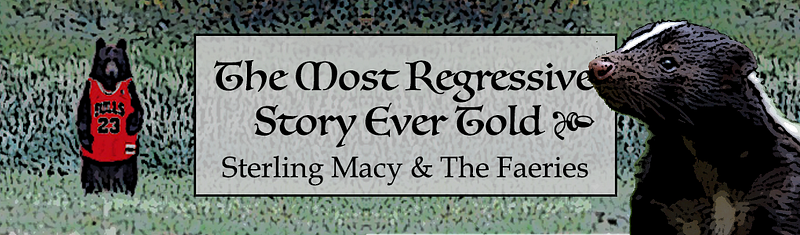
[The previous chapters of this long piece of dreck may be found here. I don’t think this will make any sense if you haven’t read the previous parts.]
The three animals continued walking into the dawn. They walked along a path that was easier to smell than to see, though, at times, it was well worn and bald from use. They passed through stands of maple, oak, and ash, which eventually gave way to a variety of pines, and finally to grassland. Along the way, especially as dawn broke, they saw other animals. A house wren flitted about them and said “good morning”, a family of Pikas stopped what they were doing and stared, a fat mole half way out of his hole blinked at them and sniffed.
“You still owe me money, rabbit,” he said,
“So, take me to fucking court then, nebbish.” Randy replied.
The exchange solidified Sterling’s suspicion that Shash and Randy knew everything and everyone in the woods, and he wasn’t sure why some animals were greeted by name and offered pleasantries while others received only a nod.
As they went along, Shash continued to sniff and break from the trail to search for food. When he found something he wanted to eat, they had to stop. For example, he found a patch of blueberries growing on the side of a pond and walked into them, stood on all fours, and mouthed off the blueberries for a very long time. During these forays, Randy the Rabbit would squat, smoke a cigarette, and occasionally pull up some vegetation and eat it. Unlike Shash, he seldom walked on all four legs. Sterling and he sometimes would talk for a bit, but often they would just sit. The animals, Sterling had learned, could abide.
Eventually, as the sun grew higher and hotter, they stopped altogether and sat on a group of huge boulders. Shash produced a big brown bag of pot, and started rolling a fat joint. “We should get high and sleep until the sun goes down a bit,” said Shash. “We have to go through the grasslands to get to Badger’s den.”
They passed the joint around. Sterling was amazed at how hard the bear and rabbit huffed on the blunt, though they showed no ill effects. The only observable change was that Shash’s eyes became more squinty. He blinked more often. The rabbit increased the incidence of his licking the fur around his mouth. When he was stoned, he did it somewhat obsessively, especially when speaking, like a verbal tick to help him think or find the right word.
There was a large pin oak that shaded the boulders, and they napped in its dappled light. The sun, where it hit, felt warm to Sterling. He was panting. He wasn’t sure if it was from the weed or the heat, and thinking about how he was panting so much made him kind of paranoid. He thought that maybe he was sick, or something wrong, but those thoughts eventually subsided and he dozed off in the mid-afternoon haze and fell into a dream. When he awoke he saw his two friends getting ready to move on.
The air was now cooler because the sun was getting long and an afternoon breeze rustled the leaves on the trees above them. After some walking, they came upon a wide expanse of grass.
“I don’t like walking through this shit,” said Randy. “This is a fucking nightmare.”
“Don’t worry,” said Shash, “Nothing will bother you if you stick close to me.”
“If you walk on all fours, I’m the tallest thing in the grass, so the eagle will get me,” said Randy, and it was true. When Shash and Sterling walked on all fours the tips of Randy’s ears were higher than the top of the bear’s back.
“Just fold your ears down and you won’t be so tall,” said Shash.
“Fold my ears down so that I can’t hear the silent wing rush of the eagle as it swoops towards me in the open field? I don’t fucking think so. If I’m going to end up getting regurgitated to a nest full of chicks I want to at least get to see the fucking thing that’s going to send me to the ducks.”
“Suit yourself,” said the bear, beginning to walk into the grassland. Soon there will be prairie dogs and they’ll warn you if anything is amiss.”
They walked across the grass for a long time. There were times where they didn’t feel as exposed because there were creosote bushes and sagebrush, and, soon enough, as the ground became sparser and strewn with rocks, Sterling heard the “yip, yip, yip” of prairie dogs barking that someone had invaded their territory.
Randy, who was at the back of their little party, ran forward past Sterling and Shash and stopped in front of the bear. From the side of his mouth he said, rather softly, “Let me handle this.”
To which Shash grinned, and replied, “Your kind of related to them, right?”
“Not to these plague-ridden assholes, no.” Said Randy. “Well, sort of.”
“You can’t choose your family,” said Shash.
“See how they’re standing outside of their holes looking at us? They’re not even afraid. Maybe if they give us shit I will let you eat a few of them.”
“I don’t want to eat dloo,” said Shash.
Just then, a large prairie dog at one of the closer holes addressed the rabbit. He was a thick and sturdy rodent. He held his hands in front of him, like a Tyrannosaurus Rex, and though this posture might have made him look silly, when combined with his downturned mouth and almond shaped eyes, it made him look like colonial judge or disapproving schoolmaster. His fur, which as reddish brown, had a band of whiter fur around his neck, giving him the appearance of wearing a chain of office or professor’s hood.
“Hola!” He said in an overtone. “Good afternoon, yon travelers. What brings you to dog town?” His voice was compressed and he over enunciated his words.
“Good afternoon, Father Sciuridae,” said Randy, sanding up straighter and looking directly at the prairie dog, “We are on our way to visit Badger and we ask permission to pass through the village of the tó dilchxoshí clan.”
“Who are you and what is your business with Badger?”
“Duck!” said Randy aside to Shash, “These fucking dogs are obsessed with genealogy.”
“What was that?” Asked the prairie dog.
“I am Randall, of House Acorn, son of Jesse. This is my frater, Shash, son of Oso, House of Karhu Paska, and this…” he said pointing to Sterling, is our amicum, Sterling, son of Stinkbomb, House of Smells.”
“Very well,” said the prairie dog. I am Don Thaddeus Konstantin Alvara de Cumbre, Hawkkiller, Pater of the tó dilchxoshí clan, Warden of the West, Lion of the Tall Grass, and son of Ardilla the Magnificent. Why should I let you pass, Randy son of Jesse? Why should the free people of the prairie mounds let you walk through our land? You increase our danger. You fill the air with the scent of eagle food. You bring Coyote and Coy Dog closer. How is it that we should forgive the danger that you put us in?”
“Duckity Duck,” said Randy, turning to Shash. “He’s asking for a fucking gift. What do you have on you?”
“Nothing,” said Shash, “Just half an ounce of skunk and four granola bars.”
“Give me one of the granola bars,” said Randy. He reached into the back pocket of his shorts and took out his wallet. From it he retrieved a calling card. Sterling saw the card, it read simply:
Randall Rabbit, Esq. Estate Law Tobacco, Fine Books, Periodicals On The Bridge, Pawcatuck
The rabbit placed his calling card on the granola bar.
“Pick me four long blades of June grass,” he said to Sterling.
Sterling quickly picked some grass, keenly aware of the stares of the Grand prairie dog and his family members, who all stood stock still watching the machinations of the traveling threesome. When he handed the grass to Randy, the rabbit cursed.
“This is love grass. Fuck, Shash, get me some June grass.”
The bear looked for a moment and then pulled up some grass, he handed it to the rabbit. With tremendous dexterity and speed, Randy packaged the granola bar and the calling card together in a tidy little square, using the grass as a ribbon, which he tied in an elaborate knot that ended up looking like a rose. Under the grass ribbons he put two cigarettes from his soft pack.
“Is it two or three, Shash?” Randy whispered to the bear.
“Always an even number, two or four,” the bear replied.
“Good, now,” said Randy handing the package to Sterling. “You must present this to the big fat dirt dog because you are the most strange to him, and you can’t fuck this up or those little bitches will bark at us the whole time we are walking through their territory, which could be an hour or two. So, go over to him and hold the package like this.”
Randy held the package with both hands at chest level.
“Thumbs on top. Feet together when you present it. Keep your back straight and say, “We have a gift for you, Father Squirrel,” and then bow slightly and extend your arms like this,” and again Randy demonstrated the formal posture he wanted Sterling to adopt.
“And whatever you do, don’t spray.”
“Yea,” said Shash, “That would fuck everything up.”
Almost as soon as Randy said that the words about the spray, Sterling began to feel pressure in his anus. It wasn’t his anus, exactly, it was more just down in that region. Holding the package carefully, he began to walk towards the hole of the big prairie dog. The long sun of the afternoon notwithstanding, it suddenly seemed very hot, and walking on his hind legs was uncomfortable. He began to pant again. He was afraid he looked undignified, with his strange bowlegged waddle, and his bright pink tongue hanging out of the front of his mouth and desperately panting, for skunks, like dogs, can’t sweat, so panting is their only means of heat regulation. He crewed up his face in an effort to not have whatever might be about to happen, happen.
At last he came to the big prairie dog, who stood at his full height, which was still shorter than Sterling. The way he held his head, slightly backward, chin raised up, and the almond shape of his eyes gave the prairie dog’s visage a most imperious mien.
“I saaaaaay,” he said, “You skunks do smell bad.”
His mouth was downturned, like a preacher. After he said this he stared at Sterling, who wasn’t sure to say, so he put his feet together, tried to staunch his panting, and bent forward, extending his arms.
“We have a gift for you,” said Sterling.
“For whooooom?” Asked the Prairie Dog.
“For you…” said Sterling, and he couldn’t remember just what he was supposed to say next, but he knew it was some sort of honorific, so he said.
“For you, The Great Squirrel.”
“The Great Squiiiiirrel???” He said.
“I meant,” said Sterling, now completely flustered and still holding the box out rigidly with his feet together, “I meant Father Prairie Dog.”
“Praaaaaairiee Dog????? Prairie Dog,” the old judge said with obvious alarm. You come here and call me a Dog to my face??? What…”
And just when the old dog was about to launch into a withering diatribe about the barbarism of skunks and their lack of manners, Sterling let go. He just couldn’t help it. It burst from his backside like a hurricane of relief. The acrid odor immediately enveloped him, and although it registered in his nose as beautiful and protective, he could immediately see the effect on others. Father squirrel jumped right down his hole, as did all of the others in close proximity. Shash and Randy took off running down the road, both, Sterling thought, were laughing. Sterling, suddenly alone, dropped the package and ran after them, but they had taken off at a good clip, and although he could see them in front of him, for the prairie still went on before them for as long as the eye could see, he didn’t get any closer to them despite his efforts at closing the gap.
Around him the grasses echoed with the barking of prairie dogs, who now seemed to emerge from every bit of the landscape to bark their high pitched “yip, yip, yip” at Sterling. He was both embarrassed and annoyed, and their barking just seemed to prevent him from thinking of anything but what a mess he had made of things. He also sensed that all the noise was dangerous. Randy and Shash were a long way off, and the constant barking made him feel very conspicuous out on the open grassland. Anything could see him. There was no cover, and the bark of the prairie dogs might alert others to his presence. Sure enough, before too long, he thought he saw the shadow of a hawk.
[Next chapter: The Ornithologist ]
