
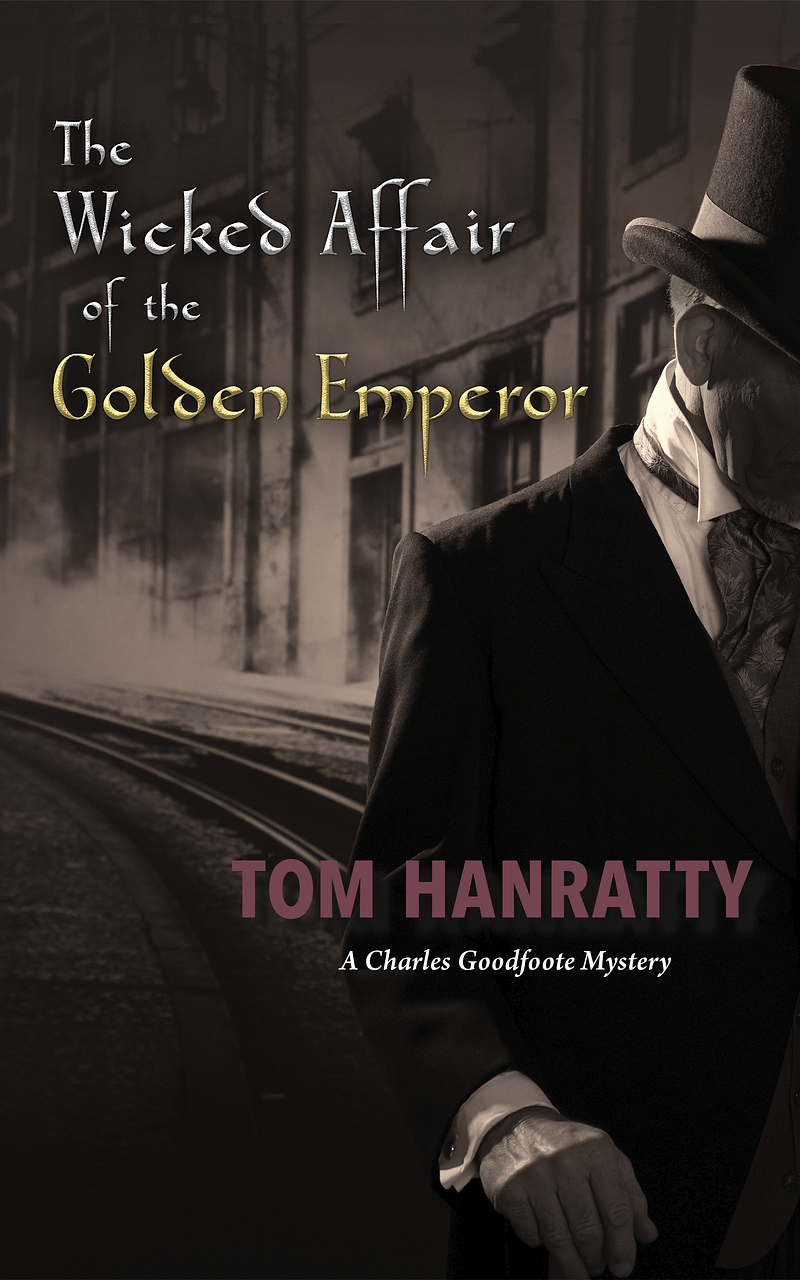
The Wicked Affair of the Golden Emperor
Chapter 3
A Charles Goodfoote mystery
Night wrapped the lodges of the village of the Red Paint People in silence. The wikiup were lit from within by small campfires, for the Spring night brought a chill among the boulders and hills at the edge of the desert. Kaya, sitting cross-legged on a puma skin in the lodge of her friend, the Medicine Woman Dashante, turned her head to listen to the soft whoop of a night bird up among the rocks.
“Perhaps recalling your time with Goodfoote would help relieve the pain of your loss,” Dashante said. The dying embers of the fire bathed the two women in a soft, red glow. Kaya closed her eyes and remained silent for several minutes. Dashante waited without speaking, for she felt the depth of her friend’s despair.
“You were in the village when Goodfoote first came among us,” Kaya finally said. Her voice was soft, nearly a whisper, and Dashante had to strain to listen.
“Yes,” the Woman of Knowledge said. “It was the fifth summer after your Sunrise Ceremony, and you still lived in the lodge of your mother and father.”
“I thought Goodfoote was a witch,” Kaya said with a sad smile. “His blue eye seemed to fasten on me, and I thought he was seeing through me to my bones.”
Dashante handed her friend a bowl of clear water, for Kaya’s voice sounded dry.
“He rode a big dark horse with a light mane and tail,” Dashante said. “I remember he came to talk to your father, but I don’t know why.”
“He was looking for a man who was killing the White-Eyes. The man he sought was part Mescalero, and he hid among his mother’s people. I listened outside my father’s lodge.”
Kaya took a sip of water. “After he left, I did the “Comes-Back” ceremony with old Keesha, the Hand-Trembler. My father didn’t know. No one knew.” She handed the bowl back to her friend. “It cost me the tanned hide of a beautiful antelope. But it worked, and Goodfoote returned the next Spring.”
“I was gone by that time,” Dashante said. “living in the village in the Stronghold. But I heard about the demonio maligno he killed.”
“Yes,” Kaya said, again so softly Dashante could barely hear her. “After he brought the Evil Demon’s weapons to give to my father to prove the killer was dead, Goodfoote stayed with us many suns.” She smiled. “He said he was tired and needed to rest, but he didn’t seem tired to me.”
In the silence of the lodge, each woman was wrapped in memories of times past.
“The monster he destroyed was a shape-shifter,” Kaya said. “And no arrow or bullet could kill him. We were told this by the Elders. Goodfoote’s name is sung around our winter campfires because of his great deed in hunting and killing the demonio maligno.”
Dashante knew the rest of the story of the slaying of the monster. Three warriors from the village were sent, with Kaya, to find and kill the beast. Kaya had ridden with the war party because her Power would help find the demon who hid in the guise of an animal or a rock. Five days after the group left, Goodfoote rode into camp carrying Kaya in his arms, unconscious. She had been struck on the head, the only survivor of the hunt. All three warriors were found dead of hatchet wounds, with empty quivers and rifles. Goodfoote didn’t stay, but turned around and rode out after the killer. Seven days later, he returned with the two axes the demon used, and all knew he had slain the enemy.
After Kaya recovered, the two young warriors became close, but the White-Eyes and Apache were going to war again, and Goodfoote had to leave. He couldn’t fight the Whites and he couldn’t fight the Apache so he had to leave the dry country and return to his people in the North.
Although her beauty brought suitors from far and near, Kaya never went with another man. Whole herds of horses were offered to her father, and some men brought the newest repeating rifles, but she rejected them all. The entire village could see the young woman warrior, so feared in battle, had been smitten by the man they called ‘Travels-Far’ for his long journeys. Kaya called him by his White-Eyes name of Goodfoote. When Travels-Far had returned for a brief time two summers back, Kaya was again left alone when the man rode away.
“I must go up on the hill,” Kaya finally said. “I must be alone to mourn for this man who will not return.”
Dashante nodded. “Your vision, my friend, has put your heart on the ground.” She tossed a pinch of sweetgrass onto the glowing rocks. The incense filled the small wikiup with its fragrance. “But you must stay and fight the Dark Men who will be coming to kill us. The People need your bravery and lance. I will fight at your side, and maybe we will die together.”
Kaya said nothing for a long time. She took a deep breath and looked into the eyes of Dashante. “We will fight the Dark Men,” she said. “Then I will go up on the hill, and you will wait for me.”
Dashante nodded. “It will be good.”
Chapter 4
No stranger to violent death, I was not discombobulated by the unfortunate and inconvenient passing of Mr. Skaggs. My own life had inured me to the all-too -often tragedy of the human condition. Being born of a Blackfoot mother and a free-trapper father of little merit, the first catastrophe I recall was when the people of my little Blackfoot village were mistaken for hostile Cheyenne, and nearly rubbed out. The Army thought I was a White captive because my Irish father, long deceased, had bestowed upon me one blue eye and a light skin. The other eye is a nut brown. The soldiers’ blunder was therefore understandable and they did apologize before they sold me for a keg of trade whiskey to a passing snake-oil medicine caravan.
Thus began a torturous saga that took me from the humiliating life of a sideshow attraction, to the comfort of the Boston Brahmin culture, and then to the US Marshals’ Service. But it was my innate cunning and man-tracking skills that eventually raised me to my current position as a Senior Operative in the Pinkerton National Detective Agency.
As the jewel in the crown of Pinkertons, it has been my experience that some mysteries come at you like an ore train roaring out of the gold fields, loud and unstoppable. Others sneak up on you like an Apsoroka pony thief, unnoticed until you find yourself sitting on a saddle with no horseflesh under you. This little rattle I’m relating started like a whisper, but, by the time I had brought it to a satisfactory conclusion, it had cost a politician his head, a detective a blood-letting, and me a broken heart.
It’s a dark tale with some uplifting moments, but is not for the faint of heart or those of an ecclesiastical bent. Young boys, always fond of catastrophe and bloodshed, will find it engrossing, if they can purloin their fathers’ copies.
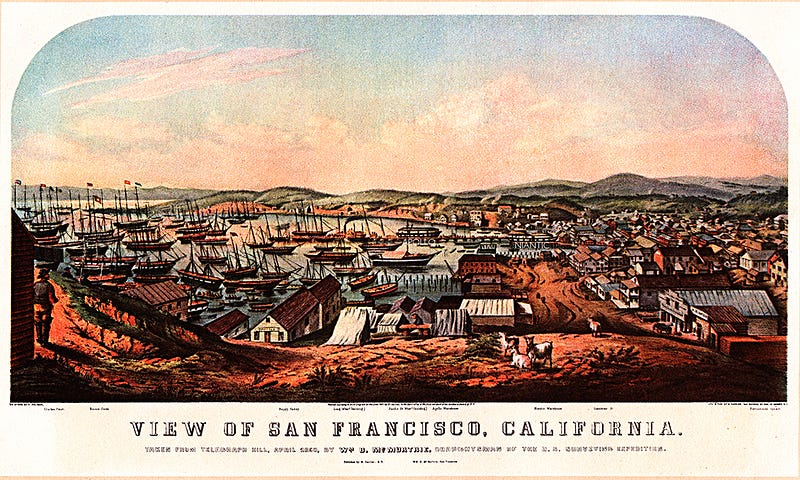
It was the morning after The Board of Enterprise fracas, and the sudden demise of Jack Skaggs, when I arrived at the Exeter Building on Montgomery, just south of Market Street, to find my drinking companion of the preceding night sunning himself on the stairs of my office building’s stoop.
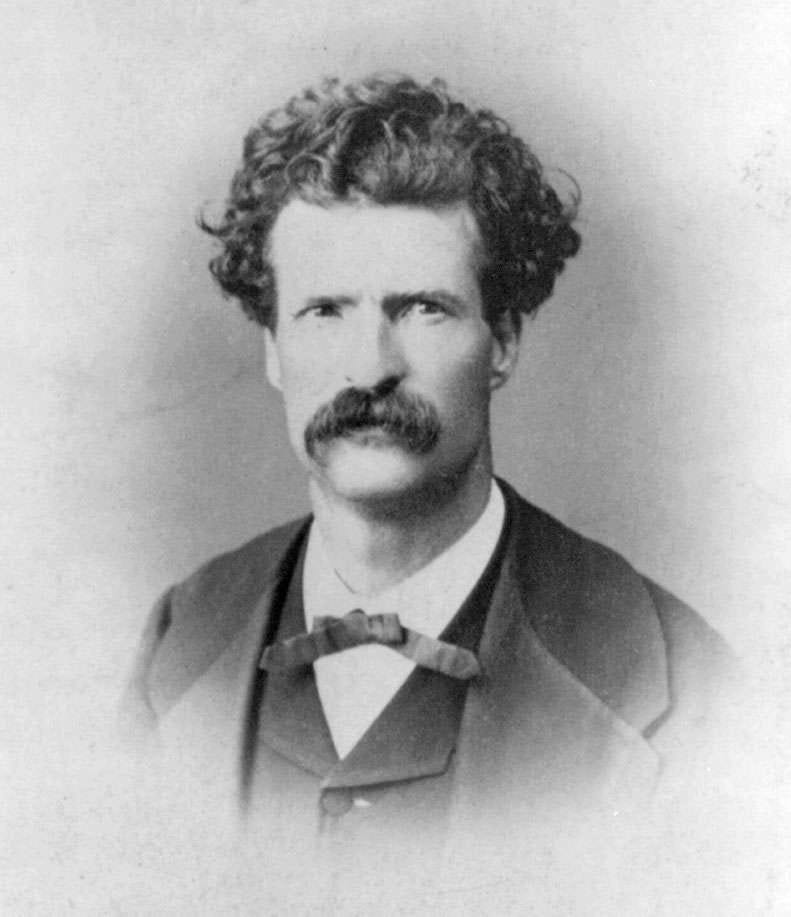
“Charles Goodfoote,” Sam greeted me, with a slight smile and twinkle in his eye. His derby, worn at a cocky angle, perched on his thatch of curly red hair.
As I approached, stepping gingerly around carriage horses’ droppings littering the streets, the reporter got to his feet, rolled up the newspaper he had been reading, and stuffed it into his coat pocket, already bulging with other scraps of paper. What caught my eye, however, was the large revolver jammed into his belt.
“Howdy, Sam. You be careful with that smoke wagon you’re toting. I’ve seen field cannon with smaller bores.”
The street door to the Pinkerton offices was locked, although I suspected my secretary, Henry, was already upstairs cooking his breakfast. After unlocking the door, I waved Clemens to precede me. “Are you a man in need of a Pinkerton detective, or are you looking for a sensational story from our private files?” I asked, as we climbed the stairs to my second floor office.
“The former,” Sam said. “A small matter of my impending assassination.” Pausing on the first landing, he continued, “It’s downright irksome. I was about to tell you about it last night when that ballyhoo started.” He then fell silent for the rest of our climb.
“I know murders are common in San Francisco,” I commented, as I hung up my hat. “We had one just last night at the Board of Enterprise right after you vamoosed. But most are among the riff-raff of the Barbary Coast. It would be a rare event indeed for a member of the press to come to a violent end.”
Henry, who is a middling competent office clerk, and a highly praiseworthy cook, had laid out a morning coffee service complete with enough fresh bread and jam to feed a platoon of pony soldiers. I motioned for Sam to take the visitor’s chair as I settled into my swivel seat behind my desk. Before sitting down, he pulled his revolver from his waistband and laid it on my desk.
He then took a pull on his cigar, but found it had gone out.
“You’re referring, I expect, to the sudden demise of that paragon of informers, known among the rabble as One-Eyed Jack Skaggs,” he said in his slow drawl. “His loss will be mourned by the gutter-press of this City, and one or two legitimate journalists. I include myself in the latter category.”
“You’ve had some dealings with Skaggs?”
“Rarely.” Sam shook his head. “Most of his intelligence was of a purulent nature, carried in the yellow rags fit only for the bottom of canary cages. Now and then, however, Jack’s large ears picked up a crumb of gossip that had immense value. Am I right in my suspicion that he was carrying one of those crumbs to you last night?”
I ignored his question. “But surely, a prominent newspaperman, such as yourself, wouldn’t be threatened by the kind of rapscallions who frequent the haunts where Skaggs listened at transoms.”
“That’s true. We journalists float above most of the criminal elements of this town. And it has long been my contention that assassinations should be visited upon those deserving folks who stick their necks out.” He paused as he put a flame to his stogie. “I have purposely maintained…” he puffed…“ a profile so low…” puff… “I could walk under a snake while wearing a top hat…” puff… “leaving room to spare.”
I smiled at his fanciful pronouncement, for Mr. Sam Clemens, usually writing under the name “Mark Twain,” was well known as a bombastic scandal-monger who frequently poked his literary stick in the eye of saloon owners and bordello madams. And even, on occasion, the city’s wealthy power brokers. Dealing with a low-life like Skaggs would not be unknown to Sam. It’s where he got ignition powder for his more explosive articles.
I poured the reporter a cup of coffee and gestured for him to try the bread and jam. He put his still smoking cigar into the standing glass ashtray next to his chair, and accepted the brew. After adding sugar, he took a long sip.
“Now, tell me, Sam, what makes you think there will be an attempt on your life? Did one of your discriminating readers send a threatening letter? I’ve been told that’s the usual method of criticism.”
Clemens put down his cup and rummaged through his coat pockets. “No, Charles, it was more subtle than that. And more inventive.” He pulled a large sheet of paper from his pocket, unfolded it, and laid it on my desk. Covered with columns of Chinese calligraphy, the bottom line in English read, “Samuel Clemens.”
“What do you make of that, Mr. Detective?” He picked up his cigar and inspected its tip.
“I’m not familiar with the Chinese language,” I replied. “Have you had this translated?”
“No need. I’ve been informed by Police Captain Bullump of the China Squad that it’s a wanted poster for my head. It was hanging on a wall in Ross Court, right in the heart of Chinatown.”
“You must have found it on ‘Murderer’s Wall.’ ” I set down my cup and saucer. “It’s where the Tong hatchet men — the bu hao dui — get their marching orders.”
“We newspapermen call them highbinders, and I’ve been assured they mean business.”
I looked again at the poster, then shook my head. “I’ve never heard of a Chinese hatchetman going after a Christian. It’s not in their best interest.” This was a puzzle. If the Chinese hatchetmen started killing Whitemen on assignment, there would be riots in the streets. “Have you anyone in mind? Anyone who may have taken exception to one of your more inventive news stories? Specifically, any Chinese?” I again extended my hand toward the food tray. “Please, help yourself to some vittles. Henry does his own baking.”
This time, Sam took me up on my offer. He picked up a slab of dark rye bread, studied it briefly, then mounded it with raspberry jam. He chomped and chewed, eyes raised, for several moments before answering.
“My job with the Morning Observer, Charles, is without a doubt one of the most killingly monotonous, wearisome jobs of soulless drudgery I have ever had. My stories are almost destitute of interest. The writing I do for that paper would not warrant a harsh word in response, let alone a murderous grudge.”
Here he paused to take another bite.
“San Francisco,” he went on, “is the home to some seventy thousand souls of every color, creed, and propensity for violence. Crimes we have here are committed by members of cultures so varied, I can’t keep track.”
He leaned forward. “We have had Hindus, Russians, Lascars and Blackamoors shoot, stab, and maim each other in the most heinous ways. Yet, I am not allowed by my paper to write anything but the most banal drivel from the resulting police reports.
“The newspaper I write for has no soul, no sparkle. It’s a fact-obsessed, plodding rag. Editor Doyle would have me write articles about the mesmerizing raptures of smelting gold, or who had tea with the mayor. However, the wealthy literati of Nob Hill find my insightful probing of the underbelly of San Francisco praiseworthy, as long as they’re not mentioned by name.”
Old Keeps-the-Lodge of the Blackfoot Nation had often told me he never believes anything a White Man tells him — especially when the man is talking about himself. And Sam’s articles were about as welcome among the wealthy as a buffalo in rut would be at a debutante’s ball.
“I’ve read a few of your articles, Sam. And fact-obsessed doesn’t come close to describing them. I don’t know about the soul of the paper, but your columns contain enough sparkle to put a diamond mine to shame.”
Sam smiled. “Most newspapers welcome the occasional story with the truth stretched a bit for interest. The intelligent reader can spot a joke a mile off.”
“But this poster with your name on that wall, is no joke. How are you with the Chinese?”
“The Chinese, Charles, have been treated kindly by me in all my works. They are, without doubt, the most hard-working, law-abiding citizens in this city. A disorderly Chinaman is rare, and a lazy one does not exist. I have expressed this sentiment in several articles. No, sir, the Chinese have no better friend in this city than the man who sits opposite you.”
“Anyone from your past, then? I’ve been given to understand you had some tumultuous times in Nevada.” I refilled his coffee cup.
“It’s a tumultuous place,” he agreed. “And, it’s true, there may have been one or two misunderstandings out there.”
“Anyone in particular who may have harbored a feeling of animosity, someone who didn’t take kindly to being ‘misunderstood’?”
He momentarily gazed at the ceiling.
“I was challenged to a duel at one point,” he finally said while sipping his coffee.
“Who won?” I asked.
He raised his bushy eyebrows and chuckled. “I discovered, quite by accident, that my opponent was a deadshot, so I skedaddled. That’s when the glitter of San Francisco beckoned me.”
“Would that man have followed you here?”
“No,” he said. “Jack Dawes, being a parsimonious man, wouldn’t waste his money chasing the likes of me.”
I sat back and thought for a minute while Sam Clemens re-lit his cigar.
“Some of your commentaries are about the most powerful men in California. You aren’t too free with your compliments.”
He waved his hand as if swatting flies.
“Point of fact, many of the men you write about,” I pressed, “got rich on crooked deals and ran over anyone who got in their path. An old uncle of mine used to say that if you pick up a skunk by its tail, you’ll learn a lesson you can learn in no other way.”
Clemens threw back his head and laughed. “I’ll remember about that skunk, Charles. It smacks of a hard-won truth.”
He again leaned forward, “The wealthy crooks I occasionally write about are powerful pirates who have plundered more gold from California by bribery, intimidation, and downright hooliganism than all the outlaw bands in the country.” Emphasizing each point with a finger-jab, he went on. “They own the police, the lawmakers, and, yes, by God, the press of this town. But I write what I see, and then fight to get it into print.” Satisfied, he leaned back again and puffed on his stogie.
We were quiet for a minute while I thought about Sam’s problem.
“What about Bullump?” I asked. “He and I go back a piece. Now, you said you showed the poster to him. Didn’t you blast him recently in an article?” The head of the China Squad was a bully and thug, especially to the Chinese. But if Clemens had piqued the copper’s anger in one of his pointed newspaper columns, a stout club wielded in a dark alley was more Bullump’s style. A poster on Murderer’s Wall seemed a little too subtle.
Before Sam could answer, Henry entered quietly, gave the reporter’s cigar a quick glance, and stomped to the window.
An old salt cod, late of the US Navy, Henry Tarbert harkens back to an earlier time. Bald as an egg, with a bristling great white beard, his face had been baked by the sun to the color of a redwood plank. A life aboard the rolling decks of windjammers, then steamers, had given him the swaying gait of a cowboy with worn heels on his boots. He favors a small nautical cap indoors and out, and only removes it when speaking to a lady, in which case he crushes it in his massive paws.
“Sam here has had his life threatened, Henry. Have a caution near that window.”
Henry snorted, and raised the sash. Campaigns with the Federal Navy during the late War Between the States made Henry more fatalistic than careful.
“It’ll be a raree shot that can scupper me, Capt’n,” he answered, his white beard bobbing around his toothless mouth. “And the cove would have to be soarin’ like a condor to get a round through this winder.” He glanced at the coffee setting, saw it was still in use, and closed the door as he left.
“Your clerk makes a good cup of coffee, and his bread is a culinary treat.”
“Henry is a rare treasure,” I agreed. “He spent most of his life aboard ship and came to baking only after he was set on the beach.”
I paused and leaned back in my chair. “Now, about Bullump.”
Clemens blew a cloud of smoke toward the ceiling and watched it swirl in the soft breeze that had drifted through the open window.
“Captain Bullump and the press have come to an understanding. Yesterday, he guided a few reporters from various newsprints, me included, on a stroll around Chinatown. We visited opium dens, bagnios, and Fan Tan parlors. It was in Ross Alley that I spotted the poster bearing my name. Naturally, I tore it down immediately.”
Now why would Bullump lead a tour of Chinatown, I wondered? He usually called on the citizens of Chinatown with a phalanx of thugs armed with sledge hammers and cudgels.
Sam answered my thought. “The good Captain had been the recipient of some pointed articles by various members of our little party. Hart over at the Enterprise has been particularly critical of his treatment of the Chinese. Bullump took pains to point out his difficulties in bringing the rule of law to godless heathens.”
“So he was getting on the sunny side of the newspapers.”
“A wasted effort, of course. We of the noble press may be ink-spattered and boozy, but we won’t be bought by a cheap meal and a cold handshake. My own price is much higher.”
“And what did Captain Bullump make of the poster?”
“He said it was probably a prank by some disgruntled reader of the Observer.”
“But he must be aware that having your name on Murderer’s Wall is a real threat. Did he say he’d find out where the poster came from?”
Clemens smiled. “Real police work is beyond the gifts of the good Captain. He’s too tied down following the orders of the robber barons who run this city. He sneered, as he does with anything to do with labor, and said I should just forget about it.”
I opened my desk drawer and rummaged until I found my old bent briar pipe. Sitting back, I began to stuff the bowl with the Latakia mixture I keep handy. It gave me time to think.
Several ideas about this mystery were starting to rattle around in my brain, and they all included Bullump. Organizing a tour of Chinatown that included Sam, and then Sam finding a poster with his name on it, was too coincidental for my liking.
“When did you receive the invitation to tour Chinatown with the Captain? Was it a spur of the moment event, or had it been scheduled?”
“Bullump telegrammed me about a week ago. And Joe Hardcastle of the Gazette published our itinerary in his Friday edition so everyone in the city knew we would be afoot among the Chinese. We met at The Golden Swan on Clay Street, where we lunched, paid for in full by Bullump, then walked all over the district.”
I put flame to tobacco and puffed out a billow of smoke. “Where are you staying these days, Sam?” I asked as I waved out the match. “Not still at that lice farm over on Pacific?”
“Not a bit of it. I’m at The Occidental. It’s the only place of any charm in this city. Heaven on a half-shell, I call it.”
I nodded. “It will keep the rain off your head. Your newspaper must provide you with a generous allowance.” Clemens was living at a hotel with rates nearly double my own at the Metropolitan.
“Gold and silver stocks, Charles. I had the foresight to purchase them when they were low and they have been climbing. Lady Luck is good to me.” Sam snuffed out his cigar.
I stood. “I’ll keep the poster, if it’s all the same to you. And I suggest you stay clear of Chinatown. Stick to busy streets when engaged in your business.” I nodded toward his revolver. “And it’d be wise to keep that cannon handy.”
Clemens got to his feet, picked up his pistol and stuck it back into his belt. He then shook my proffered hand.
“I may write a little biography of you one day,” he said. “A Blackfoot savage with a Harvard education. You are a rare combination.”
“Unique, I believe. I’ll meet with you again in a few days, if that suits you.”
“By a lucky accident,” Sam said, “I’ve been assigned to write stories from the Sandwich Islands for the next couple of months. I leave at dawn tomorrow on the Ajax. The editor of the Sacramento Union has commissioned twenty or thirty letters about my journey, to be published as they arrive.”
“A lucky accident, indeed, Sam. I’ll accompany you to the dock tomorrow and see you safely aboard ship. By the time you return, I believe I’ll have discovered who put your name on that hatchet men’s list. And why.”
After Sam Clemens left, Henry stumped in to clear away the coffee service. Shortly after I arrived in this city, just a year past, I had a listening tube installed that ran from my office to Henry’s cubby down the hall so he could listen in while I interviewed clients. It saved him from peering in the keyhole, or listening at the transom, which he had been doing with my predecessor. I could tell he was bursting to share his life’s wisdom regarding the conversation I had just had.
“I’ll jest come aboard for a chin-wag, Capt’n, beggin’ yer pardon,” he started, as he clattered the tray with coffee pot and cups. “It’s a fine kettle o’ eels a stewin’, and your’n in the middle of it like normal.”
I sat back in my chair and puffed on my pipe. “Being in the middle is where Pinkerton’s expects me to be. We have a client here, Henry.”
“Wal, it don’t bode certin’ smart to foul yer anchor among the coppers of this town, Capt’n. And I’ve heard a lot a scuttlebutt among the seafarin’ folk down the Listing Scow ‘bout this Bullump. He’s a rip-roarin’, hard-nosed Irish bull who’s so bent he walks with his head up his fundament.”
“Nicely put, Henry. You paint an engaging picture.” I rose, taking my hat and stick from the coat rack. “I have noted that the owner of the Sacramento Union, the paper providing Clemens with his trip to Paradise, is one of the same gang he’s been roasting in the Observer.” I paused as I stepped into the hallway and added, “A prime offer followed by a threat is more chance than I can swallow, and if Bullump’s involved, I want to know the why’s and wherefores before the next act of this little drama. He and I never did agree on much, and when I put the Captain’s nephew in a noose for murder, he swore he’d find a way to get even. But the first step is getting this placard deciphered into American.”
Henry, tray in hand, followed me. “You’ll be takin’ it to them heathen Chinee, I suppose,” he said, shaking his head. “They’re a cunnin’ bunch, them yellow people. Can’t trust any of ’em, includin’ yer mate John Fong. They show you a raree puppet in the right hand, and pick your pocket with the left. Or worse. Ran into ’em up near Peeking, during that Arrow War. And I’m tellin’ yer, yer’d best haul to their leeward, if yer mean to confabulate with ‘em.”
I smiled. “I’ll keep my back to the wall, Henry. But either this poster is a poor joke, or it’s a real threat. Either way, until it’s readable, we haven’t much to go on.” For a man who would spit in the eye of Old Scratch himself if the occasion called for it, Henry worried more about my continuing good health than a brooding hen does over her chicks.