
Changing FAST Fashion To SLOW, At Break-Neck Speed
Standing up against the sleaze, and shame, of fast-fashion by valuing clothes we already have, or that someone else no longer wants…
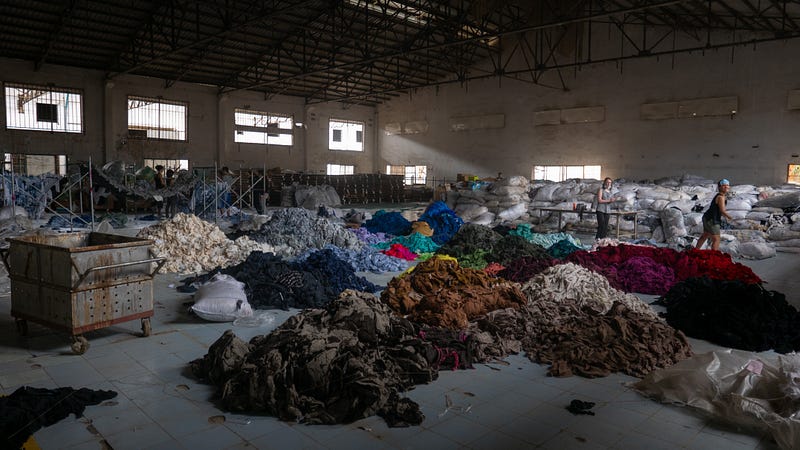
The cheetah has always been viewed as the fastest animal in the world, soon to be overtaken by the fastest fashion animal, fast-fashion, unless we can put a stop to it, exterminate it, and destroy any person who is going to cultivate its genes.
Imagine an industry whose raison d’etre (reason for existing),is copying, copying other people’s work in this case, their fashion designs, altering them a little, and moving the designs quickly, for fast fashion.
The intent, however we look at things, is evil. Make no mistake about that. Evil in its disregard for planetary health, in the way it treats workers, and evil in its lack of care about much at all, save for making money.
I found this definition by Livia Firth, an ethical fashion advocate.
‘Fast fashion is like fast food. After the sugar rush it just leaves a bad taste in your mouth.’
Don’t you just love it! I couldn’t have described it better myself.
Fast fashion has put a new stamp on the conveyor belt I knew of my youth, that is, conveying one thing from one place to another…a convenience thing, no more, no less, probably clunky in its genesis.
But now this conveyor belt is so much more sophisticated. You can’t necessarily see it, but it sure as hell works. It’s the shitty end of fashion, where work ethics finds no place, and things are copied, made up, and on the conveyor belt, to charm you, the unwary public, into buying before the stamp of agreement is signed and sealed, and before you have a chance for your excitement to cool.
It’s almost sickening in it grind.
That’s right. There’s a GRIND in fast fashion, the grind on poorly-paid workers, the grind on their souls, the grind on them to finish things (badly) in record-quick time, for abysmal salaries, and have them made up in hours, the smell of the factories still taking up residence in their packaging.
It’s sickening.
When we factor in the human and environmental costs of their production, it’s difficult to support the industry.
“Demand quality not just in the products you buy, but in the life of the person who made it”
Some years ago my husband and I went to a Slow Food dinner. It was a dinner event and a trivia night combined. Can the two co-exist? I wouldn’t have thought so, but they did.
Our table was called The Academic Remainders, my idea, a title I ‘borrowed’ from a local bookshop.
It was a great night, made even more enjoyable by the fact that we won the trivia prize, one bottle of quality wine each!
That we won, I can assure you, had very little to do with me. Still it was fitting that a group that called itself Academic Remainders could have lots of useless facts stored away in their craniums.
Sadly, any history stored in mine seems to escape readily, rather than be organized for future reference!
But kudos to those whose minds are less sieve-like!
What I can tell you is that the slow dinner we enjoyed was by far the finest food we had eaten in a long time. Every course was a feast to the eye, the flavors even finer in our mouths.
So I was ruminating about this the other night, and thinking that, just as slow, deliberate cooking, and leisurely eating, should be the way of the future for good health, the same could easily apply to fashion, for planetary health.
Slow fashion could be a reality for many of us if we get our collective thinking, and intent, into focus.
Sarah Fung, founder of ‘Re-commerce’ poses the question.
‘What if we completely stopped making clothes?
‘No, we wouldn’t all be romping around frockless; brands and individuals alike tend to hold on to an excess of clothing. Rather, we would reuse, repair, and eventually recycle what we already have. We wouldn’t need to refuse clothes, as conscientious consumers are already doing. And we would finally have a truly circular fashion economy without waste. (A circular economy designs out waste and pollution, keeps products and materials in use, and regenerates nature.’
I’m pretty sure that this is exactly what happened post war, in many countries. There was no cash (or industry) to support the production of clothes, and yet, style was everything.
That generation was innovative to say the least!
Yet today there’s a certain lack of skill, or indeed interest in re-making things, of making small alterations in order to produce something enviable.
Innovation is an absent friend!
And yet, if we absorb some of the harsh realities of this insidious industry, surely we must find a better way.
Let’s have a look at some scary statistics.
- The fashion industry is the second most polluting industry on the planet, second only to fossil fuels
- It is responsible for 3% of total global CO2 emissions
- 150 billion items of clothing are made each year, and in the USA 36kg of clothes per person are thrown away
Is that enough to make you consider, not buying junk, not being part of something so hideous, but instead choosing to be creative?
I know what you are thinking. But what about style? I like to look fashionable. People will know.
I know! Style is important to many people, including me. Dressing like a circus clown has little appeal for me, but saving the planet for others, is at the top of my list.
In this article, I talked about my fear of our not putting the brakes on planetary pollution, and I talked about my newfound intention not to buy from the offerings of fast fashion. To that end I have at last succumbed to opp shopping, or the likes. Yes, there are other commendable avenues!
I stand by that. Opp shops vary in their orderliness, but once you have found ones that are organized and can deliver, it’s just like regular shopping…not the same level of choice, but choice nonetheless.
You won’t always find something you want for yourself, but here’s the thing. Just as we have our articles curated here on Medium, why not think laterally about curating ‘for a friend’?
This is something that has only just occurred to me. I often find beautiful, mostly new clothes that are too large for me…yes Aldric Chen, your guess was right. I am on the petite side, so size eight for me. That can occasionally work to my advantage bur sadly, not so often.
But finding something that you just know would suit a friend, why not buy? The risk is minimal.
There was a time when some people, myself included, would not have considered shopping thus, but certainly here in Australia, the move is now big! And that’s mostly driven by care…care about adding as little as possible to to the current planetary crisis.
Opp shop shopping can be daunting at first! It’s not in any way like shopping in a designer shop where there are rows upon rows of the same shirts, or dresses, same shoes, same handbags, and same coats…the choice is yours for the taking. Clothes shopping in fashion shops allows us all to happily dress up as cardboard cut-outs of each other!
Where’s the joy in that?
I remember my last year in high school and the obligatory ball that followed. So many girls turned up in the same dresses, from the same store, different color maybe, but still, the same!
But not for this gal! My mom was a dressmaker, and she was also innovative, and pretty choosy about fabric, and so I KNEW nobody else would be wearing the same dress as I was!
And that pretty much sums up another reason for standing well away from fast fashion, and considering ye old opp shop (maybe not so old!). Some of your opp shop treasures will be more vintage in style, and you won’t have to worry about bumping into a cardboard cutout, your veritable doppelganger!
But back to curation…I’m thinking why not hold a curation party? You could buy clothes that don’t either fit, or suit you, but ones that you know have potential…one woman’s misfits could be another woman’s fashion statement.
No money needs to change hands. A voucher system maybe, if you don’t find anything on one occasion, and you have donated. That could work.
One thing I have found in living with less, and avoiding clothes shopping, is that I no longer worry about what to wear. I can instantly shop my scant wardrobe (I only buy particular colors), and easily combine clothes with each other.
Have you considered doing this? Focusing on colors and style? This allows for an easy mix-and-match.
So that’s another thing you can do. Before you ever buy something new, shop your wardrobe first.
If you don’t find something suitable, shop your friends’ wardrobes! If nothing else, at least you might inspire each other!
In all things bear in mind these two fast fashion quotes.
‘Fast fashion can never be sustainable, or ethical.’
‘I am somehow less interested in the weight and convolutions of Einstein’s brain, than in the near certainty that people of equal talent have lived and died in cotton fields and sweat shops’.
And now, are you ready to become your own, unique, fashion designer?


