
Change & Growth | Twittle-inspired essay
Change is Inevitable
If we don’t change, we don’t grow. It’s a question of control.
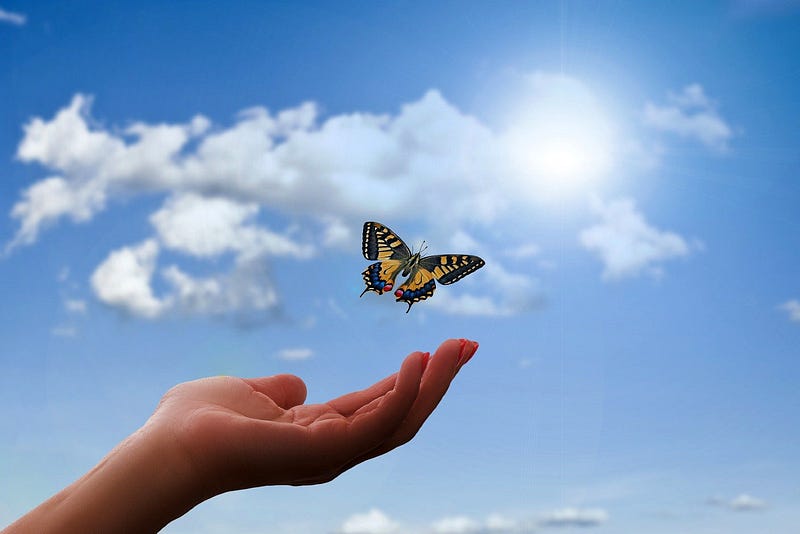
Change is inevitable if we are to advance and grow Sure, it makes us stress — and fret — and cry if it didn’t, how would we ever know?
© Carolyn Hastings 2021
If we don’t change, we don’t grow. If we don’t grow, we are not really living. Growth demands a temporary surrender of security. Gail Sheehy (1936–2020) Source
Adaptation. Adjustment. Transition. Transformation. Upheaval. Metamorphosis. Reorientation. Restructure. Evolution. Revolution. Whatever you want to call it, change invariably pushes us out of our comfort zone. To paraphrase Gail Sheehy, author of bestseller, Passages: Predictable Crises of Adult Life, change forces us to relinquish our control.
Even when the change is fleeting, it still registers in our sympathetic nervous system and triggers an involuntary response. If we tune into our bodies, we can detect the increased heart rate, the beads of sweat, the butterflies in the tummy, the quickening of breath, the tensing of muscles, the brain on alert.
We feel it.
We feel the change that is upon us.
Whether we like it or not, it becomes part of us and there’s no turning back.
Change is an inevitable part of life. Yet, no matter how hard we try, we’re not immune to the impact it has on our senses, our viscera and our thought processing. Just as change is inevitable, so too is our reaction to it.
How we respond to change is the part we do have control over. To quote Gail Sheehy in full -
If we don’t change, we won’t grow, and if we don’t grow we’re not really living. Growth demands the temporary surrender of security. It means giving up familiar but limiting patterns, safe but unrewarding work, values no longer believed in, relationships that have lost their meaning. As Dostoyevsky put it, “taking a new step, uttering a new word, is what people fear most.” The real fear should be the opposite course. Source
John F Kennedy puts it this way -
Change is the law of life. And those who look only to the past or present are certain to miss the future. Source
And to link back to the opening line of my twittle -
Change is inevitable. Growth is optional. John C Maxwell Source
Why am I telling you this?
The words, ‘change is inevitable’, randomly popped into my head amid the morning’s humdrum of chores. That’s how most of my twittles start — with a random phrase at a random point in the day.
Curiosity got the better of me, as it usually does. I downed tools, made a beeline for my desk and started scribbling and counting letters. Before long I had a twittle (it’s the 100-letter, 4-line micropoem you read at the beginning of this article — there’s another one at the end).
But more to the point is the idea that, in creating the twittle, I caused change.
I hadn’t intended to write a twittle, let alone a twittle about change. My plan, after completing my chores, had been to work on the layout for a picture book. By changing my mind and going with the twittle option, I changed the course of my workday.
As a result of that change, I’ve changed.
In the process of writing this article, I’ve taken time to think more deeply about change and the impact it has on each and all of us. I’ve done some research and thought some more. I’ve come out of it a little wiser and more knowledgeable.
I’ve grown.
I’ve learned that what my husband and I are going through is what Gail Sheehy calls a ‘predictable crisis of adult life’.
You see, we’re empty-nesters. My husband has been a bit unhinged by the loosening of our parental responsibilities. I’ve found this odd given that he’s the entrepreneur.
That puts him at the forefront of change, doesn’t it?
Shouldn’t that make it easier for him to adapt to life’s changes?
Apparently not.
Why not?
It’s a question of control.
Some changes we can control, others we can’t.
My husband can’t control that our adult children choose to live their lives away from the family home. What he can control is how he goes about adjusting to the changes brought about by this ‘predictable crisis’ in his life.
In the same way, I can’t control the thoughts that jump into my head. What I can control is what I do with them. I could’ve chosen to dismiss the thought, ‘change is inevitable’. I could have chosen to put it on hold and deal with it later. Instead, I chose to act on it straight away. It was a conscious decision to change the direction my day was going in and to turn it into something else. I controlled the change.
From a broad-scale perspective, we’ve seen more change in the past 40 years than any other period in human civilization. We’re immersed in change. Some would say we’re drowning in it. And like drowning swimmers, we feel like we’re losing control.
We need only to look at the changes wrought by the pandemic to get a sense of the magnitude of the changes we face in today’s world.
We’re dealing with a microscopic contagion that has the power to jet propel us out of our comfort zones and shift the trajectory of human existence.
How can that be?
Well it is. It just is.
And so is the reality that we’ll never return to the way of life we had before the pandemic. Whether we like it or not, we’ve been changed and we’ll continue to change. In big ways and small, and in ways we’re not even aware of or have any control over.
From a Medium platform perspective, change is happening here all the time. I read earlier this week that a popular publication, P.S. I Love You, will be mothballed at the end of June.
That change has sent shockwaves through the platform with many writers taking to their keyboards to register their dismay, anger and fear at what, to them, is a move in the wrong direction.
It’s another example of what happens when we feel we don’t have control over change.
We’re not comfortable with having things taken away from us, especially if we don’t know what will fill the hole — and more importantly, if it will be better than what was there.
We react instinctively by resisting and pushing back in a valiant, but often futile, effort to re-establish the status quo.
We try to convince ourselves that it’s better to keep what we have safe and dry rather than take the plunge into uncharted waters and risk drowning in change that we have no control over. Gail Sheehy talks about it when she quotes Fyodor Dostoyevsky in Crime and Punishment, “taking a new step, uttering a new word, is what people fear most.”
No matter the scale, change is inevitable. Without it, life would be exceedingly boring. In fact, without it, we wouldn’t exist. Our sympathetic nervous systems ensure that change does not pass undetected and as uncomfortable as it can be, it sets us up to take control of change so that we not just survive, we thrive.
Your life does not get better by chance, it gets better by change. Jim Rohn (1930–2009) Source
Change is inevitable It’s a force upon our lives pushing us past our comfort zones driving us to survive, strive and thrive
© Carolyn Hastings 2021
Thank you for reading and thank you to Dr Mehmet Yildiz and the editorial team at ILLUMINATION-Curated for giving my words a place to live. I hope that by embracing change you are driven to thrive. 🙏 💕
Note: this post contains affiliate links. If you use a link to purchase a product, I may receive a commission at no cost to you. Thank you.


