
Change How You Look at Things = Things You Look at Change
Experience is the child of perception.

I. There’s no Reality, Only Perception
“There are no facts,” said Nietzsche, “only interpretations.” Or to put it simply: there’s no reality, only perception. Hence perception is reality!
To illustrate the above insight, let’s briefly make use of Einstein’s famed thought experiment method.
Picture, if will, having just survived a car accident and lying in a coma — that extended version of what Shakespeare called “sleep [which] is the cousin of death.” And so, let me ask: while you’re lying in this coma — surrounded by loved-ones and flowers that flank your bedside — does any of this exist to you?”
What’s understood need not be explained. …
But the instant those eyelids for curtains of yours lift . . . abracadabra — the world’s stage adorned with all its actors magically appears.
Poof!
For ages, philosophers have known it’s in fact the mind that shapes things, not things that shape the mind. Or to put it another way: if beauty lies in the eye of the beholder, then, what the beholder knows is not a beautiful sunset, but only a mind that perceives “beauty” in a setting sun.
In short, because of the 5,000,000,000 species to have ever graced the world’s stage — from aardvark to zebra — we’re the only species armed with a mind, it must be the case — change how you look at things = things you look at change.
No wonder John Milton famously concluded:
“The mind is its own place and in itself, can make a Heaven of Hell . . . a Hell of Heaven.”
II. Change the Channel

Because example trumps precept, I’ll briefly recall a real-life case in point.
Rewind Father Time’s hands back a few years ago, and there I sat in our living room. My girlfriend at the time had invited a few gal-pals over.
Of course, it wasn’t so much a slumber party as it was a chance to get “dolled up” before heading out to Club 1-OAK and Avenue.
Though I tried my darndest to immerse myself in the basketball game, I couldn’t. After all, the endless stream of chatter and boisterous laughter drowned out commentary on LeBron’s spin move. And so, I listened. …
“Girl, I can really use a nose job,” one of the voices said.
Seconds later, another added: “Next week I’m getting a consultation with Dr. Miami.” This collective voicing of seeing things called “imperfections” went on for several minutes.
Given that I’ve long been fascinated by human nature, I welcome the chance to study behavior whenever the occasion arises. And so, I had an idea.
First, I turned up the volume. Second, I whispered in the remote: “TLC. Unpretty.”
Within seconds, the classic beat came rumbling on. Apparently, as the ladies did some last-minute touching up, they welcomed hearing the deeply rich vocals of T-Boz complemented by Chilli.
My girlfriend stormed into the living room. With arms folded, she briefly shot me the Reaper’s grim stare before making her return trip to the “dressing room.”
The instant the classic hook came on, I rubbed my hands in anticipation. After all, I delighted in the chance to observe a dose of classical conditioning in real time:
“You can buy your hair if it won’t grow You can fix your nose if he says so You can buy all the make-up that MAC can make,
But if . . . You can’t look inside you Find out who am I to Be in the position that make me feel So damn unpretty” — TLC, Unpretty
The more the ladies hummed TLC’s anthem, the more I noticed a subtle shift.
Eventually, some five minutes later, my girlfriend’s bestie at the time — Nicki — randomly blurted: “You know what, my nose is kinda cute, huh!”
Seconds later I heard whispers of how “Dr. Miami is kinda overpriced.”
Bingo!
As the ladies made their grand exit into the New York City night, my gf made it a point of emphasis to wink at me while mouthing — “you’re good, babe.”
After all, there’s no reality, only perception! And so, it must be the case:
Change how you look at things = things you look at change
III. The Takeaway
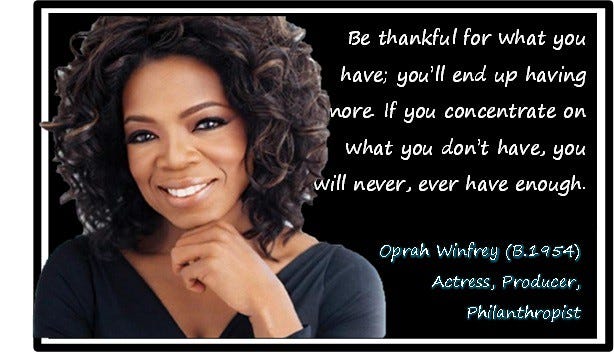
If each day is a lifetime, each morning we awake must leave an aftertaste of birth. And so, I start off by opening two gifts every morning — they’re called my eyes.
I whisper, “Thank you for blessing me with eyesight to see another day.” After all, both my great-grandmother and her husband were blind.
As for my expression of gratitude for another day, given that roughly 150,000 people twirl into the Reaper’s grim arms each day, I make sure to — count my blessings before I count my money.
Given that I live a healthy lifestyle, though I never gave her my math (phone number), Nature abruptly comes calling each morning.
I whisper, “Thank you for blessing me with a healthy digestive system.” After all, IBS affects between 25 and 45 million people in the U.S. alone.
When I take a seat for each morning’s breakfast, I whisper, “Thank you for blessing me with the means to afford sustenance.” After all, presently on the world’s stage, almost 700,000,000 people regularly go to bed hungry.
Notice a theme?
When the Oracle at Delphi crowned Socrates “the wisest man in Athens,” he honored the coronation by noting:
“He who is not contented with what he has, would not be contented with what he would like to have.” — Socrates
So far as the only aim of life is happiness, perhaps it’s important to remember this: happiness is the child of gratitude. Bingo!
To master the art of living boils down to knowing that happiness lies in seeing reality thru grateful eyes. After all, the happiest person isn’t someone who has the most, but rather is usually someone who is the most grateful for what she has.
Did not the Buddha teach us ages ago that “happiness does not depend on what you have or who you are, it solely relies on what you think”?
Perhaps depression, then, merely reflects focusing on a negative thought waaaaay more often and with greater intensity than usual. Remember, there’s no reality, only perception. Hence perception is reality.
Perhaps it’s not so much we become happy as it is we learn to stop being unhappy. The instant we master having an attitude of gratitude, contentment befriends us.
In short, the more I live, the more I’ve come to suspect for my own happiness or unhappiness — I have only what I think about things to either thank or blame.
After all,
Change how you look at things = things you look at change
Chat With Adrian Drew Over a Coffee
Adrian’s offering free 25-minute consultations to all interested in kickstarting their writing career. Click here to find out more.


