
Chance Encounter With An Artist
The amazingly talented Mr. K G Babu
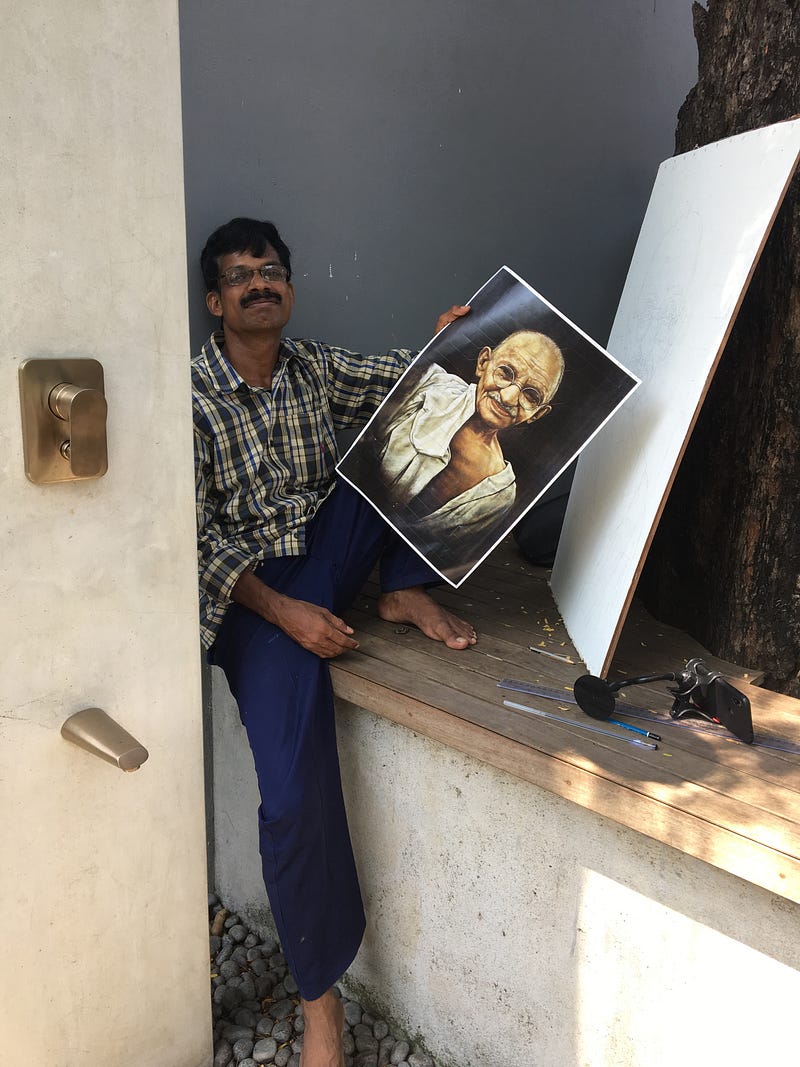
Browsing for souvenirs…
About a month before we would all be sheltering in place, hiding from a pandemic, I was happily traveling around in beautiful Kerala (AKA God’s Own Country) with my husband, our youngest daughter Shirin, and my sister Christine, who lives in France. We had just visited the historical synagogue in Mattancherry and were about to walk back to our hotel. But first Christine and Shirin needed to find some gifts and postcards for their friends.
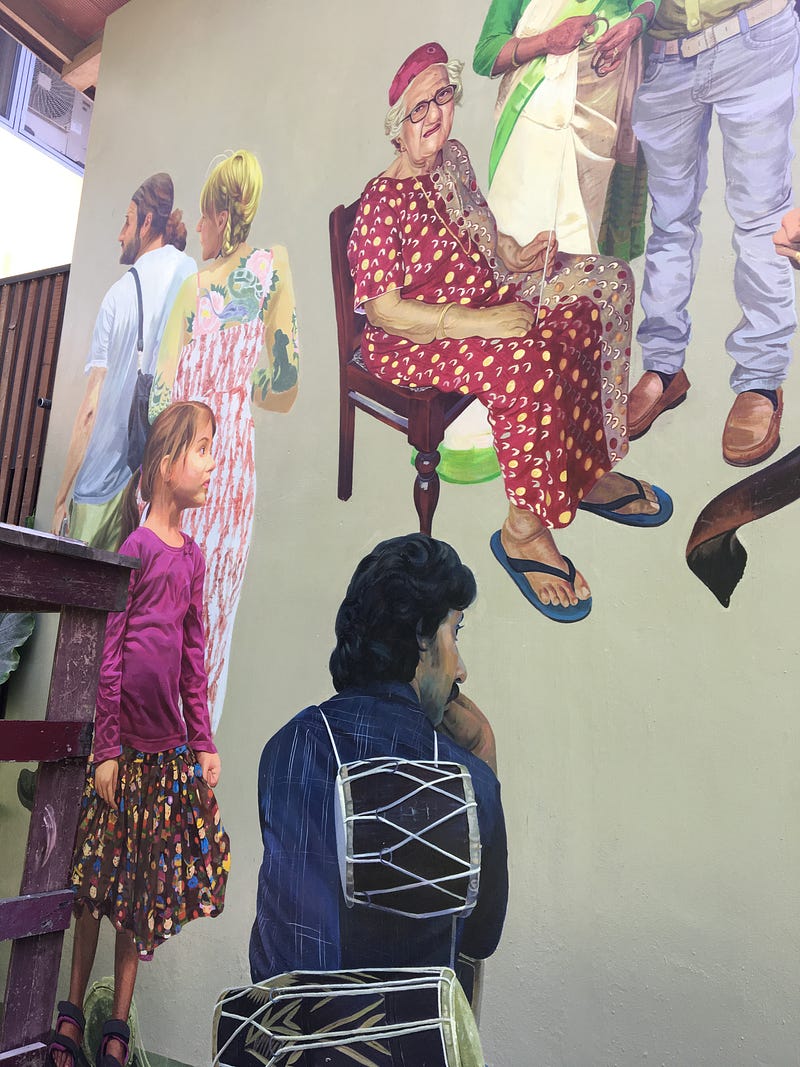
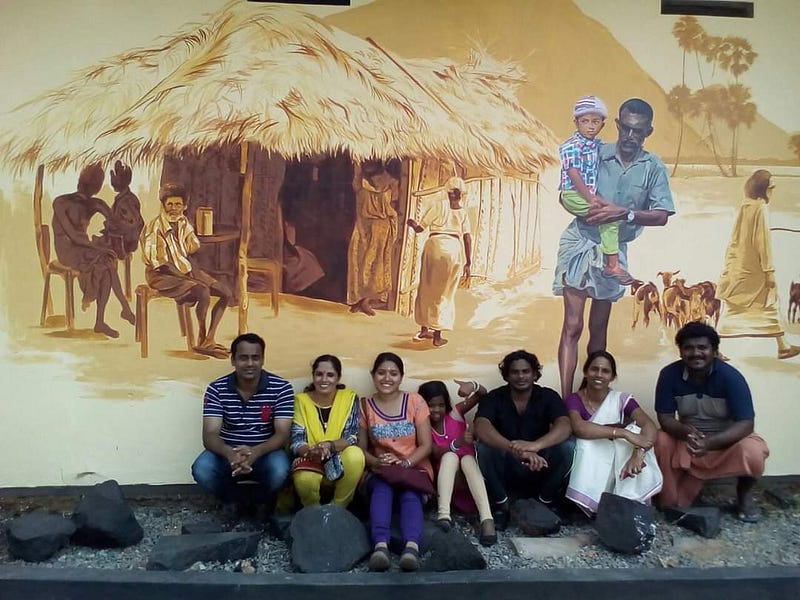
While browsing the nearby shops, we stumbled upon the open doorway of Mandalay Hall, a very unique-looking hotel. The view of its verdant courtyard was intriguing, so we walked in and asked the receptionist if we could have a look around. We were in for a surprise: one of the courtyard walls was covered in exquisite, hyper-realist murals of Cochin street scenes, featuring locals, known — like the late Sarah Cohen — and unknown, and even tourists. The work appeared to be still in progress.
Some of the subjects were painted with their backs toward the viewer, as if they, themselves, were onlookers or passers-by. My limited photographic skills cannot do justice to the artwork, but you will get the idea.
We meet a mysterious artist
Dying to find out who the artist was, we asked a man who sat relaxing in the far corner of the courtyard for information. We could’t believe our luck when he turned out to be the painter, in person. A conversation followed, me gushing shamelessly, he answering my questions with endearing humility. I especially wanted to know if he also painted on canvas, because I’d love to acquire a small work by him, provided I could afford it. “ I have a website,” he said.
We exchanged contact info, and I promised to do a story on him. Back home, I did my due diligence, downloading his résumé and his website (below).
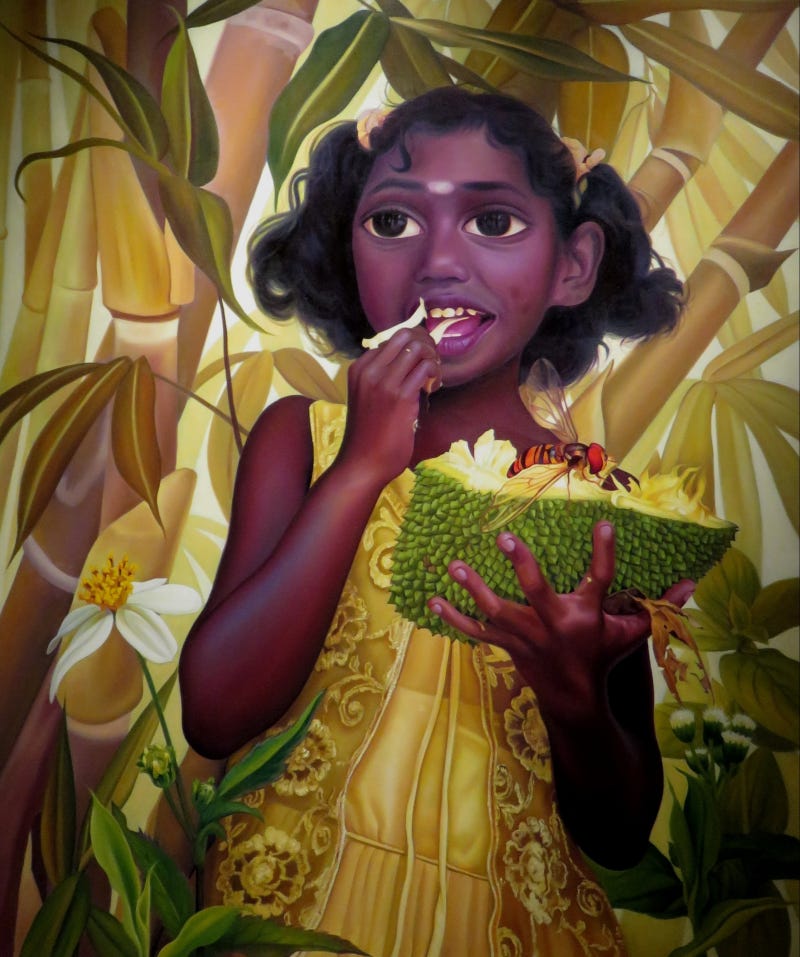
I also admired dozens of his astounding canvases, found on Google Images. Many of them have a touch of magic realism, with a uniquely Indian twist. I loved this one of a girl eating jackfruit:
Studying these materials, I found out a lot more about the artist: that he was self-taught, and socially and environmentally engaged. Much of his work had been done on commission from cultural organizations, leading to various solo and group exhibitions and awards in India, and also a few international art shows. But not nearly enough, in my opinion.
A little backstory
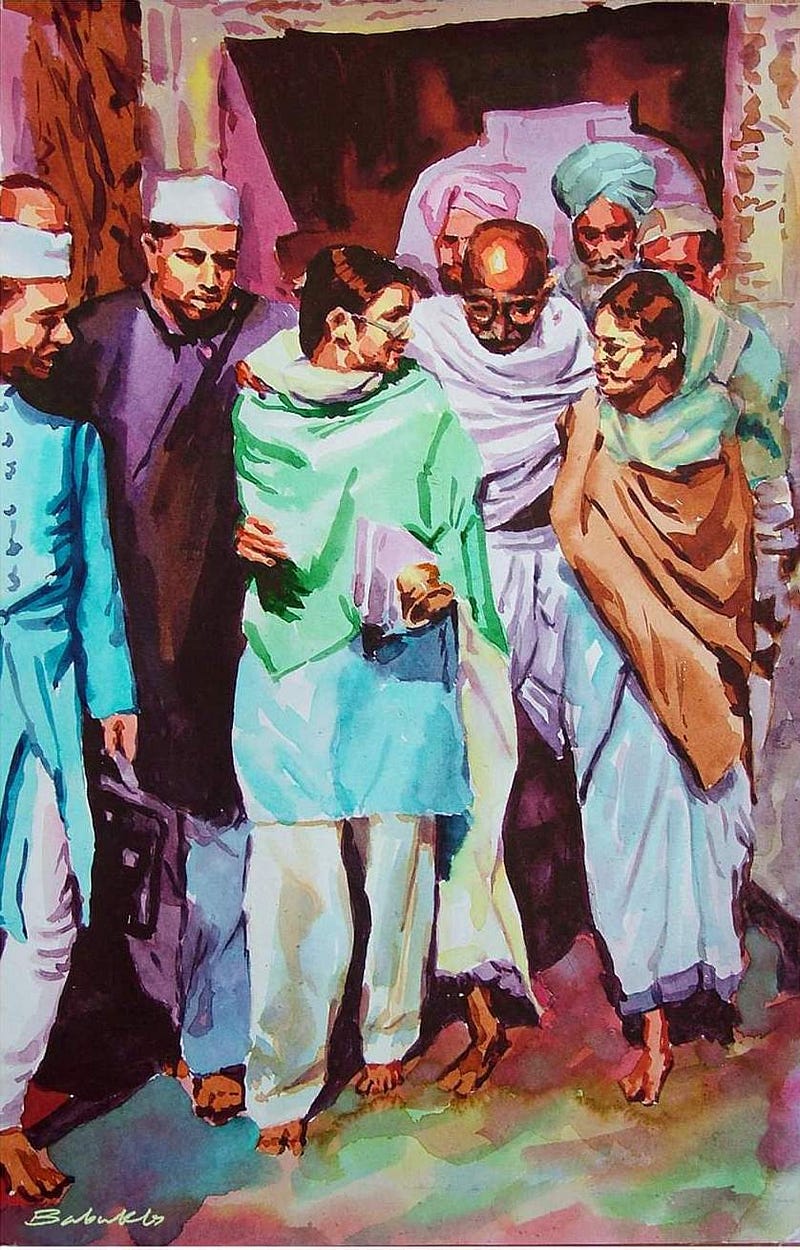
Something of a child prodigy, K G Babu started out with color pencils, then watercolor. Later he branched out to other media like enamel paint, charcoal, oil, pastel, and acrylic. By the time he was in high school, people were taking notice. But in India, you need connections to advance, and his family was of modest means. Like many artists, he admits to having no talent for business, and for years he struggled to get by. He gratefully accepted commissions by cultural organizations for several groups of artwork to accompany biographical exhibits about figures like Mahatma Gandhi and various Kerala cultural icons. Working from photographs, he brought them to life.
His series of sixty-two exceptional frames on the life of Gandhi were also used in a television program on the Mahatma. This kind of “bulk orders” don’t pay well, but they brought his work to the attention of the public.
Even in mural art, K G Babu is entirely self taught, he told me: “No guru.” By studying the paintings of great masters, he figured out how to do it. His murals are not frescoes, but gigantic acrylic paintings, and so they are by nature ephemeral, he says. The artist finds happiness in his creative work, and that is all that counts for him.
He painted his first mural four years ago, in Kodungallur. It’s based on a famous novel by O V Vijayan. For inspiration he walked the places where the novel was set and made sketches. He also incorporated the author’s picture in it. The mural was used as the backdrop for a theatre performance, and has also been captured in two Malayalam movies.
A multifaceted artist
K G Babu is not only a uniquely gifted artist, but a man of deep thoughts and humanity, as I discovered while reading a long essay that he wrote, “Art — A Pilgrimage to Purity.” It was published in a Malayalam-language magazine, and he sent me a translation done by one of his art students who lives in England.
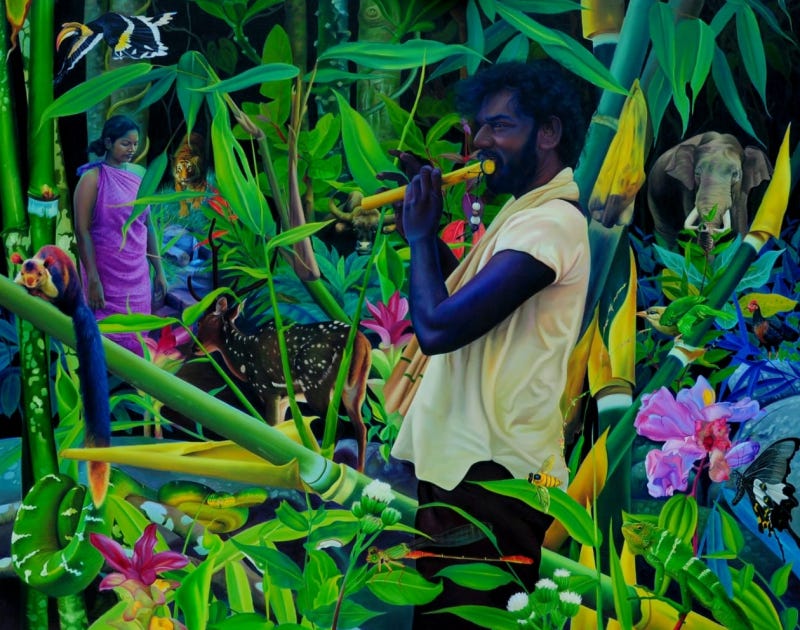
His compassion for the underdogs of Indian society, the tribals, the poor, women and children, shines through in his art. Few people in the West are aware of the Adivasi (aboriginal) tribes of India: the Gonds, the Bhils, the Santals, and many others. In Kerala, the indigenous tribes are called “the protectors of the forest.” K G Babu idealizes them. Tribal people, he feels, are more pure, less polluted by our “civilization.”
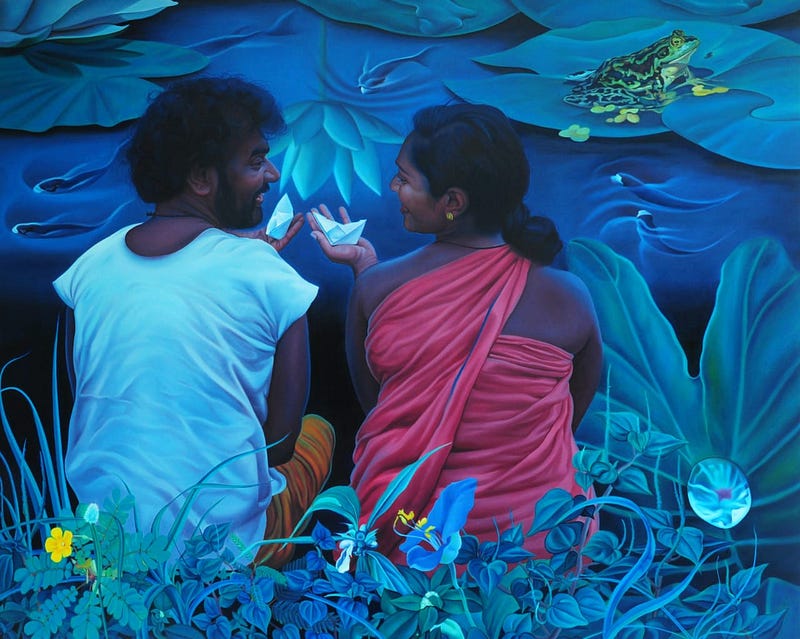
On WhatsApp he told me of his dream to paint all the tribal people of the world, including the Native Americans. But he is aware that this is, most probably, impossible. My family and I were blown away by his art. Much of it has a haunting quality. After meeting the man behind it, I believe this artist deserves wider, indeed worldwide, recognition.
*What looks like an innocent, romantic interlude depicted above, is in fact an allegory of the impact of humans on their environment and the artist’s own hope that our coexistence with Nature will evolve into a cohabitation. The paper boats signify life, “on the shores of exuberating freedom and intimacy” that such a union with Nature would offer. In conclusion he writes: “This painting is the realization of nature as the torn half of my soul and the lost part of my being. It is the proclamation of this realization to the world.”


