
Challenging “Full To Capacity” COVID Reports and Results of Refusing COVID Testing In The Emergency Room
An eyewitness account of two local not busy ER backroom, lobby, and staff.
The Initial Discrepancy: A “Full” Emergency Room Proclamation
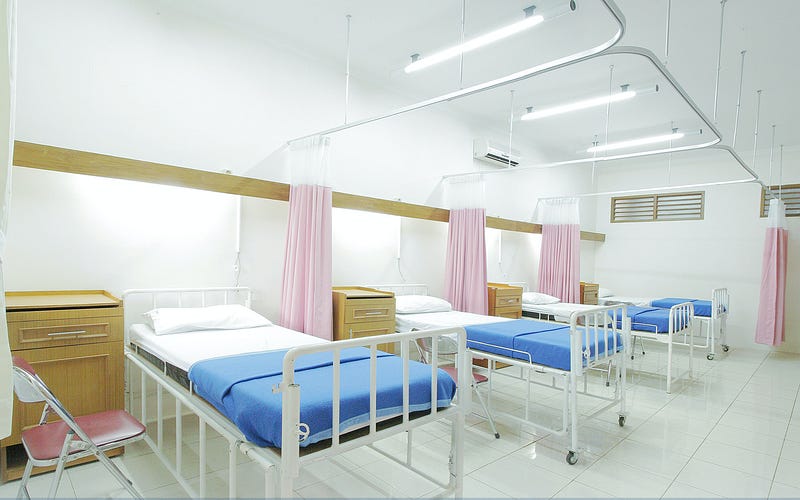
Last Friday, my daughter and I walked into an Austin Baylor Scott and White emergency room as one of three total ER patients. There were no other patients in the emergency department. There were a total of four to five cars in the entire employee parking garage.
When my daughter was brought back from the lobby to the emergency department, she noted that all other rooms, except for the two holding the other two patients we walked in with, were empty. There were no other patients in the entire emergency room except for my daughter and the two other patients who had arrived at exactly the same time as we had.
However, the emergency room nurse stated to my daughter that the emergency room was “full to capacity.”
An experienced nurse, I understand medical and staffing terminology and requirements for hospital and departmental census.
Full to capacity in the medical field means that every room in a certain department or facility (in this case and most often, the emergency room) is filled with a patient and more often than not, excess patients are also housed in overflow rooms.
“While ED crowding is a complex issue caused by many extrinsic and intrinsic factors [2, 3], research has shown that the primary cause of ED crowding is boarded patients at the ED [2, 4]. “Boarded patients” refer to patients who remain in the ED after having been admitted to the hospital but are unable to be physically transferred to an inpatient unit because there are no available inpatient beds.” BMC — Implementation Science, 2019
The term does not define a predicament in which there are suddenly too many, (three) patients for the two nurses on duty who came in to and were staffed for a very low original emergency room census, while all other ER rooms remain unoccupied.
A Second Discrepancy: The Result of Refusing A COVID Test In The ER
My daughter and I are rarely a divided team when she receives treatment. I am on all of her release of information paperwork in every medical situation. Due to our collective efforts to keep her safe and well, she asked the nurse when I could join her, as the nurse stated to her originally that after she was triaged, I could come back.
During triage, as my daughter was attempting to explain that she had been recording and monitoring her high blood pressure for three days, the nurse responded with, “What? You have been high for three days?”
After she was triaged, the nurse pulled a COVID test swab out of its package and proceeded to attempt to perform a COVID oral test on her, without any explanation or without obtaining my daughter’s permission.
My daughter asked what the nurse was doing. The nurse stated, “Your mom cannot come back with you unless you get tested for COVID.”
Let me better explain this scenario.
My 21-year-old daughter has a history of strokes and hypertension. She had a conducive event of profuse, frank rectal bleeding this particular evening with a blood pressure of 154/102, among other symptoms, so we sought medical help as she is at high risk for heart attacks, bleeding, and subsequent stroke.
She did not have diarrhea, cough, fever, body aches, or respiratory symptoms.
Madeline is very conscientious about her health and about the research of all her diagnoses, symptoms, and medications. She knew she was not COVID positive and knew her current symptoms were related to a problem originating with her medical history and related hypertension.
She refused the COVID test, but we both questioned the fact that, had she agreed to it, the nurse could not answer why I was not required to have a COVID test myself in order to join her in the back of the ER.
The nurse could not give a reason as to why a visitor would not need a COVID test to be with a patient, but the patient required one to have a visitor come to the back of the ER to be with them.
I am not a fan of inconsistent information, much less, inconsistent medical information. My medical license was obtained through much education in science, biology, pharmacology, and disease process.
I also possess critical thinking skills. I am not bound to understand how or to believe that an emergency department is “full to capacity” with only three patients.
The incongruencies in this ER experience did not stop with the COVID testing or capacity statements.
The Final Discrepancies
I would like to be able to say that the poor and relatively non-existent care that my daughter received that night was solely due to the ineptitude and inexperience of the medical personnel.
However, there was something else wrong with the situation here at this Baylor hospital.
It appeared obvious to us that the emergency room staff was not willing to treat my daughter for her symptoms unless those symptoms could be chalked up to a possible positive COVID status.
Having never left the room after triage, the nurse told my daughter that she was going to give her something for pain. My daughter asked her what medication it was. The nurse stated, “I don’t know. I won’t know what the medicine is until I draw it up.”
Medications must have an order and the nurse cannot possibly go to draw up a medicine that she has no name for. The physician had not yet seen my daughter and typical implementation of any protocol standing orders for any of her symptoms was not being performed.
Madeline had to suggest an EKG to get one.
Standing ER orders for hypertension, rectal bleed, and/or stroke prevention would have included an EKG, and other extensive interventions had there been a standard order that the nurse was following.
My daughter has had many EKGs in her lifetime. She knows that at minimum, the EKG is to run for 30 to 60 seconds. She observed that the nurse did not know how or where to apply the EKG patches and, timing the test, noted that the machine ran for under 10 seconds, obviously not the standard run time necessary to get a quality reading.
No lab panels coinciding with a protocol for her symptoms and complaints were ordered, and no imaging was ordered.
The nurse attempted to start an IV, which is a normal procedure. What is not a normal procedure is for the nurse to abruptly move the IV bag of fluids from its resting place next to the patient to across the room when that patient attempts to read the label. Madeline then refused fluids until the doctor saw her.
My daughter watched the nurse insert the heplock and flush it with normal saline. Watching, she witnessed no lab taken.
Albeit, a few minutes passed and the emergency room doctor entered and stated that her “lab was fine.” Madeline asked how he knew that when she had not seen any lab taken. The physician stated that the lab was indeed taken.
Reverting back to the nurse’s claim that the ER was “full to capacity,” there would have been no way for lab results to be back in under ten minutes.
He then verbally refused to investigate or treat the cause of the profuse rectal bleeding, hypertension, or rule out associated cardiac events with any cardiac workup or imaging, despite the ongoing overwhelming fatigue and debilitating headache my daughter was experiencing, stating “he had done his due process” in “running” a lab my daughter never witnessed being drawn.
I waited 20 minutes after discharge to speak with the charge nurse. She was one of the two nurses in the back. When she emerged, she stood solidly in front of me, legs wide, obviously expecting me to air my grievances in the lobby with the neighbors of one other patient listening. I had to demand to be taken somewhere else for privacy to discuss my daughter’s lack of care.
I re-explained the symptoms that brought us to the ER and demanded an explanation for the lack of standard follow-up for the symptoms. The charge nurse was rude, defensive, and stated I could talk to the ER doctor, as she could not answer even one of my questions.
The ER doctor reiterated that my daughter’s symptoms did not warrant more intervention than the refuted lab draw. After a heated conversation in which I listed for him the very protocols associated with her ER complaints, he blandly suggested a CT.
Ending the non-productive conversation with the physician, my daughter told him where he could go and we left.
Madeline was in and out of the ER in just over an hour. We had come to the emergency room for severe hypertension, increased fatigue, rectal bleeding, severe and persistent headache, and independent nausea.
A Second “Full To Capacity” Claim
Two days later, with all the same symptoms, my daughter’s blood pressure at 154/110, we went to a second Austin emergency room, Seton on 38th. We walked into the lobby and were informed that only patients could remain in the lobby, due to COVID. I had to return to the parking garage.
My daughter was the only patient in the ER lobby for several minutes. I watched from the opening on the first floor of the parking garage as less than a handful of patients entered the ER a little while, later.
However, I actually observed far more ER patients discharged. Having discharged ER patients myself, I understood the scene.
As soon as my daughter was taken to the back of the ER, one of the nurses informed her that the ER was “full to capacity.” She observed that there were more patients than the first ER had in the back, but was quizzical when the nurse also stated they were discharging everyone in “the back.”
Madeline also overheard several patients loudly contesting being discharged, citing they needed to be treated for their emergent symptoms.
While waiting for the ER doctor to see her, she could hear the nurses loudly laughing and talking about their personal lives and laxidasically commenting on other non-medical topics. This is definitely not what one would expect a nurse would have time to do in a declared city-wide COVID emergent situation.
This scene is not a common one in an ER department that is “full to capacity,” neither are repetitive patient discharges consistent with staying at “full capacity,” especially as local and national media insistently report the nationwide phenom of maxed out ERs and ICUs due to COVID raging once again.
In addition, emergency room patients with emergent conditions are traditionally treated for their presenting symptoms, not discharged.
Hospitals and ERs (admitted COVID patients begin in an ER setting) that are indeed full of sick and admittable COVID patients, would not be repetitively discharging multiple ER patients whom we are being told, are mostly there for serious COVID symptoms.
The first thing the ER doctor asked my daughter after hearing the list of her still present, serious symptoms, was “Have you happened to have had the COVID vaccine?”
Very interesting question.
Unfortunately, this ER doctor was also uninterested in treating any of the life-threatening complaints my daughter was continuing to experience.
Again, after more non-productive, strong suggestions to have Madeline treated for her symptoms, she was discharged home with no treatment for her emergent condition.
Her discharge papers read that she had come to the ER solely for an incident of hypertension.
One day later, at the PCP’s office, she was finally medically treated with the appropriate interventions. Our provider verbalized her own knowledge of the current lack of care in ER visits in this area.
In Closing
Our experiences are a testament for both communities and individuals to initiate critical thinking and personal research as a standard response to “facts” and “scientific evidence” presented to the public.
Believing only what we hear without pursuing concrete evidence compromises our own good judgment and discernment, and in the case of a viral pandemic, compromises every subsequent aspect of our lives.
Before my daughter and I personally had visited these ERs for her recent problems, we had noted the empty or near to empty parking lots of several Austin emergency rooms over the course of the last few months. My professional nursing experience has not included the empty parking lots of “full” emergency rooms, the second of which we are being told is the case in every city, due to rampant COVID cases.
I have never known a patient’s emergent symptoms to go untreated after refusing any kind of testing. It is also medically unethical to refuse this care generally, but especially, in the face of a pandemic, for any reason.
Both patients and non-patients, especially during this delicate period globally, must be vigilant in scrutinizing and physically researching any and all information served to us via governmental and media communications.
Challenging the status quo and vomited information we are bombarded with is foundational in preserving our rights to free speech and thought, and our physical, spatial freedom in the world.
A definition of “full capacity” is an observable status. As a citizen and human being, you have the right to drive by hospitals and see for yourself. You will not be allowed in unless you are a patient.
No visitors are good visitors, no questions are good questions when entities aim to create agendas.
Inquisitiveness is not a crime. It is imperative to both a society’s and a individual’s well-being and development.
If someone tries to tell you that your empty glass is full, are you going to believe what you are told, or are you going to look in your glass, again?
Then, what will you do?