
Chain-of-Table: How to Talk to Your Data Directly? 🙀
The idea of Text2SQL isn’t groundbreaking: instead of crafting SQL queries yourself, you pose a regular English question, and AI translates it into SQL queries customized to your database’s data frame and schema. This translation process is facilitated by Large Language Models (LLMs).
We successfully deployed Text2SQL internally at our previous company, promoting data self-service and facilitating the onboarding process for new data scientists. This implementation showed substantial potential in reducing the workload for the data BI team.
In addition to Text2SQL, there are alternative methods for interacting with your data without manual coding or relying on BI tools. One such method is through the use of the DataDM tool, which we’ve previously introduced:
In today’s discussion, we’ll introduce the latest solution, using the “Chain-of-Table” technique. This approach enables a step-by-step table reasoning process, allowing operations like adding columns, row selection, grouping, and sorting. It mirrors the concise data representation methods used by data scientists. 👇
What is Chain-of-Table?
As the name suggests, in addition to your input table, there exists a “chain of tables.” These tables serve as intermediate steps generated through the Large Language Model (LLM) reasoning process. They are interconnected in a “chain” because they play a role in a series of operations determined by the LLM, addressing your user query about the dataset.
Let’s walk through an example query to understand the full process: “Which country had the most cyclists finish within the top 3?” While the source input data may be simple, constructing a query to solve this problem is not straightforward. The “country” information is embedded in the “Cyclist” column within parentheses.
How would you approach solving this question?
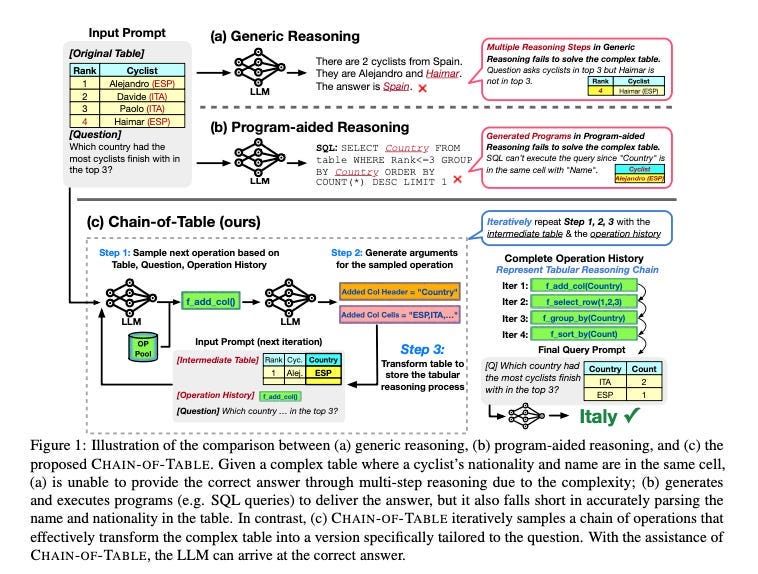

Essentially, this illustrates how the LLM tackles the challenge through a sequence of reasoning steps.
Curious to delve deeper into this method?
Watch Professor Mehdi explain the “chain-of-table” method in real-time in the video below!👇
Subscribe to Our YouTube Channel!
We are kicking off our YouTube channel in the new year, and we invite you on board as we walk you through some of these intricacies about AI, fueled by the feedback from our readers, friends and colleagues!
We want to make our channel about AI for everyone. Similar to this newsletter, we’ll talk about new AI products, the latest trends, the nitty-gritty engineering stuff, career insights for AI enthusiasts, and, of course, one of our favorite topics — the entrepreneurial side of AI — 🥳
we’re here to show you how you can ride the AI wave and be your own entrepreneur using the cool tools available in the market.
🛠️✨ Happy practicing and happy building! 🚀🌟

Thanks for reading our newsletter. You can follow us here: Angelina Linkedin or Twitter and Mehdi Linkedin or Twitter.
Source of images/quotes:
🔍 Paper: Chain-of-Table: Evolving Tables in the Reasoning Chain for Table Understanding https://arxiv.org/abs/2401.04398
🔨Implementation: LlamaPack: Chain-of-Table: Step-by-step table reasoning and operations for enhanced LLM tabular data understanding. https://llamahub.ai/l/llama_packs-tab...
📒Notebook: https://github.com/run-llama/llama-hu...
📚 Also if you’d like to learn more about RAG systems, check out our book on the RAG system:
📬 Don’t miss out on the latest updates — Subscribe to our newsletter:


