
Ch. 12: Black People Are Not A Monolith
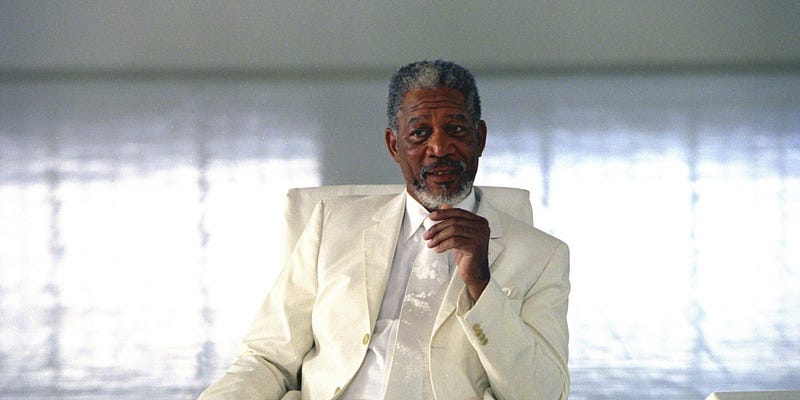
The most iconic voice in cinema teaches me a valuable lesson. (Just the voice, not the man)
Let’s review…
Let’s make an inventory of the crazy stuff that has been happening to me on the journey of writing this memoir.
Sam Jackson as Jules from Pulp Fiction appears to me as some angel/devil and tells me that I have to atone for my “black sins.” Viola Davis is the first confessional in the aforementioned series of black sins for which I’m atoning. There seems to be a pattern here.
But if Sam truly is the proverbial “devil” on my shoulder, then who I’m about to encounter must most definitely be the “angel.” A voice of reason with respect to this whole issue of addressing my blackness (or lack thereof).
But first, I need to set the stage for his arrival.
“I’ve listened to this nonsense quite a bit. This concept only serves to create a divide where none exists, provides some people with an excuse, and serves to silence dissenting viewpoints. And those who perpetuate it are little more than useful idiots for the extreme left.” ~ Yet Another Jackass on Facebook
“White people denying the existence of white privilege is kinda like a fish denying the existence of water.” ~ Me
A startling discovery
That first quote above from Mr. Jackass (again, not his real name, but more of a descriptor of his personality) was the inspiration for that second quote by me. It genuinely baffles my mind that people can be so dense about something which is blatantly obvious to so many other people.
I can appreciate that some white people who are ignorant of the privilege they have, are genuinely good people, so they feel needlessly attacked when that term is thrown on them. But they at least have open minds and soft hearts willing to listen and change.
And then you have Jackass, who wrote this to me after I shared a post giving examples of white privilege.
“Victimhood. Yay!”
Now, if he disagreed with my views on this issue, he could have easily just rolled his eyes and scrolled on down his feed. But no. He just had to throw in his two cents and invalidate everything I had written.
So, I call him on it, and he responds with the quote above, then continued:
How much actual racism have you been subjected to? Rather than engaging in racism yourself by blaming white men, maybe you should just live your life. I’ve found over the years that people tend to find what they’re looking for. If you look for racism everywhere, guess what, you’re going to find it. Or at the very least you’ll believe any injustice, insult, or boorish behavior is based on race…whether it is or not. Quit worrying about what other people think and live your life.There was a part of me that didn’t want to engage with or reply to this dude. I had been on that ride way too many times (remember our friend Dufus Asshole?) But, on the off chance others were reading who may have similar questions, I addressed his comments and each one of his questions.
We go back and forth in typical Facebook fashion. I offer a long, well-thought-out, vulnerable and passionate expression of what it’s like living in this country as a person of color. I remind him that I’m not creating a divide where none exists. It exists! The fact he doesn’t see it is, all together now, “privilege.”
I tell him about the importance of empathy. And most importantly I admit that even though I personally have never had a cross burned on my lawn, or been in a church that was bombed, that doesn’t mean I can’t empathize with those who have. The amount of overt racism I have nor haven’t experienced should have no bearing on whether or not I stand up for racial justice.
Lastly, I remind J.A. that me acknowledging his privilege is NOT the same as calling him a racist.

This issue of white privilege has its own meta element. Those white people who deny its existence, or call it nonsense, or bullshit, or an excuse, are by that very act participating in the thing they are so vehemently denying. How do you convince a fish who denies the existence of water that he is swimming in it if he refuses to believe it?
Or, could it be that squirmy little fellow knows full well it exists, but is afraid of contaminating it with the crap, scales, and activity of other fish and amphibians who dare to swim in his pond, or breathe his same water.
We had some more of the usual, unproductive back and forth. I said that what I’m telling him is apparently falling on deaf ears, then he accused me of the same. I promptly corrected his false equivalency with this analogy:
If you tell me my experiences are NOT real, and I disagree with you, that is NOT your words falling on deaf ears. That is a man passing another man who is being mugged, and while the guy being mugged is yelling for help, the passerby tells him, “Stop complaining. You’re not being mugged.”More back and forth. And then he said something that really struck me.
I love the interview with Morgan Freeman where he said we could eliminate racism if we’d quit talking about it all the time and if people would refer to him simply as a man instead of a black man.He’s referring to a 2005 interview on 60 Minutes with Mike Wallace. And I have to admit, I was taken aback when I read that. How could Morgan Freeman ever say such a thing? How could any African-American older than 50 (who isn’t Clarence Thomas or some right-wing political commentator sell-out) ever say such a thing? It seems like an infuriatingly stupid comment to make.
Why do you say that Ron?From out of nowhere I hear the unmistakable voice of Morgan Freeman.
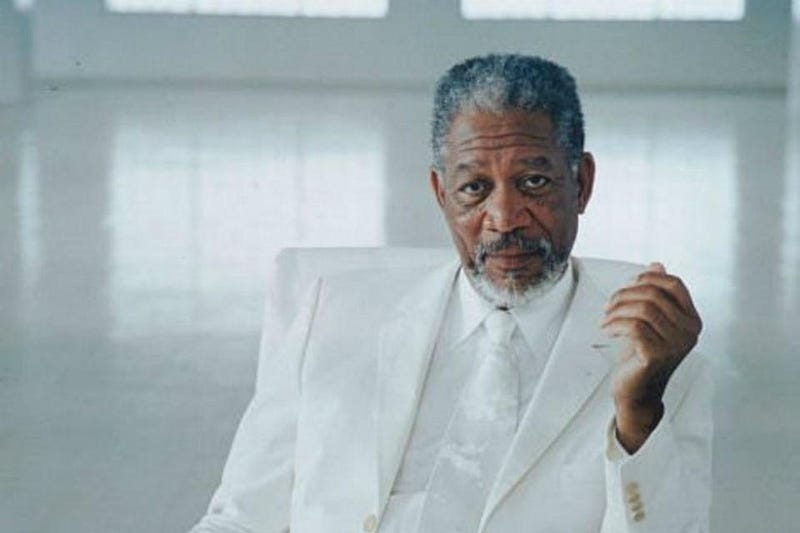
What the hell, or, er, heaven, is going on!
Easy Did It
Growing up as a kid in the early ’70s (especially as a kid who watched a lot of TV) there were a few shows that were must-see TV. Sesame Street (of course). 321 Contact. And the other was none other than The Electric Company.
I’m guessing many of you reading this will be old enough to have seen it (or at least would have seen old videos on YouTube). But on the off-chance you don’t know what I’m talking about, the Electric Company was a contemporary children’s show to Sesame Street. But it had a hip, ’60s, flower-child, hippy kinda vibe. And it was one of the earliest acting gigs for such stars as Bill Cosby, Rita Moreno, and the man whose voice was now echoing in my room — Morgan Freeman.
Morgan played a number of characters on the sketch education show — but perhaps his most famous was Easy Reader (Get it? Like “Easy Rider.”)
Easy was an afro-having, bell bottom-wearing, walking cliché of a ’70s, jive-talkin’ hippie. He was sorta like a reject from a Gordon Parks blaxploitation casting call. His whole gig was reading things: from menus to matchbooks to bottles—if it had words, Easy Reader would read it real coooooool.
He also played a number of roles in the Spider-Man skits they did on the Electric Company. (If you think the earliest TV incarnation of the wise-cracking web-slinger was that corny early ’80s cartoon, just Google “Electric Company Spider-Man”).
Then of course, after that, you have all the other film appearances of Morgan that have made him an indelible part of our collective consciousness. Without a doubt, two of my favorites are Red from Frank Darabont’s adaptation of “Shawshank Redemption” and Principal Joe Clark in “Lean On Me,” the 1989 film about the real-life principal that turned around the New Jersey inner-city school of East Side High.
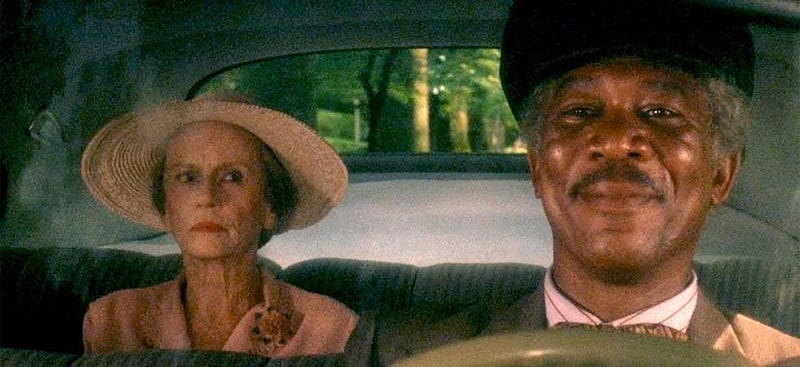
With all of these iconic and strong African-American characters (his “Driving Miss Daisy” character notwithstanding), I just couldn’t understand how such a comment would come out of his mouth.
But I Googled it, and there it was. The video interview with Mike Wallace where he not only said Black History Month was ridiculous (because “black history is American history”) but he said racism would end when we “stop talking about it.” Oh, why Morgan! WHY?!
Voice of Morgan Freeman: Son, don’t you think you’re being a little melodramatic?There again, was the voice of Morgan Freeman. Just his voice. Booming down from heaven.
Me: No. No I don’t think I’m being melodramatic. I am seriously at a loss for words.I must have looked like a crazy man talking to my ceiling.
Morgan replied.
Voice of Morgan Freeman: Why?
Me: Because, suggesting we don’t need black history month because Black History is American history, is just so, so…
VOMF: So what?
Me: I don’t know. Stupid? Ignorant? Naive? If African-American history was as an ingrained part of what is taught in school as white history, we wouldn’t need a black history month.
VOMF: And what is “white” history?
Me: C’mon, Voice of Morgan Freeman. You know what I mean. The history of people, events, and places in this country largely favors those topics as they pertain to white people.
VOMF: And it apparently upsets you that you didn’t learn more about black people?
Me: Well. It’s not that it’s a matter of upsetting me.
VOMF: Well obviously it has.
Me: No. What was upsetting was hearing you offer such a ridiculous sentiment. “Racism will end if we stop talking about it?” That comment right there is a classic case of the proverbial ostrich sticking its head in the sand.
VOMF: Tell me something son, how old are you?
Me: I’m old enough to know that racism won’t disappear by ignoring it.
VOMF: Okay. Fine. But humor me. How old are you?
Me: Five-oh. As in Hawaii.
VOMF: So, basically, you were in diapers when MLK was shot?
Me: Well, technically, he was shot almost exactly 6 months before I was born.
VOMF: That proves my point even more. Who do you think has a stronger leg to stand on when addressing the evils of racism? A “kid” like you? Or someone who was in the prime of his life, early 30s, living in the thick of the American Civil Rights era.
Me: Well, I obviously…
VOMF: That’s right. You obviously have neither the experience, wisdom, nor right to tell any man or woman from that era what they can or can’t say about what they lived and breathed every day while you were sitting and sleepin’ in your own crap and piss.
If I didn’t know any better, I would say Morgan is channeling his role as Joe, the principal character from “Lean on Me.” I kinda wish I got the “Driving Miss Daisy” Morgan Freeman.
Me: So no part of you sees that statement as problematic?
VOMF: That interview was nearly 15 years ago. How much research have you done since then? People’s minds change, circumstances change, beliefs evolve. Imagine if you were to be held accountable for some of the things you did or said 10, 15, or 20 years ago? Can you tell me you have a great leg to stand on when it comes to your outlook on race relations? If you were in some court of law where you had to prove your blackness, and we were to peel back the curtain and reveal the history of a one Ron Dawson, you mean to tell me you could win an award for “Most down brutha of the century”?
Considering my experience with Samuel L. Jackson, I think it’s safe to say that the Voice of Morgan Freeman “has laid my shit bare.” And he’s right. I don’t have shit to say to him, or any person. Given my shameful history, I am probably the last person to be holding any black person in judgment for their past deeds. Least of which, the Voice of Morgan Freeman.
Me: I see your point. And it makes sense. It does. I shouldn’t have come at you sideways like that. I’m sorry.
VOMF: Apology accepted.
Me: But can you at least tell me how you feel now? Is that a belief you still have?
VOMF: Let’s just say that in life, not everything is black and white. Some things aren’t always as they seem. And rather than trying to determine where you think mine or anybody else’s beliefs stand, I think you have a lot more soul-searching of your own to do. And when the time is right, I promise you’ll understand, and you’ll realize you won’t even need to ask me that question.
Me: Okay. If you say so.
VOMF: In the meantime, I’ll be around and I’ll drop in every now and then to see how you’re progressing.
Me: Sort of like your God character in “Bruce Almighty.”
VOMF: No, son. Not like that at all. This isn’t a movie. It’s a book. I’ll be seeing you.
Me: I’ll be seeing you too. Or rather, hearing you.
And with that, the Voice of Morgan Freeman was gone.
In the immortal words of Alice, this shit is getting “Curiouser, and curiouser.”
Be sure to follow this publication to be notified when the next chapter goes online. Visit Dungeons-n-Durags.com to learn more about the book and ways in which you can get early access to future chapters, and insights into the writing.
Next chapter
Previous chapter