Losing Friends Over George Floyd — and Now, Jacob Blake
From Instagram Stories featuring unmasked boat parties to grids with black boxes — but no action — Black Americans are developing a clear understanding of who their friends are
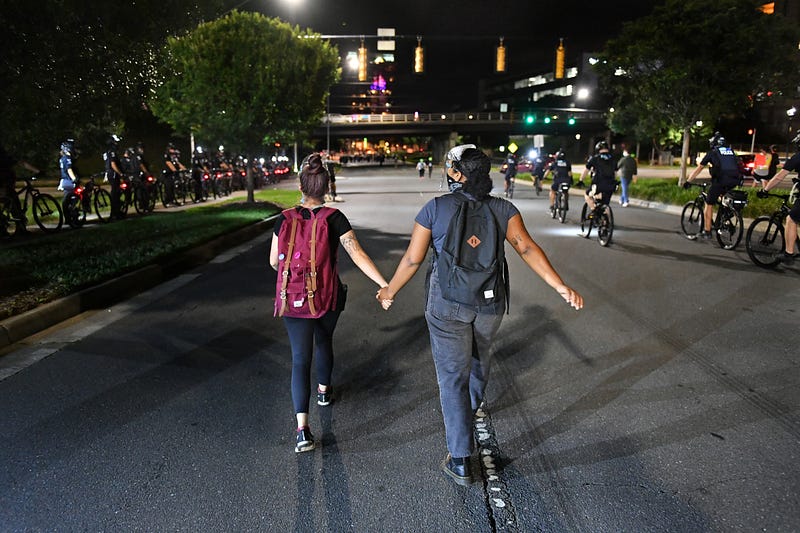
A week after George Floyd’s death, I took it upon myself to call out my closest White friends who had yet to say anything publicly about the tragedy. By this time in late May, my favorite French band Ofenbach had posted a GoFundMe link for the Floyd family, and Timothée Chalamet was spotted at protests in California. While I’m not impressed by White people deciding to take action in the fight for social justice, I was disturbed by my White friends doing little to nothing, especially since celebrities who never displayed their views before started to showcase them so openly.
Most of my friends just needed a push and to be made aware of how their lack of support and concern made me feel. But others gave me pushback, and I quickly forgot them. It had never been so clear to me that many I once viewed as progressive and caring were complacent and unbothered, causing me to reassess my friendships and romantic interests.
I’m not alone: The death of Floyd and the Black Lives Matter movement’s resurgence have provided a new sense of clarity to the Black community about our social circles. Black people have found themselves having tough conversations about advocacy and activism, and gaining new insight into how their friends, peers, and co-workers view their community’s well-being.
Braedon Montgomery, a 25-year-old stylist in Dallas, Texas, told his White friends he didn’t want to talk to them about George Floyd. He was overwhelmed by Floyd’s brutal death and the protests that followed; he wanted space to process everything.
Several friends responded to his request with resentment, and one outright ignored it. This friend attended a protest and insisted on talking to Montgomery about the experience, which was new for him, but not for Montgomery.
“I’m telling him, as a Black person, this is triggering for me,” Montgomery said. “This is a lot for me. I don’t want to talk to you about this. And then it turned into, ‘Well, you’re racist because you don’t want to talk to me because I’m White and I’m out here fighting for you.’”
So Montgomery did something he’s done several times since the 2016 presidential election: He cut ties with the friend.
We have a romantic view of friendship that it can withstand all things, and that “politics” shouldn’t get in the way of a long-term friendship.
“I’ve cut off so many people from high school onward who weren’t in support of movements like Black Lives Matter that, this time around, it was easy,” he said.
As Montgomery recognized, it is valid for Black people to believe that they do not owe their friends, co-workers, and peers anything when it comes to education about race. With resources available online, hundreds of documentaries and films that focus on the Black experience, and lists of books by Black authors populating social media feeds, it is effortless to self-educate.
But, as friends often do, many Black people initially take this form of educating upon themselves with hopes that their ignorant friend will be receptive. Unfortunately, those conversations are not always well received. Cutting off these friendships is understandable and necessary. We have a romantic view of friendship that it can withstand all things, and that “politics” shouldn’t get in the way of a long-term friendship. But racial justice isn’t political — it’s human. And friendship rests on a shared respect of the other’s humanity.
Caroline Joyner, 27, is an account executive in Brooklyn, New York, who grew up in a mostly White town in Massachusetts. Her college was also predominantly White, resulting in a largely White friend group from childhood throughout adulthood. Still, as a biracial Black woman, Joyner has always been openly passionate about social justice. She believed her friends felt the same way since they never had a problem with her speaking up before.
Yet she describes this period of reckoning as feeling different.
“I started to realize that the closer I am to Whiteness, and the more I erase my Blackness, and the quieter I am about these things, the more accepted I am by those communities at large,” she said.
When Joyner reached out to her extended community for support, she was surprised to encounter people trying to rationalize incidents like Floyd’s death and Amy Cooper’s phony cop call.
“I started to feel disconnected from a lot of people. I didn’t feel like I had community in the same way as I believed I did before,” Joyner said.
Frustrated by the lack of understanding and support, Joyner started to use social media to post stories about injustices happening in the Black community and share ways to get involved. But she was disappointed again when she noticed most of the people in her circle did not jump on board.
“A lot of my friends just posted a black square and then didn’t post anything or do anything to begin with, and are continuing on with their lives,” she said.
Since she started using her platform to talk about racial justice, Joyner has noticed she’s been unfollowed by a lot of people who she thought she was close with. Other friends have accused her of being too harsh.
Joyner hasn’t entirely cut off a close friend, but she’s had serious conversations that would have damaged relationships if the feedback hadn’t been received well. When it comes to acquaintances and people in her wider social circle, she is quicker to drop friendships now.
“If you’re saying you care but not really doing anything or actually being open to reflecting on the way that you live, then there’s really no point in us being friends,” she said.
Shasta Nelson, a friendship expert based in New York City, defines a healthy relationship as one where both people feel seen safely and satisfyingly.
According to Nelson, people can bond with those who hold different beliefs and whose lifestyles are completely opposite. But if those beliefs are leading to not feeling seen in a safe and satisfying way, damage will occur.
Black Lives Matter and other social justice issues, she said, are “not even a political thing. It’s actually somebody’s identity in a deeper way than even a political standing, and that’s where we are seeing so many relationships being frayed.”
One 27-year-old New Yorker felt the same way when it came to deciding whether to cut off her dad. Sarah*, who is White, and her dad always disagreed on race and politics, but it wasn’t until the racial revolution during the pandemic that she realized her arguments with him were a lost cause.
“Here’s someone who treats Black people, Latinx people, and queer people differently — I wouldn’t tolerate this from anyone else, so why does my dad get a pass? When the fear, hatred, self-centeredness, and misinformation is so deep-seated, it seems like there’s no hope for education or him to see past his own experience and put himself in someone else’s shoes, so I decided to cut it off,” she said.
Like Sarah, I’ve had to come to terms with letting go of people who once held important roles in my life. The realization that some of the men I’ve dated and friends I spent weekends traveling with are not nearly as progressive as I imagined is not only upsetting but startling. It proves that my vetting skills need improvement; evaluating friends based on whether they are supportive of racial justice efforts is crucial in maintaining healthy, authentic relationships. The only silver lining I can recognize during this movement is the lucid view it created in social circles that were merely surviving off trivial similarities — and thankfully, I’ve learned how to avoid these relationships in the future.
*Name changed to protect anonymity