avatarPrateek Dasgupta

Free AI web copilot to create summaries, insights and extended knowledge, download it at here

6428

Abstract

ie <b><i>Mulan</i></b>, you may be familiar with this conflict. The story of <a href="http://afe.easia.columbia.edu/ps/china/mulan.pdf">Mulan was inspired by a poem written in the early fifth century</a> about the conflict between the Rourans and the Wei.</p><p id="2a09">Rourans controlled the lucrative Silk Road trade. They hired the Göktürks to make weapons and armor for their army. But the Turks were also talented warriors.</p><p id="ae4f">Legend has it that<a href="https://en.wikipedia.org/wiki/Bumin_Qaghan"> <b>Bumin</b></a>, head of the <a href="https://en.wikipedia.org/wiki/Ashina_tribe">Göktürk <b>Ashina clan</b></a>, put down a rebellion for the Rouran Khagan. Bumin then asked for the princess's hand in marriage. The Rouran chief laughed at the request and rejected it, claiming that a woman of noble birth would never marry a blacksmith slave.</p><p id="f8d6">Insulted and humiliated, Bumin led a revolt against the Rourans in 551. He routed the Rourans, captured their capital, and declared himself Khagan at <a href="https://en.wikipedia.org/wiki/Otuken">the new capital, <b>Otuken</b></a>.</p><p id="5c97">The Göktürks spread west and east, raiding rich Silk Road frontier towns in Central Asia and China. <a href="https://en.wikipedia.org/wiki/Istämi"><b>Istami</b>, Bumin’s brother</a>, ruled the empire’s western half. Istami was the <b>Yabgu</b>, an official title for a semi-autonomous ruler who swore allegiance to the Khagan. The primary seat of power remained in the empire’s eastern half, which was based in modern-day Mongolia.</p><p id="aed2">Bumin died in 552, a year after establishing the Göktürk Khaganate. His son <b>Issik</b> succeeded him. Issik’s reign didn’t last long as he died within three months of ascending the throne. Bumin’s second son, <b>Muhan</b>, assumed power, ushering in a new era for the Turkic people.</p><h1 id="9e30">Expansion: War, diplomacy, and trade</h1><figure id="b4c5"><img src="https://cdn-images-1.readmedium.com/v2/resize:fit:800/1*7NKF6c9Cp-mDSMFT3rcmgw.jpeg"><figcaption>Sogdian noble Anjia (right) brokering a deal with a Turkic aristocrat (left). Image source: <a href="https://en.wikipedia.org/wiki/First_Turkic_Khaganate#/media/File:An_Jia_brokering_an_alliance_with_Turks._Shaanxi_Provincial_Institute_of_Archaeology,_Xi’an.jpg">Wikimedia Commons</a></figcaption></figure><p id="b9ec">The two realms of the Turkic Khaganate, east, and west, provided a unique opportunity for Muhan and Istami. Uncle and nephew could go in different directions and target wealthy empires in the Middle East, Central Asia, and northern China without relying on each other for orders. The fluid command structure helped in the rapid expansion of the Göktürks.</p><p id="6930">Muhan conquered the nomadic kingdom of the Khitans in the east and the Kyrgyz people (after whom the country of Kyrgyzstan is named) in the south. Muhan’s conquests are poorly documented beyond this point. We have a better understanding of Istami’s exploits because his forces came into contact with Persians and Romans (Byzantine), who were better at recording historical events.</p><p id="5ae7">Initially, Istami allied with the Sassanid Persians to conquer the <a href="https://historyofyesterday.com/3-lesser-known-empires-which-were-larger-than-alexanders-41fca4a7e29e"><b>Hephthalite Huns</b>, better known as the White Huns</a>. Göktürks held a grudge against the Hephthalites because they shielded the Rouran nobles fleeing the Turkic empire. The Hephthalites engaged in a long war with the Persians subjugating the Sassanids, and even executing a Persian emperor.</p><p id="a594">Hence, the Sassanids welcomed an alliance with the Göktürks. A joint <a href="https://en.wikipedia.org/wiki/Hephthalites#Western_Turk_takeover_(625_CE)">Persian and Göktürk army routed the Hephthalites</a>. The Göktürks gained greater control of the lucrative Silk Road trade by <a href="https://en.wikipedia.org/wiki/Hephthalites#Western_Turk_takeover_(625_CE)">absorbing the Hephthalite networks</a>.</p><p id="87e4">Despite the initial alliance with the Persians, things soon turned sour. Persians didn’t allow the Göktürk envoys to sell silk in the Sassanid empire. The next fifty years saw repeated conflicts between the Persians and the Turks, with victories on both sides but no significant shifts in territorial boundaries. The wars with the Persians didn’t prevent the Turks from gaining wealth through trade and finding new allies.</p><figure id="b801"><img src="https://cdn-images-1.readmedium.com/v2/resize:fit:800/1*PRdu44EjBZiy4LxNigLpJQ.jpeg"><figcaption>Illustration from Shahnameh depicting a conflict between Persians and Turks. Image source: <a href="https://en.wikipedia.org/wiki/First_Turkic_Khaganate#/media/File:The_Battle_between_Bahram_Chubina_and_Sava_Shah_LACMA_M.2009.44.1_(3_of_9).jpg">Wikimedia Commons.</a></figcaption></figure><p id="739a"><b>Maniah</b>, a Sogdian diplomat, convinced Istami to bypass the Persians and sell the silk directly to the Romans, who were the largest buyers of silk products in the world. In 568, <a href="https://en.wikipedia.org/wiki/Justin_II#Foreign_policy"><b>Justin II</b>, the Roman Emperor, received a Göktürk delegation</a> at Constantinople. The next year, the Turks warmly welcomed a Roman envoy. The Romans and the Turks formed a military, commercial, and diplomatic alliance. During their conflicts with the Persians, the alliance proved beneficial to both the Turks and Romans.</p><p id="bbb4"><a href="https://en.wikipedia.org/wiki/Sogdians">Sogdian merchants</a> played a key role in helping the Göktürks become a commercial power. Diplomatically adept, the Sogdians also aided the Turks in creating the Old Turkic alphabet, the foundation of the Turkic writing system. The script was monumental because it resulted in nomadic people in the Steppes writing their history for the first time.</p><p id="b5e4">In the east, after Muhan died in 572, his brother <b>Taghpar</b> took over as Khagan. Once a devout follower of the ancient <a href="https://en.wikipedia.org/wiki/Tengrism">Turkic religion of Tengrism</a>, Taghpar changed his ways and became a Buddhist. He began an ambitious project to construct monasteries and study centers throughout the realm. Taghpar sponsored the Sogdian and Turkic translations of Buddhist canonical works.</p><p id="84df">Following the death of Taghpar, the Khaganate split into two independent ki

Options

ngdoms. The eastern Turkic Khaganate saw an opportunity to raid China. China was in anarchy in the early 7th century. According to Chinese sources, the Turks launched 67 attacks during the transition period from the Sui dynasty to Tang rule.</p><p id="00f7">The Chinese would soon find a way to settle scores with the Turks. They would pit one nomadic group against the other, and the once-mighty Turkic Khaganate crumbled.</p><h1 id="f6e1">Decline and legacy</h1><figure id="c4f5"><img src="https://cdn-images-1.readmedium.com/v2/resize:fit:800/1*jeW4V_ZXPdI7pB_QRlbcSw.jpeg"><figcaption>The Orkhon inscription, the first recorded history of the Turkic people, Orkhan museum, Mongolia. Image source: <a href="https://en.wikipedia.org/wiki/Orkhon_inscriptions#/media/File:Kultigin_Monument_of_Orkhon_Inscriptions.jpeg">Wikimedia Commons.</a></figcaption></figure><p id="6bf5">Before we get into how the Chinese sowed discord among the Turks, it’s important to understand why they could do so. After Taghpar died, his son <b>Apa</b> was supposed to be the Khagan. <b>Nivar</b>, Taghpar’s brother, usurped the throne.</p><p id="6e35">Apa asked <b>Tardu</b> the Yabgu from the west for help to get rid of Nivar. Nivar routed Apa and Tardu’s combined army. But Apa would not give up on his dream of ruling an empire. He betrayed Tardu and took over the Western Turkic Khaganate, dividing the first Turkic empire into independently ruled east and west.</p><p id="1861">The schism in the Khaganate did not mark the end of Turkic rule over Central Asia, but they were weaker than before. The Turks took advantage of the chaos in China to launch raids inside the country.</p><p id="135d">In 626 <a href="https://en.wikipedia.org/wiki/Illig_Qaghan"><b>Illig Khan</b>, the Khagan of the Turks</a> marched onto the Chinese capital Chang’an, forcing the Tang ruler to accept a peace treaty. <a href="https://en.wikipedia.org/wiki/Emperor_Taizong_of_Tang"><b>Taizong</b>, who ruled the Tang Dynasty</a>, is one of the most famous rulers in Chinese history, and he wouldn’t forget the humiliation at the hands of the Turks.</p><p id="3984">The Chinese had centuries of experience fighting nomadic warriors, whom they called barbarians. The Tangs bribed one of the Eastern Turkic Khaganate’s vassals to revolt against the Khagan. This rebellion was enough to destabilize the Turkic realm.</p><p id="67c0">Taking advantage of the revolt, the Tangs crushed the Göktürks at the <a href="https://en.wikipedia.org/wiki/Battle_of_Yinshan"><b>Battle of Yinshan</b> in 630</a>. Illig Khan was captured and taken as a prisoner. China absorbed the eastern half of the Turkic Khaganate.</p><p id="fa91">Chinese records mention the tribe who revolted against the Turks as <b>Huihe</b>. Today we know them as <b>Uighurs</b>.</p><p id="0a35"><a href="https://en.wikipedia.org/wiki/Tang_campaigns_against_the_Western_Turks">In 657, the Tangs also conquered the Western Turkic Khaganate</a>. The Turks recognized Emperor Taizong as Khagan of Heaven, making him the first Chinese emperor to achieve such a title.</p><p id="e878">There was a brief resurgence of the Göktürks who defeated the Tang and formed the <b>Second Turkic Khaganate</b> in 682. It lasted until 744 when the increasingly assertive Uighurs toppled the Göktürks and established the <b>Uighur Khaganate</b>.</p><figure id="bc0e"><img src="https://cdn-images-1.readmedium.com/v2/resize:fit:800/1*-j1eXylpE-Qf60Fixa2gbw.png"><figcaption>Pontic Steppes in 1015, showing the successor states of the Göktürks such as Oghuz, Khazar, Pecheneg, Kipchak, Ghaznavids, and Karakhanids. Image source: <a href="https://en.wikipedia.org/wiki/List_of_Turkic_dynasties_and_countries#/media/File:Khazarfall1.png">Wikimedia Commons.</a></figcaption></figure><p id="9ecf">The Göktürks ruled a vast territory and controlled a profitable trade route for almost 200 years. Their legacy, however, lasted well into the modern era. After the breakup of the Turkic Khaganate, various Turkic tribes emerging from this realm shaped the politics of Europe, Asia, and North Africa until the 20th century.</p><p id="b539">The successors of the Turkic Khaganate, the Ghaznavids, Kara-Khitans, Uighurs, Khazars, Seljuks, and Ottomans played an important role in world politics from the middle ages till the modern era.</p><p id="39a7">Today, there are over 200 million speakers of Turkic languages all over the world, and they can trace their origins to a band of blacksmiths living in the foothills of the Altai mountains.</p><p id="1660">Empires of the Steppes receive little attention from historians. But with new archaeological evidence, there is an increasing interest in knowing about mighty nomadic warriors who left few written records.</p><p id="2cba">Among the empires of the Eurasian Steppes were the rivals of the Göktürks, the Hephthalites. The Hephthalites defeated both India and Persia, forming a gigantic empire.</p><p id="f250">Interested to know more? Check out the story below.</p><div id="2476" class="link-block"> <a href="https://historyofyesterday.com/3-lesser-known-empires-which-were-larger-than-alexanders-41fca4a7e29e"> <div> <div> <h2>3 Lesser Known Empires Which Were Larger Than Alexander’s</h2> <div><h3>They were not built by the Romans, Persians, Mongols or Chinese.</h3></div> <div><p>historyofyesterday.com</p></div> </div> <div> <div style="background-image: url(https://miro.readmedium.com/v2/resize:fit:320/1*cumUilXToBcJGo9tCVBWhw.jpeg)"></div> </div> </div> </a> </div><p id="a3a0"><i>Enjoy this? <a href="https://prateekdasgupta1.medium.com/subscribe">Subscribe to my posts </a>and never miss the best tales from the past. Not a Medium member? Unlock complete access to thousands of stories by <a href="https://prateekdasgupta1.medium.com/membership">joining Medium today using this referral link</a>!</i></p><h1 id="9aec">Sources</h1><ul><li>History of Civilizations of Central Asia(1999), Vol II, UNESCO Publishing.</li><li>History of Civilizations of Central Asia (1999), Vol III, UNESCO Publishing.</li><li>Beckwith, Christopher I. (2009): <i>Empires of the Silk Road: A History of Central Eurasia from the Bronze Age to the Present</i>. Princeton, NJ: Princeton University Press.</li></ul></article></body>

Centuries Before the Ottomans, Turks Built the World’s Largest Empire

The Göktürks forged the world’s first and largest Turkic empire
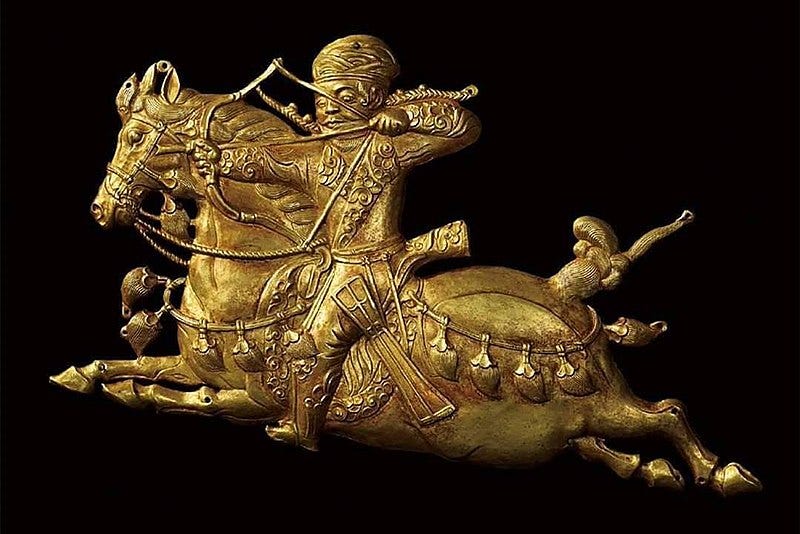
Göktürk warrior, 6th or 7th century. Image source: Wikimedia Commons

When you think of a powerful Turkic empire, what comes to mind? The most common answer is the Ottoman empire, a long-time rival of the Europeans for control of the Middle East, Balkans, and the Mediterranean Sea. During the Crusades, the Seljuks were another major Turkic power seen as the defenders of Islam and the nemesis of Christendom.

But long before the Ottomans and Seljuks, a group of blacksmiths in the Eurasian steppes forged the world’s first and the largest Turkic empire. They were the Göktürks (Romanized from Kök Türük meaning celestial or blue Turks).

The First Turkic Khaganate (a Turkic term for empires of the Steppes) stretched from Siberia in the East to the shores of the Black Sea in the West. It was the largest empire in the world in the 6th century.

The Göktürks were the first to use the term “Turk” to refer to a specific cultural, linguistic, and political group. They set the stage for the rise of the later Turkic powers such as the Uighurs, Kara-Khitans, Khazars, Ghaznavids, Seljuks, and Ottomans who ruled different parts of Asia, Europe, and Africa, dominating world politics from the middle ages to modern times.

Who were the Göktürks? How did they become an important political player in Eurasia? To know more let us start off with a legendary tale of their origins.

The wolf’s children

Photo by Jan Kopřiva on Unsplash

The Göktürks, like most nomadic empires of antiquity, did not leave any written records about where they came from. In the 8th century, they were the first warriors of the Steppes to write their stories in the Orkhon inscriptions. But the recording was almost 200 years after they first appeared as a political force.

A lack of writing tradition didn’t stop the Göktürks from passing down their creation stories orally. There are three myths describing the origins of the Turks in Chinese literature. We will discuss the most popular one: the abandoned child brought up by a wolf.

The legend tells of a young boy who was brutally attacked by enemies and left for dead in a swamp. The child was rescued and nursed back to health by a she-wolf.

Doesn’t that sound familiar? Romulus and Remus and the birth of Rome, anyone?

But here’s where the story differs. The boy and the she-wolf seek refuge in a cavern. After a few years, the boy, now a young man, impregnates the wolf. They have ten half-human half-wolf boys. Several generations later, the first Turks arrive on the scene, descended from the half-human half-wolf men. They become the blacksmiths of the Rourans.
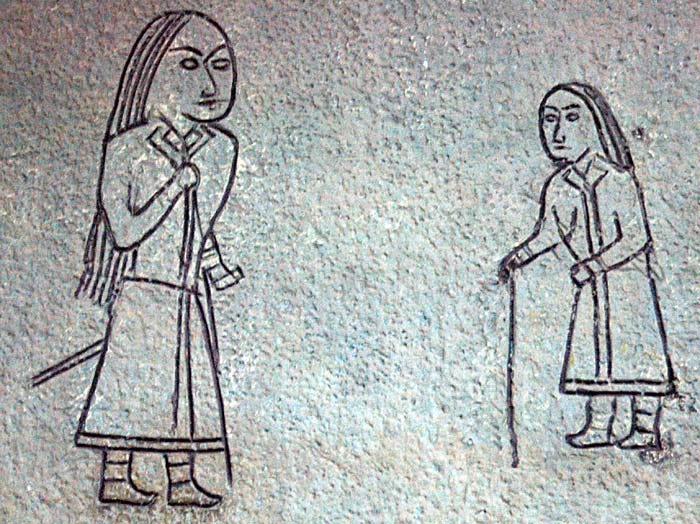
Göktürk petroglyphs from Mongolia, 6th-8th century. Image source: Wikimedia Commons

I will explain in a moment who were the Rourans. First, let us analyze the legend. The story reads like a traditional creation myth, but there is sound evidence to suggest the tale was metaphorical.

We have proof that the early Turks were blacksmiths, famous for their metalworking skills, who lived near the Altai mountains in Central Asia. They produced high-quality weapons and armor that were sought after by armies across Asia. The cavern in which the young boy and the wolf sought refuge could be a metaphor for a mine.

The legend also tells us the importance of the wolf in Turkic mythology. A myth involving the wolf is a common theme in many cultures originating in the Steppes of Eurasia, such as the Indo-Europeans and the Mongols. According to traditional Turkic beliefs, their ancestors were wolves.

Skilled people always find royal patronage, and the early Turks were no exception. The Rouran Khaganate employed them. Who were the Rourans and why are they relevant to our story?

The rise of the first Turkic Khaganate
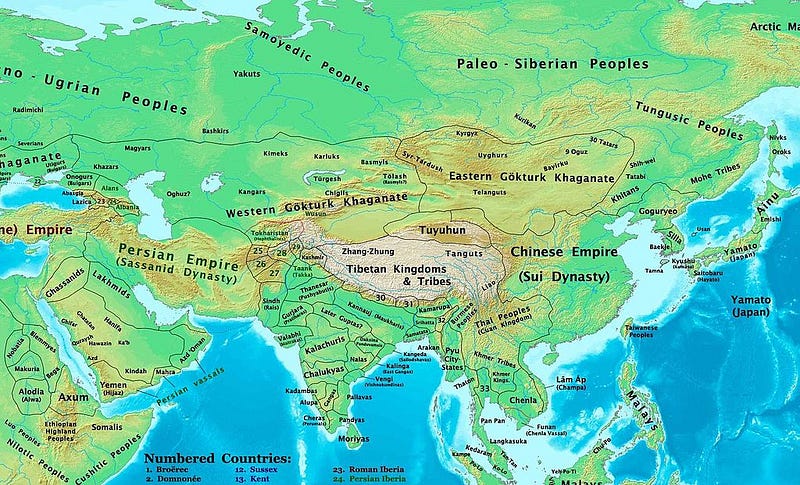
Map of the Turkic Khaganate, showing the regions under the eastern and western halves of the empire around 600 AD. Image source: Wikimedia Commons.

The Rouran, also called Juan-Juan or Avar Khaganate, were ancestors of the Mongols. The Rourans lived in Mongolia and Northern China. They were the first nomadic group to use the term Khagan (pronounced Kha’an) to refer to an emperor. You may recognize the term Khagan from the Mongol rulers such as Genghis Khan.

In the fourth century, the Rourans and the Northern Wei dynasty, who ruled much of northern China, locked horns in a legendary war. If you’ve seen the Disney movie Mulan, you may be familiar with this conflict. The story of Mulan was inspired by a poem written in the early fifth century about the conflict between the Rourans and the Wei.

Rourans controlled the lucrative Silk Road trade. They hired the Göktürks to make weapons and armor for their army. But the Turks were also talented warriors.

Legend has it that Bumin, head of the Göktürk Ashina clan, put down a rebellion for the Rouran Khagan. Bumin then asked for the princess's hand in marriage. The Rouran chief laughed at the request and rejected it, claiming that a woman of noble birth would never marry a blacksmith slave.

Insulted and humiliated, Bumin led a revolt against the Rourans in 551. He routed the Rourans, captured their capital, and declared himself Khagan at the new capital, Otuken.

The Göktürks spread west and east, raiding rich Silk Road frontier towns in Central Asia and China. Istami, Bumin’s brother, ruled the empire’s western half. Istami was the Yabgu, an official title for a semi-autonomous ruler who swore allegiance to the Khagan. The primary seat of power remained in the empire’s eastern half, which was based in modern-day Mongolia.

Bumin died in 552, a year after establishing the Göktürk Khaganate. His son Issik succeeded him. Issik’s reign didn’t last long as he died within three months of ascending the throne. Bumin’s second son, Muhan, assumed power, ushering in a new era for the Turkic people.

Expansion: War, diplomacy, and trade
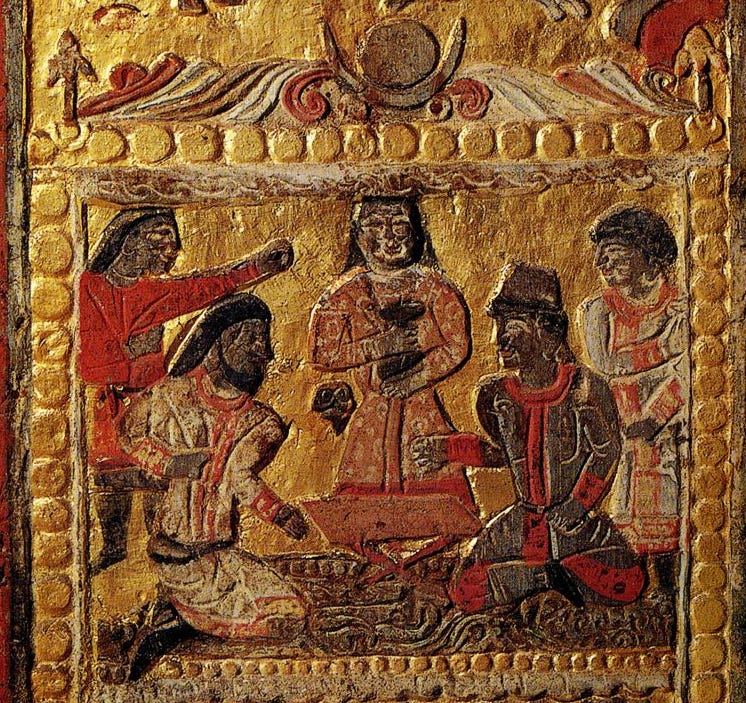
Sogdian noble Anjia (right) brokering a deal with a Turkic aristocrat (left). Image source: Wikimedia Commons

The two realms of the Turkic Khaganate, east, and west, provided a unique opportunity for Muhan and Istami. Uncle and nephew could go in different directions and target wealthy empires in the Middle East, Central Asia, and northern China without relying on each other for orders. The fluid command structure helped in the rapid expansion of the Göktürks.

Muhan conquered the nomadic kingdom of the Khitans in the east and the Kyrgyz people (after whom the country of Kyrgyzstan is named) in the south. Muhan’s conquests are poorly documented beyond this point. We have a better understanding of Istami’s exploits because his forces came into contact with Persians and Romans (Byzantine), who were better at recording historical events.

Initially, Istami allied with the Sassanid Persians to conquer the Hephthalite Huns, better known as the White Huns. Göktürks held a grudge against the Hephthalites because they shielded the Rouran nobles fleeing the Turkic empire. The Hephthalites engaged in a long war with the Persians subjugating the Sassanids, and even executing a Persian emperor.

Hence, the Sassanids welcomed an alliance with the Göktürks. A joint Persian and Göktürk army routed the Hephthalites. The Göktürks gained greater control of the lucrative Silk Road trade by absorbing the Hephthalite networks.

Despite the initial alliance with the Persians, things soon turned sour. Persians didn’t allow the Göktürk envoys to sell silk in the Sassanid empire. The next fifty years saw repeated conflicts between the Persians and the Turks, with victories on both sides but no significant shifts in territorial boundaries. The wars with the Persians didn’t prevent the Turks from gaining wealth through trade and finding new allies.
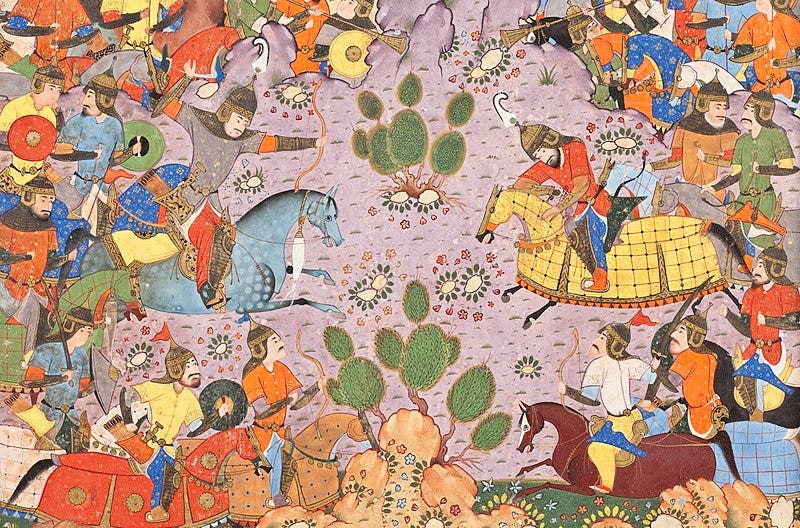
Illustration from Shahnameh depicting a conflict between Persians and Turks. Image source: Wikimedia Commons.

Maniah, a Sogdian diplomat, convinced Istami to bypass the Persians and sell the silk directly to the Romans, who were the largest buyers of silk products in the world. In 568, Justin II, the Roman Emperor, received a Göktürk delegation at Constantinople. The next year, the Turks warmly welcomed a Roman envoy. The Romans and the Turks formed a military, commercial, and diplomatic alliance. During their conflicts with the Persians, the alliance proved beneficial to both the Turks and Romans.

Sogdian merchants played a key role in helping the Göktürks become a commercial power. Diplomatically adept, the Sogdians also aided the Turks in creating the Old Turkic alphabet, the foundation of the Turkic writing system. The script was monumental because it resulted in nomadic people in the Steppes writing their history for the first time.

In the east, after Muhan died in 572, his brother Taghpar took over as Khagan. Once a devout follower of the ancient Turkic religion of Tengrism, Taghpar changed his ways and became a Buddhist. He began an ambitious project to construct monasteries and study centers throughout the realm. Taghpar sponsored the Sogdian and Turkic translations of Buddhist canonical works.

Following the death of Taghpar, the Khaganate split into two independent kingdoms. The eastern Turkic Khaganate saw an opportunity to raid China. China was in anarchy in the early 7th century. According to Chinese sources, the Turks launched 67 attacks during the transition period from the Sui dynasty to Tang rule.

The Chinese would soon find a way to settle scores with the Turks. They would pit one nomadic group against the other, and the once-mighty Turkic Khaganate crumbled.

Decline and legacy
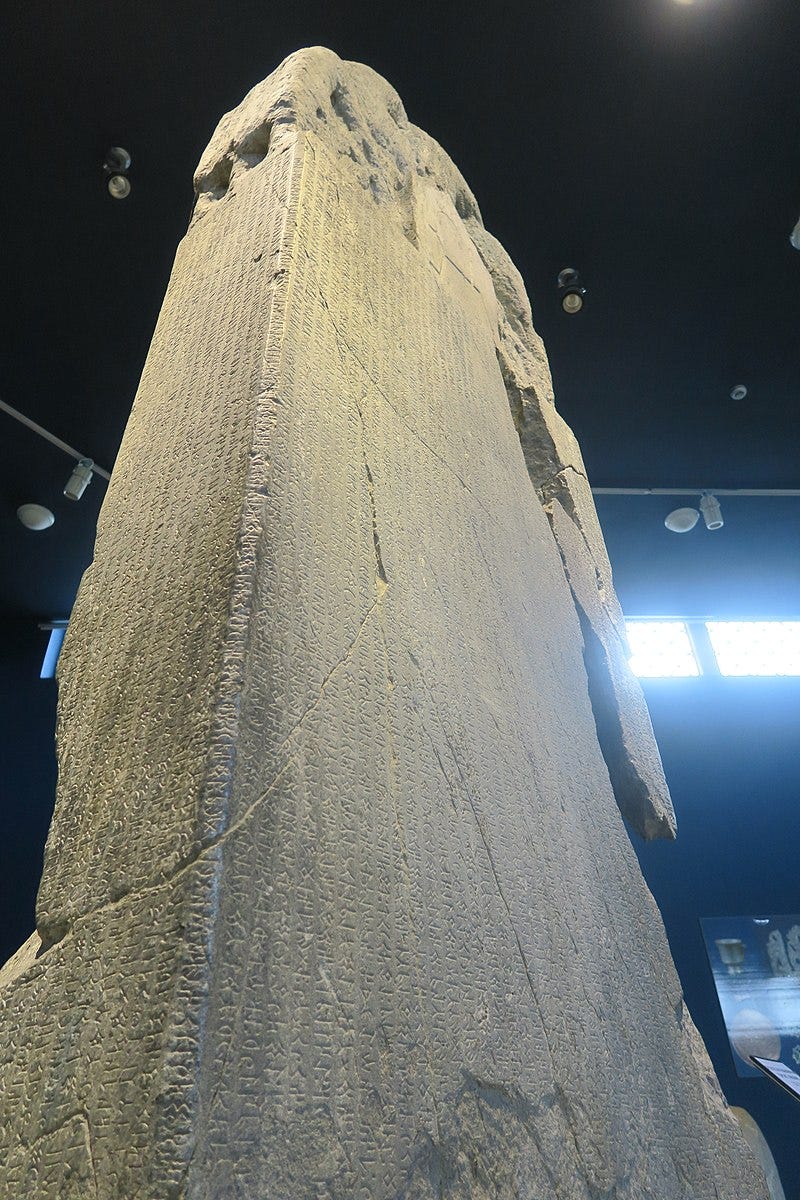
The Orkhon inscription, the first recorded history of the Turkic people, Orkhan museum, Mongolia. Image source: Wikimedia Commons.

Before we get into how the Chinese sowed discord among the Turks, it’s important to understand why they could do so. After Taghpar died, his son Apa was supposed to be the Khagan. Nivar, Taghpar’s brother, usurped the throne.

Apa asked Tardu the Yabgu from the west for help to get rid of Nivar. Nivar routed Apa and Tardu’s combined army. But Apa would not give up on his dream of ruling an empire. He betrayed Tardu and took over the Western Turkic Khaganate, dividing the first Turkic empire into independently ruled east and west.

The schism in the Khaganate did not mark the end of Turkic rule over Central Asia, but they were weaker than before. The Turks took advantage of the chaos in China to launch raids inside the country.

In 626 Illig Khan, the Khagan of the Turks marched onto the Chinese capital Chang’an, forcing the Tang ruler to accept a peace treaty. Taizong, who ruled the Tang Dynasty, is one of the most famous rulers in Chinese history, and he wouldn’t forget the humiliation at the hands of the Turks.

The Chinese had centuries of experience fighting nomadic warriors, whom they called barbarians. The Tangs bribed one of the Eastern Turkic Khaganate’s vassals to revolt against the Khagan. This rebellion was enough to destabilize the Turkic realm.

Taking advantage of the revolt, the Tangs crushed the Göktürks at the Battle of Yinshan in 630. Illig Khan was captured and taken as a prisoner. China absorbed the eastern half of the Turkic Khaganate.

Chinese records mention the tribe who revolted against the Turks as Huihe. Today we know them as Uighurs.

In 657, the Tangs also conquered the Western Turkic Khaganate. The Turks recognized Emperor Taizong as Khagan of Heaven, making him the first Chinese emperor to achieve such a title.

There was a brief resurgence of the Göktürks who defeated the Tang and formed the Second Turkic Khaganate in 682. It lasted until 744 when the increasingly assertive Uighurs toppled the Göktürks and established the Uighur Khaganate.

Pontic Steppes in 1015, showing the successor states of the Göktürks such as Oghuz, Khazar, Pecheneg, Kipchak, Ghaznavids, and Karakhanids. Image source: Wikimedia Commons.

The Göktürks ruled a vast territory and controlled a profitable trade route for almost 200 years. Their legacy, however, lasted well into the modern era. After the breakup of the Turkic Khaganate, various Turkic tribes emerging from this realm shaped the politics of Europe, Asia, and North Africa until the 20th century.

The successors of the Turkic Khaganate, the Ghaznavids, Kara-Khitans, Uighurs, Khazars, Seljuks, and Ottomans played an important role in world politics from the middle ages till the modern era.

Today, there are over 200 million speakers of Turkic languages all over the world, and they can trace their origins to a band of blacksmiths living in the foothills of the Altai mountains.

Empires of the Steppes receive little attention from historians. But with new archaeological evidence, there is an increasing interest in knowing about mighty nomadic warriors who left few written records.

Among the empires of the Eurasian Steppes were the rivals of the Göktürks, the Hephthalites. The Hephthalites defeated both India and Persia, forming a gigantic empire.

Interested to know more? Check out the story below.

Enjoy this? Subscribe to my posts and never miss the best tales from the past. Not a Medium member? Unlock complete access to thousands of stories by joining Medium today using this referral link!

Sources

  • History of Civilizations of Central Asia(1999), Vol II, UNESCO Publishing.
  • History of Civilizations of Central Asia (1999), Vol III, UNESCO Publishing.
  • Beckwith, Christopher I. (2009): Empires of the Silk Road: A History of Central Eurasia from the Bronze Age to the Present. Princeton, NJ: Princeton University Press.
History
Culture
Language
War
Türkçe
Recommended from ReadMedium