
Centralised and Decentralised Societies Compared
or The Journey to Society 4.0
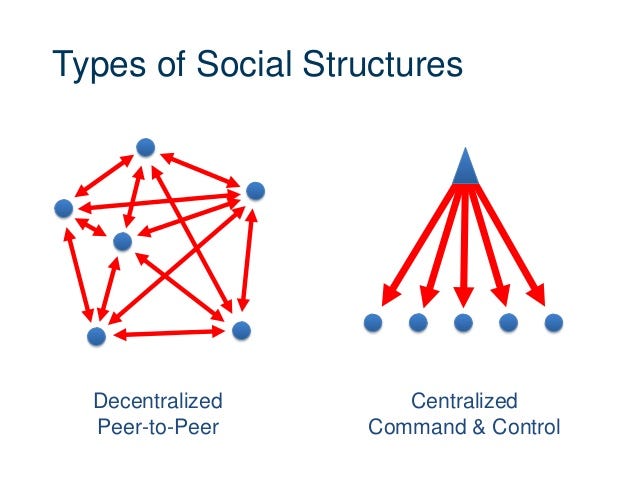
In the blockchain and cryptocurrency world the utopian dream is decentralisation: the process of distributing or dispersing functions, powers, people or things away from a central location or authority. The belief is that decentralised, peer-to-peer, distributed, open source, cryptographically secured, maths based, trustless blockchain technology is the way to empower the people to bypass centralised financial and government institutions, leading the way to true sovereignty and freedom.
But are there societal, historical parallels in decentralisation? Let’s explore.
Alexis de Tocqueville
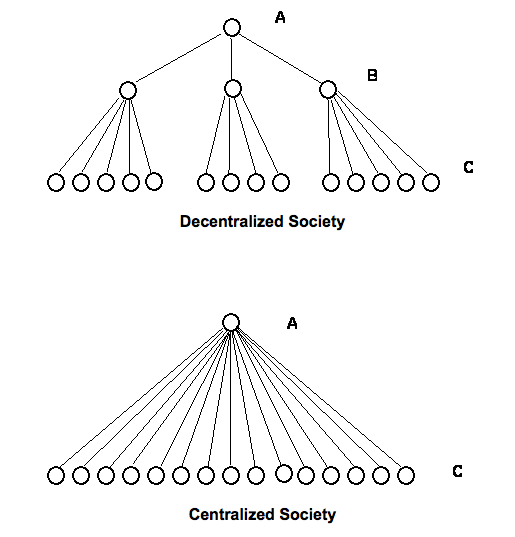
De Tocqueville (1805–1859) was a French diplomat, political scientist, and historian. He was best known for his works Democracy in America. He believed that decentralised society is the structure of liberty and that feudal societies were decentralised. A was the king, B the aristocrats, C the commoners. In his mind, Britain followed this model. Democratic America also followed this model, but A was the federal government, B were voluntary associations, and C the citizens.
De Tocqueville believed that centralised society is the structure of despotism. The absolutist monarchs A (e.g., Louis XIV in France) centralised authority under the old regime by reducing the power of the aristocracy B and levelling society C under them. Thus, the level B drops out and the aristocrats and commoners are levelled at C. The democratic Revolution in France of 1789 did not change this structure of despotism because it merely replaced the king with the National Assembly at A. He believed it is almost impossible to move from democratic despotism (centralised society) to democratic liberty (decentralised society).
Émile Durkheim
Durkheim (1858–1917) was a French sociologist, who is commonly cited as the principal architect of modern social science. He believed that modern society had become too large and centralised, and the individual may feel isolated and not see how he or she fits in. He called this anomie — a condition of instability resulting from a breakdown of standards and values or from a lack of purpose or ideals. As a solution, he proposed occupational groups B (a form of decentralised society) to connect the individual A to the whole of society C. Durkheim compared his proposal to medieval corporatism and proposed a modern form of democratic corporatism: when individuals freely associate, and the associations help control the state.
Philippe C. Schmitter
Schmitter (1936) is a Professor of the Department of Political and Social Sciences at the European University Institute and co-author of Transitions from Authoritarian Rule: Tentative Conclusions About Uncertain Democracies.
Schmitter’s theory is that corporatism takes the structure of a decentralised society. He distinguishes between Liberal or democratic corporatism and state corporatism. In Liberal or Democratic Corporatism, power flows from the bottom up, consistent with Durkheim’s model. Citizens C freely form associations B, which help control the state A. In state corporatism, power flows from the top down: Nazism and Fascism are extreme forms of this. The state A uses organizations it creates B to control the population C.
As you can see, the concept of “decentralised societies” is a relative term. Historical models of decentralised societies simply shifted power from one layer to another. Today, decentralised technologies are being developed in almost every industry and market. Collectively, these technologies have the potential to cause a radical shift from the status quo, potentially signalling the start of the Decentralisation Revolution.
What are the more modern visions of decentralised societies, empowered by these emerging technologies?
The bottom line?
The invention of the Internet enabled disintermediation: the elimination of the need to physically visit the provider of goods and services. This capability created a shift in the way in which we engage with institutions (banks, businesses, governments, etc.) and a shift in the way we think about individual accountability.
Today, blockchain technology is decentralising the way we store data and value and manage information. Central databases are being replaced by computers owned by many and owned by none. The potential here is that alongside the rising distrust in institutions, technology is leading to a reduced role for one of the most important regulatory actors in our society: the middleman. This significant shift is allowing us to build the decentralised peer-to-peer societies philosophers and social scientists have dreamed about for centuries.
Project 2030
You made it to the end! If you’re interested in helping us solve some of the planet’s grand challenges with our ambitious Project 2030, please check out the overview, and invite others to do the same.
Postcards from 2035
Have you come across Postcards from 2035? It’s a series of profoundly simple interlinking ideas describing life in a highly desirable society, where everything and everyone is advanced, happy, intelligent and problem-free. It’s a blueprint of the world we need to co-create. Here’s what that world could look like.


