
Celebrating New Orleans Poets Keeping Poetry Alive
French Quatrain vs. French Quatern Poem Form
New Orleans has a long and rich history of poetry, and the Crescent City continues to produce some of the most exciting and innovative poets in the world today. It’s that city’s diverse poets, from a variety of backgrounds, that I celebrate today.
In New Orleans, I also think of when it comes to the newer French Quatrain poem form — it too suits the richness of the place where they are writing from. They uniquely write poems about a variety of topics, but they are all united by their love of poetic language and NOLA.
Poetry deserves to be an art that is both meaningful and beautiful. Because of NOLA’s rich history, whether they know it or not, they are continuing under the long traditional influence of French poem forms. From New Orlean’s more current and well-known poet masters: Brenda Marie Osbey; John Warner Smith; Tyehimba Jess; Nicole Cooley; and Maurice Carlos Ruffin (just to name a few). I celebrate them.
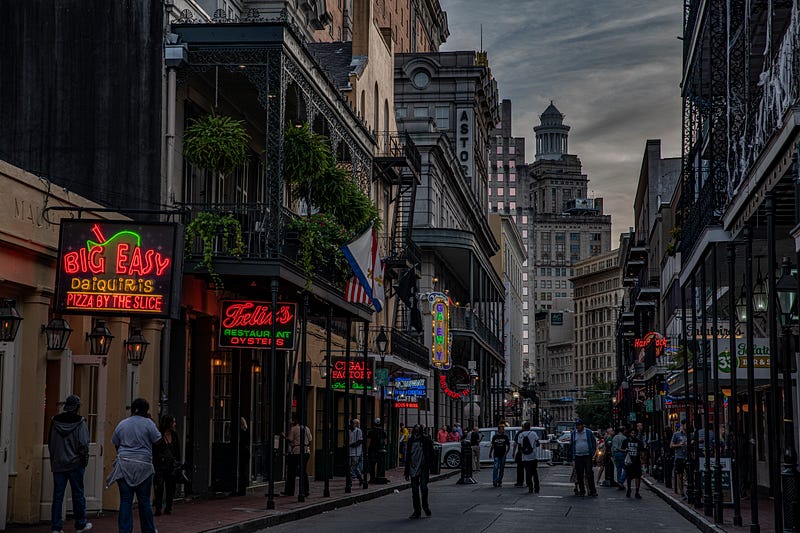
Within New Orleans, thanks to centuries of tourism, the area known as the French Quarter is the oldest. The ghosts of the past, even in poetry, still resides there and can be a source of inspiration. It’s a lot like one of the oldest French poem forms — the French Quatrain. It too deserves to be a poetry art form that is still meaningful and beautiful.
The Foundation of French Quatrain Poems
This old French poem form has been around since the beginning of the Middle Ages. At first glance the old French Quatrain is a poetic form consisting of 16 lines, divided into four quatrains (four-line stanzas). Usually Each line has eight syllables, and the rhyme scheme is AABB.
The first line of the poem is the refrain, and it is repeated in the second line of the second stanza, the third line of the third stanza, and the fourth line of the fourth stanza. Every serious poet should know this French poem form. It’s a delightful way to write poems.
Old Quatrain vs. Newer French Quatern Poem Form
Let’s being with one of the best examples of a modern day French Quatern poem inspired by the city of New Orleans is Billy Collins’ poem, “French Quarter,” and work our way back to its foundation, the French Quatrain.
I think the French Quatern is a great testament to the uniqueness of Louisiana, when it comes to inspiring writing poetry. It proves you don’t have to be a NOLA poet to feel the poetry of the region.
French Quarter — by Billy Collins © 2001
In the French Quarter, the air is thick With the smell of jazz and gumbo. The streets are narrow and crowded, And the music is always loud.
French Quarter, French Quarter, Where the drinks are strong and the music is sweet.
I love to wander through the Quarter, Taking in the sights and sounds. I see street performers and tourists, And couples dancing all around.
French Quarter, French Quarter, Where the drinks are strong and the music is sweet.
The French Quarter is a place where anything is possible. It’s a place where dreams come true. And it’s a place where I always feel alive. French Quarter, French Quarter, Where the drinks are strong and the music is sweet.

Vive la différence!
Vive la différence! is one French expression you’ll hear a lot. It means “Long live the difference!” It is one expression I will always remember, because it a quote my Cajun Mama’s Grand-père Emile Navarre often said. She still loves to quote it.
Even as a very young child and later as a young tween, I remember his joy as he said it. Mind you, for him it was about adding garlic to everything in cooking. A little garlic made all the difference! But in poetry, however, time evolves poem forms and that adds a new layer to Vive la différence!
You might ask what is the difference between an old fashioned French Quatrain and a new era French Quatern? It is just a breaking and the inevitable ever evolving spins on be a rule changer or breaker when it comes to writing poems.
Such poem forms are often used to celebrate diversity and to encourage people to be themselves. The expression is a reminder that it is okay to be different, and that our differences make us unique and special — even in our poetry.
New Orleans, On Borrowed Time — Quatrain Poem — Version 1
Before the sea claims Louisiana’s shore, Before the storm erases all we’ve been, Before the climate’s wrath we can’t ignore, Before division’s seeds have all been sown,
New Orleans, you are on borrowed time, A precious jewel, a city so sublime.
Before our Cajun tongue is lost and gone, Before our Creole heritage is done, Before our buildings crumble to the ground, Before the river’s salty depths are found,
New Orleans, you are on borrowed time, Your bells of St. Louis will no longer chime.
Before our history is erased from view, Before the winds of time sweep us anew, Before the city sinks into the deep, Before all flee for higher ground to keep,
New Orleans, you were always on borrowed time, But can we save you, this city so sublime? — Jerilee Wei © 2023
New Orleans, Quatern Poem— Version 2
Before the Gulf’s embrace, Before the storm’s erase, Before the climate’s ire, Before political division’s fire,
New Orleans, borrowed time, A jewel so sublime.
Before our Cajun tongue are stilled, Before our Creole tale is filled, Before buildings turn to rubble, Before the river’s last rumble,
New Orleans, borrowed time, St. Louis’ bells will chime no chime.
Before history’s erased, Before time’s winds are chased, Before the city sinks, Before all flee and shrink,
New Orleans, borrowed time, Can we save you, so sublime? — Jerilee Wei © 2023
Final Thoughts On These Two French Poem Forms
Honestly, I can’t decide which one I prefer. I will say that any time a poem form has less rules and constraints it’s easier to write. So there’s that on the plus side of the Quatern poem’s side. Still it was challenging to write despite the greater freedom to experiment.
Both poem forms require a careful use of language and attention to making sure your finished poem is meaningful and pleasing.
Lastly, I’ll leave you with some tips for writing both types of French poem forms:
With Quatern French Poems:
- Choosing a topic or theme for your poem.
- Brainstorm words and phrases that fit with your topic or theme.
- Experiment with your words and phrases into each set of four lines.
- Create a poem that has a clear beginning, middle, and end.
- Always be open to do-overs.
With Quatrain French Poems:
- Start by choosing a rhyme scheme for your poem.
- The most common rhyme scheme for quatrains is AABB.
- However, you can also use other rhyme schemes, such as ABAB or ABCB.
- Choose a meter for your poem. Iambic tetrameter is the most common meter for quatrains.
- Trochaic tetrameter or anapestic tetrameter are also allowed.
- Brainstorm a list of words and phrases related to your topic or theme.
- Experiment. Experiment. Experiment.
- Have a clear beginning, middle, and end.
- Write different versions of your poem until you are satisfied with your results.
“Two French poem forms dueling for the best one to write one is like two Cajun chefs dueling for the best Gumbo recipe in a cook-off. There is no one right way. Everyone has their own preferences, especially when it comes to adding garlic. Vive la différence! But in New Orleans, only if you know whether to use Slap Ya’ Mama or Tony Chachere’s, when you choose your own spicy words, some say can you lay claim to writing the best poem.” — Jerilee Wei © 2023