
James Randi’s Lifelong War Against Bulls**t
The legacy of the amazing Randi
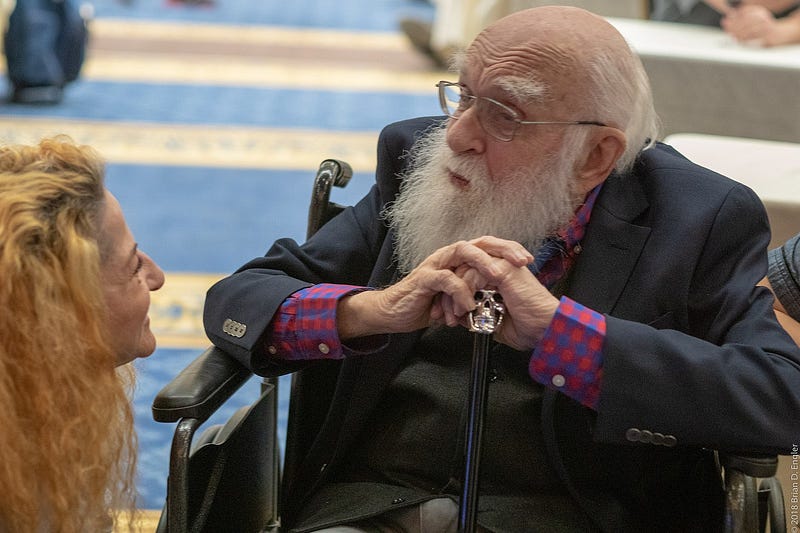
The first time I ever saw James Randi, born Randall James Zwinge, he was giving a lecture about homeopathy at CalTech.
My first impression was that he was a funny-looking man, his hair and beard as white as a garden gnome, an ill-fitting suit draped awkwardly over his slightly hunched frame. Yet he positively crackled with energy, intelligence and mischief. It was clear that he wasn’t only delighted to be explaining why homeopathy was pseudo-scientific, he was delighting in his performance as he did so.
Even though he was talking to some of the top minds in the country about molecular concentrations and Avogadro’s constant, he delivered his material with the timing and flair of a veteran stand-up comic.
Take, for example, the extract below, where he recalls asking a friend to help him describe how dilute homeopathic remedies are:
I called my friend Martin Gardner and said, “Martin, I really need something for the layman. I don’t know what 10 to the 1500th is. It’s a huge number. A very, very, very large number, but how do I illustrate that?”
He said, “I’ll call you back.”
Later on in the day, he called me back, he said, “Okay, you got a pencil ready?”
I said, “Yep.”
He paused for a minute, “I’ll call you back. This can’t possibly be right. It’s ridiculous.”
Twenty minutes later he calls me back and says, “No, I was right the first time.”
Martin said, “If you take one grain of rice, crush it up in a teaspoon, you then dissolve that powder, in a sphere of water, the size of the solar system, with the sun at the centre and the orbit of Pluto at the outside, then you repeat that process. Two. Billion. Times.”
Now there are naturally, this might have occurred to you, a couple of technical problems here…

Randi began his career working as a magician and stage performer called “The Amazing Randi”, but soon found that his true talents lay in exposing pseudoscience and unscrupulous “psychics”. In 1972, he released a book called, “The Truth About Uri Geller in which he accused Uri, one of the most famous “psychics” in the world, of being a fraud. He helped Johnny Carson to set Geller up on an episode of “The Tonight Show” by asking him to demonstrate his powers with props that Geller and his team weren’t given access to beforehand.
Surprisingly enough, Geller’s psychic abilities temporarily deserted him.
Randi spent the next few years exposing numerous other performers who claimed to have supernatural powers, but his biggest coup came in 1986 when he exposed the then internationally renowned faith-healer, Peter Popoff, as a charlatan. At the time, Popoff was earning around $4 million a year, mostly in donations from credulous people who believed his abilities were a gift from God. Popoff would call out to members of his audience, describe personal information about their ailments, and then call them up on stage to be “healed”.
Randi, however, revealed that the messages Popoff was receiving weren’t coming from God but from a radio transmitter operated by his wife, who was hiding backstage. Randi, who had managed to isolate the frequency they were using to communicate with each other, played the audio of his wife’s instructions over footage of Popoff’s performance. Popoff filed for bankruptcy the following year.
In 1996, Randi offered $1000 of his own money to anybody who could demonstrate any kind of supernatural abilities under conditions that both parties could agree upon. The prize fund later increased to $1 million. Numerous high profile psychics and mediums were offered the chance to win the money, but none of them made it past the preliminary test. Most refused to even try.
In 1998, John Maddox, the then editor of the prominent scientific journal “Nature”, asked him to give his thoughts on a series of experiments into homeopathic treatments which seemed to support the conclusion that homeopathy is effective. Randi suggested a new, more rigorous protocol which, when applied, revealed the earlier findings to be inaccurate.
Randi spent the majority of his life encouraging people to think critically, and yet through a certain lens, his efforts could be viewed as a failure. A few years after filing for bankruptcy, Popoff earned millions of dollars from a series of faith healing infomercials. Uri Geller’s fans continued to support him, a fact that surprised Geller himself. His failure left his fans further convinced of his authenticity:
If he were performing magic tricks, they would surely work every time.
Homeopathic treatments are still widely available, even though Randi routinely consumed “fatal” doses of homeopathic sleeping tablets before his lectures to demonstrate that the pills didn’t have any effect.
But the legacy of “The Amazing Randi”, who died last week aged 92, was never going to be turning everybody who walked the face of the earth into a rigorous, scientific thinker. There are always going to be people who will choose a pretty lie over an ugly truth. Instead, Randi reminded us that just because we don’t understand what we see, doesn’t mean that what we see can’t be understood. He reminded us that we can be fooled, and so shouldn’t let ourselves be fooled completely. He was a magician who never revealed his tricks but made it his life’s work to help us spot the tricksters.


