Celebrate Frustration
It helps you identify your weaknesses
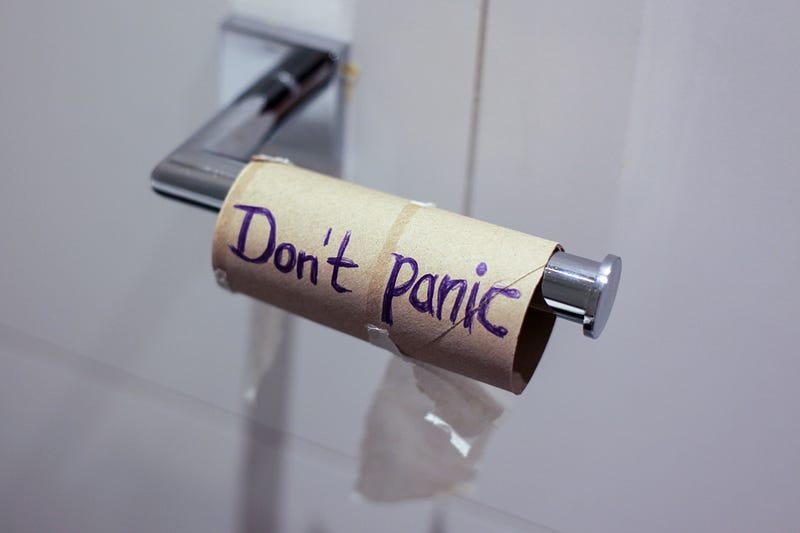
The job was not going well.
We were trying to put a new toilet on an old closet flange. Twice we had tried, and twice the toilet had leaked. Now the porcelain behemoth was filled with water making it heavy and awkward. To make matters worse, there wasn’t enough room in the mounting space to allow us to handle the toilet together.
“If this doesn’t work, you’re calling a plumber,” Andy said.
“Well then,” I said, “let’s hope it works.
Adversity
A two hour job that turns into a 12 hour ordeal starts to break you down. The physical part comes first, but you don’t get into real trouble until you hit the mental exhaustion.
When you are tired and frustrated, you can’t think straight. That leads to even more mistakes. Sometimes your best course of action is to take a step back and allow your mind to catch back up to the present.
“Let’s think about this.”
“We need to stop and think about this.”
With the ever present need for urgent results, human beings don’t give themselves enough time to stop and think. The inclination is detrimental to our species, and to our quest for individual satisfaction.
Working on toilets
I hate doing work on the toilet. When I get done I throw all my clothing into an incinerator and spend a half hour in the shower scrubbing myself with bleach.
Working on a toilet is like being surrounded by the plague. You get a creepy-crawly sense that everything is being contaminated.
When I popped off the lid of my toilet, the stamp in the tank read 09/29/74. The toilet was older than me! I turned to my wife, “Imagine all the things this toilet has seen!”
“Yuck!”
I looked at the job as jumping through a wall of flame. You hold your breath, close your eyes, take a running start, and jump.
The community in your septic system
Modern toilets use PVC piping. Old toilets use cast iron tubing. My house was built just after the end of the Civil War. There’s a chance the tubing is more than 100 years old. There must be genetic material from hundreds of people on the inside walls of that pipe.
Gross.
The job
I’d started the job because I’d noticed some moisture gathering behind the toilet. Moisture is bad. It leads to rotted joists and house centipedes. If you don’t know what a house centipede is, don’t google it, it’s the stuff of nightmares.
The toilet needed to go. The floor needed to be tiled.
Ripping up the floor
Whenever you do work on an old house, there’s always a bit of trepidation as to what you might find. Although you’re hopefully to get into the walls and discover gold bars, it’s much more likely that you’ll find human remains.
If you’re lucky, you’ll only find rotting boards.
We were really lucky, the floor was in good shape. We tiled in confidence, unsuspecting that the flange was going to rise up to smite us. The first few hours of the job lured us into a false sense of confidence.
Molten lead
In the old days, they used to affix the toilet to the flange by pouring in molten lead. The flange is still a standard size, but the top platform is only about half as wide as a modern flange. There’s a space to accommodate the lead. This means your wax ring will sink into the space and fail to make a seal.
What we needed was a spacer to fill in the gap of the old flange. We figured this out through painful trial and error. The failure made us angry and we wouldn’t have gotten to the solution if not for a fortuitous break.
Navigating problems
The thing that worked out in our favor was the fact that the hardware store was twenty minutes away. Confronted with the problem, we descended into a manic state. We wanted to get the job done. It was a matter of push, push, push.
But nothing was working! We needed more materials, time to pile into the car!
The drive gave us time to cool down, slowly the frustration quit dominating us and we transitioned to problem solving.
“Do you think there’s a hole in the toilet?”
“No, I didn’t see anything.”
“Are the bolt holes in the flange in the wrong position?”
“No, that should be standard, even though it’s from a hundred years ago.”
“Is the floor out of level?”
“No, we checked that.”
“Is the wax ring compressing?”
“I don’t think so.”
“Why not?”
We’d found our heading.
The wrong rabbit hole
When you have a problem to solve, it’s the same as being lost in the wilderness. To solve the problem, you have to select a direction.
Sometimes, it’s easy to confuse action for progress. There’s a certain security in simply picking a spot in the distance and starting to walk. You feel pacified by the fact that you’re doing something. However, if you go the wrong way, your action only makes the situation worse.
It doesn’t matter if you’re installing a toilet, making a career choice, or evaluating a relationship. You always have to take the time to work the problem. When you’re worked up and urgent, you do not give yourself the chance to succeed.
Frustration versus inspiration
When you have a failure, it’s important to conceive of a theory as to why that failure happened. With future efforts, you have to reevaluate your theory.
Everybody is familiar with that tingling in the back of their mind that indicates they have forgotten something. It is a strange phenomenon and if you’re smart, you’ll learn to pay attention. There’s a part of your mind that operates beyond the conscious, that knows when something is absent. You have to focus and draw up the answer.
The more you practice, the better you get, but you can’t create these moments artificially. You have to seize them when they happen.
Making it work
There wasn’t anything at the hardware store specifically designed to solve our issue, but once we identified the problem area, we were on the way to a solution. It wasn’t the toilet, it wasn’t the floor, it wasn’t the wax ring, it was the gap in the flange!
Armed with a new course of action, we had renewed strength. We had suffered a setback, identified the problem, and conceived of a solution. There wasn’t a kit available for our unique need, but we got what we needed to make something work.
Platform installed, we affixed a new wax ring, waddled the water-laden toilet into position, bolted it in place, and turned on the water. The test was the flush. On the previous two tries, water had seeped from the edges.
We held our breath, pushed the handle, and waited.
No water.
The seal had held!
Deliberate action
Thinking takes energy, sometimes we lose sight of how taxing it can be. Sometimes it’s tempting to do a job on auto-pilot.
“This is a standard job. I’ve done this job hundreds of times. This process has been effective hundreds of times. There’s no need to reconsider anything.”
Then, when the process fails you, you are shaken. In the course of a few hours, you have to navigate the five stages of grief. We do this on a smaller and larger scale all the time. Depending on your adversity, each stage can take months, or it can pass in the blink of an eye.
Success and reflection
With the project over, it was time to get cleaned up. A shower and a new set of clothing can change your mental state. You’re a new person, you’ve rid yourself of the filth that soiled you. The physical part is over, but there’s more mental work to be done.
Frustration is debilitating. It feeds on physical exhaustion and compels you to make further mistakes. It’s important to recognize when you succumb to frustration, and make adjustments to prevent your emotions from dominating you in the future.
The path to progress
There’s no frustration that’s too small to examine. It’s similar to that tingling sense you get when you’ve forgotten something. A minor mistakes that leads to an inordinate amount of frustration is a sign that you need to adjust your thinking. Success cannot be achieved by throwing darts, you won’t ever come across an epiphany by chance.
Celebrate your frustration. It’s a roadmap to the mental tasks that need your attention. Once you recognize them, you have to do the work. The more you process your emotions after a minor frustration, the better equipped you will be to handle major adversity.
We all take baby steps toward self-improvement, but even baby steps in the right direction represent progress.


