
If your notes inbox feels like a processing factory instead of a sweet place to think… you’ve been optimising for the wrong outcome.
The Problem With “Processing” Your Notes (& What To Do Instead)
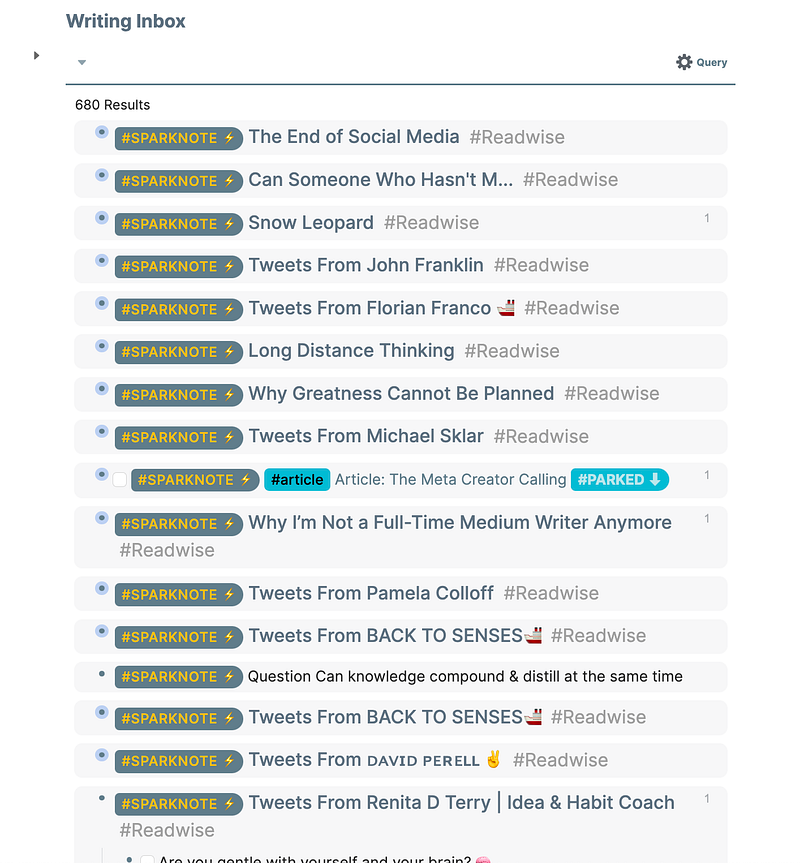
If I look in my writing inbox right now I’ll find 680 ‘unprocessed notes.’
My writing inbox is where all of the notes I’ve taken while I’m consuming content end up ready for my daily writing practice where I take them, think on them & use them as prompts to start to develop my own ideas.
It’s my single most important tool as a creator.

It’s fun when I share my screen with people and suddenly they get that anxious look, like how can you have so many notes that you need to process and it not cause you major anxiety.
And while it might look like I don’t actually process any of the notes, I’m in my writing inbox every day, so it’s not a lack of time I’m spending in there. The reason I have so many is that getting to inbox zero is not my outcome — so I don’t optimise for that.
A Shift From Processing To Thinking
When I first started exploring the Zettealksten method of note-taking I was militant about taking notes and then processing every one of those notes into a permanent note before I could move on to reading something else.
But instead of building a rich library of knowledge and a practice that was fulfiling, all I ended up doing was creating shallow knowledge & notes because I was simply trying to churn through my literature notes to process them all.
It was all process without substance.
Worse yet, what ended up happening was I STOPPED spending time writing because the thought of having to do all that processing daunted me so much and most days I just couldn’t bring myself to open my inbox.
So I reframed how I thought about my writing inbox.
Pay Attention To What You Are Optimising For
Our outcomes guide our everyday behaviour
So whatever outcome you aim for (either implicit or not) you automatically start to optimise your behaviour around what you want to achieve.
So when my outcome was getting to inbox zero every day in my writing inbox my behaviour automatically reflected that. But when I flipped the switch and made my only outcome thinking deeply, being curious & developing ideas, I ended up with completely different behaviour.
Outcome: Inbox Zero = Behaviour: Processing Factory
When I focused on the number of total notes in my writing inbox and reducing that to 0 every session my behaviour followed. I felt like I had to churn through notes as quickly as possible because my outcome was getting to 0.
These notes ended up being shallow and then I would file them away quickly somewhere, hit ‘complete’ and then move on to the next one. It was more a processing factory than a thought library.
But I felt like I was achieving my outcome. Except something still didn’t feel right. Because maybe clearing the decks or getting to inbox zero or whatever we want to call it isn’t actually the outcome that makes us feel most satisfied.
Is speed really the name of the game when it comes to building our knowledge library? Will it cause us to do our best thinking? Or develop our best ideas that we can put out into the world?
Optimise For Thinking Not Processing
Now, my only outcome in my writing inbox every day is to sit and think deeply. To be curious & develop ideas. Some days that means I only process one note & I’m completely satisfied with that in a way processing 600 notes could never be.
And that is how I’ve ended up with 680 notes in my writing inbox. Because the total number is not important to me anymore. What is important is that every day I am thinking deeply and developing unique ideas.
It’s not fast. It’s slow & it’s deliberate.
And I am more satisfied than ever that I am actually embodying the knowledge I am collecting & learning. Rather than building a database of notes & quotes that I might use someday.
When you optimise for thinking deeply and developing thought rather than ‘processing’ notes you end up with a much richer practice, rather than an obligation to empty your notes inbox.
And that’s what keeps me coming back to my writing inbox day after day frankly. Because every morning it’s rich with ideas and there is no sense of obligation for anything else.
We’re All Just Suffering From Knowledge FOMO
And I get it. I know that anxiety-inducing feeling that you have SO MUCH to process through. After all didn’t you capture all these spark notes? Aren’t they all worth diving into?
And the answer is yes.
There are so many good ideas out there in the world today. More than humanity has ever been exposed to.
And that is our problem. We get knowledge FOMO. We feel like we are missing out on all the good stuff, so we collect it up, kidding ourselves into thinking we can consume it and synthesize it all if we just go faster, and speed up our process and get our system optimised down to the finest degree.
But FOMO stops us from something much sweeter.
It stops you from experiencing the joy of being fully present & immersed in the knowledge you have in front of you right now. You stop yourself from diving in fully because there is so much other stuff to get to.
It’s a BIG mindset shift on this knowledge building journey to start just being content with the knowledge you are building without thinking you have to consume and synthesise ALL the knowledge.
So how do you get over the number counts & focus on the writing?
Your Writing Inbox: A Forcing Function For Sweet, Scrumptious, Deep Thought
Here’s the process I use to have a rich, beautiful time each morning in my writing inbox.
Ignore the number of total notes. That’s a given now, just put your hands in the air and declare processing bankruptcy and relish in the thought that you are going to have a delicious time in the notes you focus on today.
Take the first note & think deeply. When I first get into my writing inbox for the day I simply take the first note from the top of the list and I start to think about that. There is no formula for writing atomic notes. I simply start thinking & writing. I ask why did this resonate? What do I think about this? What other knowledge do I have that connects or reminds me of this concept?
Think for as long or as short as you need. Just write and think & be in the present moment. And do that for as long as you need to until everything is emptied out and you’ve scoured every nook & cranny of that idea.
Then if you have more time, take another note (any note this time) and do the same. Repeat that over and over until the time is up.
And at the end, you’ll be so satisfied like you savoured a well-prepared meal with a pairing of good wine rather than rushing through the drive-through at Mcdonald's and gulping down a quick meal.
So keep consuming content & capturing spark notes into your writing inbox. But don’t get so hung up on the total number of notes in it. Optimise for the behaviour that is going to help you build knowledge, deep knowledge that you can use as a creator to create unique content that also satisfies your audience.
And then let everyone else get anxious when they see your inbox number 😬
If you liked this post here are 3 things you can do to support me:
- 👏 Give the article a clap
- 🤞Follow me for upcoming articles
- 💌 Sign up to my free email course to discover the 3 (PRO) Creator systems you need to go from a stressed-out hustle creator to an effortless leveraged creator.
And don’t forget you can always reach out to me on Twitter to continue the conversation.


