
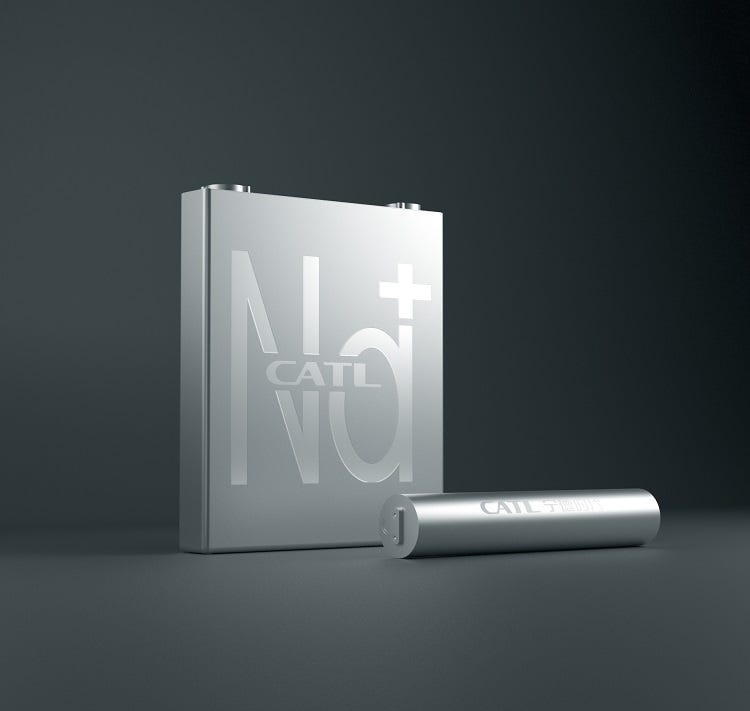
CATL’s New Battery Will Cause An EV Revolution
Tesla should be very worried.
Battery technology is the key to winning the EV race. If you can make a battery that is super cheap, light, able to charge incredibly quickly, and has a tiny impact on the environment, then you can easily build an industry-leading EV years ahead of the competition. This is precisely what Tesla is trying to do with its 4680 battery. But CATL, one of Tesla’s own suppliers, is about to blow the 4680 out of the water with its groundbreaking sodium-ion battery. So, should Musk be worried?
Before we dive into CATL’s new battery, we first need to understand what sodium-ion batteries are. You see, most modern batteries in our EVs, laptops, and phones use lithium-ion battery chemistry. We use this chemistry because it offers fantastic energy density and rapid charging. This is why modern EVs can carry enough batteries to drive more than 300 miles and can fully charge in under an hour. However, lithium-ion batteries aren’t perfect. They pose a significant fire risk, have a short life cycle, struggle under thermal stress, have a considerable environmental impact, and cost a bomb to manufacture!
Many companies, including Tesla, are trying to develop lithium-ion batteries that mitigate these weaknesses. But sodium-ion is an alternative battery chemistry that seems to solve all of these issues.
Sodium-ion batteries use much more widely available materials that are easier to mine and refine, making them significantly cheaper. But it isn’t just cost that makes sodium-ion batteries amazing. They are also much safer, last far longer, charge way quicker, and have a miniscule environmental impact. Annoyingly, sodium-ion batteries also have a very low energy density, making it impossible to build practical EVs with them — at least until recently.
CATL has solved sodium-ion batteries’ energy density problem. Last year, they unveiled their first-generation sodium-ion battery, and its specifications are incredible.
It has an energy density of 160 Wh/kg, and CATL has a patent to raise this to 200 Wh/kg. This means they are only slightly heavier than lithium-ion batteries, which sit at about 220 Wh/kg, making a sodium-ion-powered EV possible. The battery itself can be charged from 0% to 80% capacity in only 15 minutes. Its life cycle is rated for over 3,000 charge cycles, equivalent to driving a million miles. It is super cheap at only $77 per kWh, equating to $5,500 in savings per EV (given that current lithium-ion packs cost $132 per kWh). CATL has predicted they can produce them at a staggeringly low $40 per kWh once production is fully scaled, equating to $9,200 in savings per EV!
Let’s compare this to Tesla’s industry-leading 4680. As you would expect, the 4680 is more energy dense at around 270 Wh/kg. This means a 100 kWh 4680 battery pack would weigh 130 kg less than CATL’s sodium pack. This is a significant weight difference for performance cars, but not for everyday vehicles. However, CATL’s sodium battery wipes the floor in every other aspect. 4680’s charge at less than half the speed as they go from 10% to 80% in 30 minutes; they only last 1,500 charge cycles, or the equivalent of 500,000 miles; and they currently cost $91 per kWh. Now, Tesla has said that costs could fall to $60 once production is fully scaled, but that is still more expensive than CATL’s sodium battery once it is up and running.
It seems like CATL has made a near-perfect EV battery. So should Tesla be worried?
Well, the 4680 is far from the battery Musk promised it would be (read more here), and those currently being produced are just larger versions of their old batteries. Musk is really struggling to get his manufacturing processes sorted and scaled up because the 4680 relies on bleeding-edge technology such as silicone anodes and dry-coated electrodes. In comparison, CATL is the largest EV battery maker in the world, and their sodium-ion battery doesn’t rely on such difficult-to-build technology. So production of this battery should quickly catch up with and overtake the 4680, and it could reach its insane $40 per kWh reasonably soon.
CATL recently stated that they aim to get their sodium-ion battery into production in 2023 and are already talking with manufacturers about using it in their cars. Ultimately, it seems like CATL is ready to take centre stage in the EV battery race and cause a revolution.
EVs using their battery will be thousands of dollars cheaper than anything else, charge far quicker, and last far longer. To top it all off, they will be far better for the environment! When a battery like this exists, why would you use any other?
I genuinely think that CATL’s sodium-ion battery could make EVs truly affordable and usable. This would render Tesla’s 4680 obsolete, and Musk would have wasted millions developing a useless product. But this might not be a problem for Tesla, as CATL is already one of its biggest battery suppliers. So Tesla could easily adopt this battery instead of using their troublesome 4680. Who knows, maybe they will use this battery in their upcoming $25k Model 2? Either way, the EV world is about to undergo a revolution thanks to CATL.