
Caterpillars and Life Cycles
Six Word Story Photo Challenge: “Freestyle”
Creeping, Crawling Caterpillars Keep Us Connected!
We love to see butterflies in our butterfly garden. Who wouldn’t enjoy seeing beautiful splashes of color flying from flower to flower? We do! And my grandkids can name the butterflies as they spot them. We most often see monarch butterflies and Gulf Fritillaries, and Zebra Longwing butterflies.
Butterflies are only one stage of their life cycle. Butterflies feed on flowers but lay eggs on leaves. The eggs hatch into caterpillars. The caterpillars eat and grow and eat and grow, because, as you know, they are hungry, hungry caterpillars. Finally, each caterpillar stops to pause, attaches itself to a leaf or branch, and then transforms into a chrysalis. We wait and watch and wait and watch, and then, the chrysalis splits open to reveal another new butterfly. It joins the others getting nourishment from our flowers.
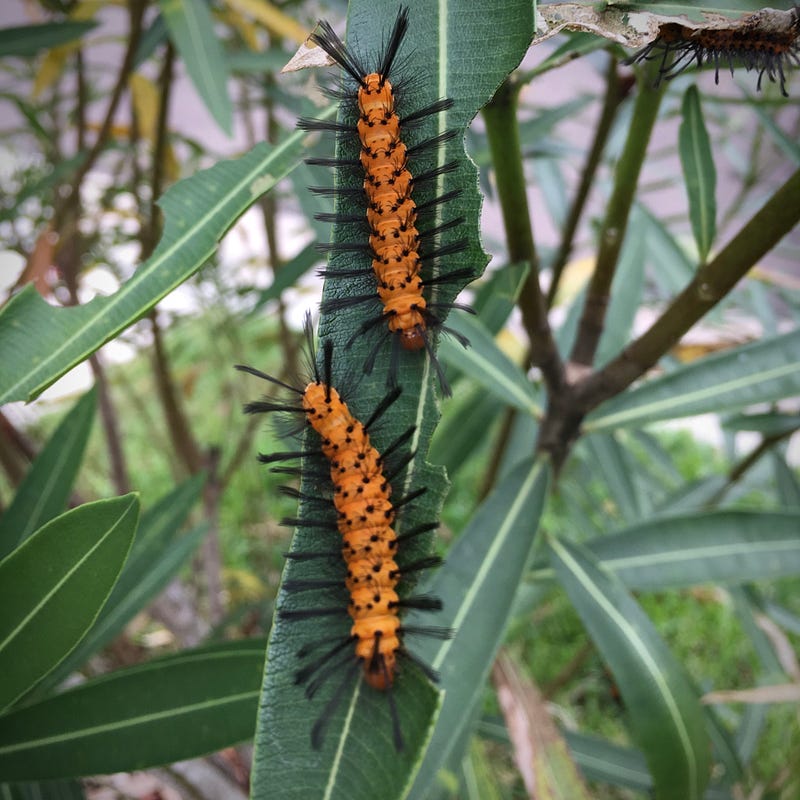
The pair of caterpillars in the photo are Gulf Fritillary caterpillars (Agraulis vanillae). They require passionflower vine leaves (Passiflora sp) for nourishment. The butterflies use the nectar from several flowers in the garden, but we have passionflower vine growing specifically for the Gulf Fritillary caterpillars.
We have to feed both parts of the life cycle, both the butterflies and the caterpillars, if we want to have a successful butterfly garden. We also know that since the Gulf Fritillary butterfly is native to Florida, we have to plant the native host plant. We also want to ensure that the plants have not been sprayed with insecticide, so we buy our passionflower vine plants from native plant nurseries that help to provide plants native to our area.
We are trying to “bring nature home”.