
Cash Flow Disruption: Exploring the Drivers of Freelancing Volatility
And how to tame them.

The volatility of freelancing can’t be understated.
While it’s possible to tame this beast by instituting retainers and taking a proactive approach to client acquisition, I think it’s also worthwhile to analyze the drivers of volatility by exploring real experiences.
From Expansion to Contraction: The Rise and Demise of My Longest Client Relationship
My longest-running client was an auto refinancing company, which had an in-house editorial staff who outsourced articles to a group of freelancers. Their goal from day one was to build out their blog, boost their SEO rankings, and drive targeted traffic to their site.
From February 2020 to December 2022, I wrote 50+ articles for their blog, at about $500 to $600 per article. The math works out to a regimented two assignments per month, with an occasional third for good measure. But, surprise, it was a much messier inflow of work, as you can see in the chart below.
Let’s explore the events or “drivers” of this volatility.
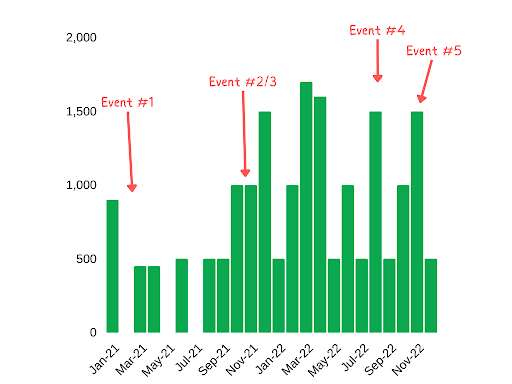
Event #1: The company starts looking into hiring an associate editor. The senior editor wears many hats, so it’s hard for her to compile briefs and divvy out articles evenly to her freelancing team. Hence the empty months.
Event #2/3: After seven months and a mis-hire, my client finally lands a solid associate editor. On top of that, they announce they’ve merged with another company, meaning more content needs.
Event #4: The company hires another associate editor and acquires another business, opening the door to even more assignments in the long run — but likely some delays in the near term.
Event #5: The senior editor leaves. The associate editors are gone shortly after. The next month, the VP of Communications of the combined enterprise reaches out and sets up an introductory call. She talks through her desire for a clearer, fixed cadence of monthly articles by entering a new contract with me at a higher rate.
Fantastic.
Except she, too, would part ways with the company. Unbeknownst to me, of course.
So, when I reached out in January to gauge the new-and-improved pipeline, I received an email from the Chief Digital Officer that explained: “There is no 2023 content strategy, so we probably won’t have anything for a while.”
Needless to say, that was goodbye.
To recap:
- An overloaded staff creates a bottleneck.
- M&A activity often changes (and, in turn, disrupts) existing processes.
- Departures cause lapses in communication.
While the flow of work could be described as choppy, at best, it averaged out to about $1,000 of monthly work. Plus, by writing dozens of articles on a very niche subject (auto refinancing), I developed subject matter expertise, so I could write an article in about four to five hours.
Key takeaway: Sometimes — probably most of the time — business disruption is outside of your control. Content freezes, hiring delays, strategic pivots. All of these obstacles can lead to volatility, and none of them are the fault of the freelancer.
How Freelancers Can Proactively Mitigate Business Disruption
To combat the uncontrollable, we need financial safeguards in place to buttress our businesses. Here are a couple of ideas for you to explore.
Diversify your income streams
It’s a basic, even cliche recommendation, but we put ourselves at risk when we put too many eggs in one basket (i.e., rely too much on any single client or service).
Explore different ways to make money, such as offering various services, selling digital products, or coaching less experienced counterparts. The more income sources you have, the less vulnerable you’ll be to fluctuations in demand.
I recently spoke with a fellow freelancer who was feeling the pains of inconsistent income. One avenue I suggested was to explore copywriting. Blog posts are typically the initial standard service offered by new freelancers. Perhaps it’s time to expand your offerings from blog posts — email campaigns, landing pages, one-pagers, etc.
Create a cash flow buffer
Suffice it to say, diversifying your income streams is much easier said than done. So, let’s approach this issue from another angle.
To help manage irregular income, create a cash flow buffer by setting aside a portion of your earnings during profitable months. Use this buffer to cover expenses during lean times, and replenish it when business picks up again. At the very least, a cash flow buffer will help reduce the financial (and emotional) impact of business disruption and allow you to regain your footing.
Until next time, happy freelancing!
Carter
P.S. Do you have a success story or tip for taming volatility? Comment below 🔽