
Carnivore Research: A New Type of Scientific Discussion Forum
Hello! I practically live and breathe carnivores. Formally, my academic credentials include an undergraduate degree in ecology and evolutionary biology from Princeton, a research Master’s degree from Duke in biology, and a research computational-biology Master’s degree from Columbia’s computer science department. Along the way, I wrote several scientific publications and made conference presentations. As an undergraduate, I was fortunate enough to study the Carnivora and I have a publication from that time. Afterward, I left carnivore research. I’m currently outside the scientific community, but connect with professional scientists on social media and follow the research on the Carnivora.
I am also heavily involved with the Spaces feature of Quora.com. Spaces are basically collaborative blogs where a curated community can post and share information about a specific topic. On Medium, I’ve published a tutorial about how to contribute to Quora Spaces in the publication Better Marketing. If you want to learn more about how to use Spaces, I recommend you go through this tutorial.
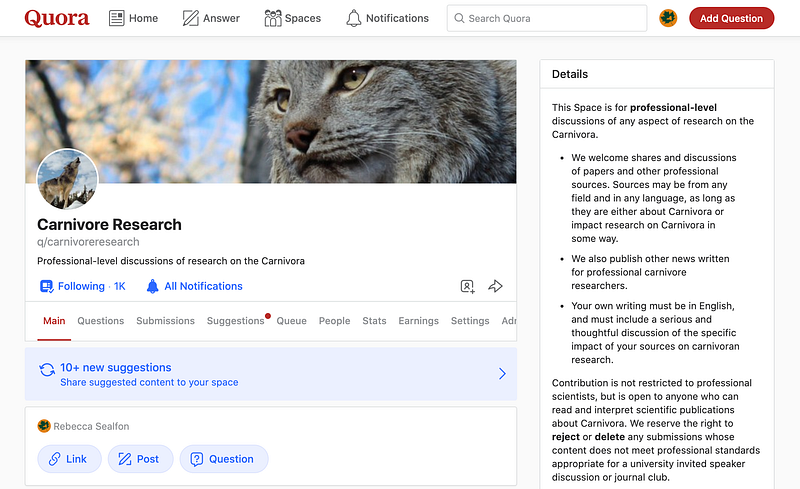
Spaces can be used for a variety of purposes. One of my Spaces, Carnivore Research, is an online journal club about the Carnivora. I started it to have higher-caliber, more focused, and more directed discussions than occur in most of the other animal-related Quora Spaces. Currently, Carnivore Research accepts professional-level discussions of any aspect of carnivoran biology, or about other topics with information on how they impact carnivoran research. Members of the public can follow the Space and can even contribute. In fact, we’ve taught some non-professionals about finding and analyzing scholarly sources, since the use of such sources is essentially our criterion for what type of carnivore-related content makes it onto Carnivore Research. After a bit more than six months, we have over 1,000 followers and nearly 20,000 views.
One of our initiatives is more focused discussions of specific topics. These can help people gain their bearings in a subfield of carnivore research. Back in March, we voted on which topics to discuss. The consensus was to start by covering the mass extinctions of carnivorans at the end of the late Pleistocene. Over the past several months, a number of posts were in this area, about topics from the ecology of the short-faced bear to the impact of other species’ extinction on carnivorans to the Younger Dryas impact hypothesis. One of my favorite papers was about a paradigm for analyzing the debate over the Quaternary mass extinctions, which has helped me think about other controversies I like to write about in a different light.
With a professional dog communication researcher as a co-administrator, we intend to change topics now to carnivoran communication. With recent advances in machine learning, a topic I have some expertise in as a formerly Google-employed technologist, breakthroughs are occurring in the field of animal communication. I’m fascinated by Yossi Yovel’s work on bat vocal communication at Tel Aviv University and his lab’s computational analyses showing how much we underestimate its complexity. Alexandra Green at the University of Sydney is also doing interesting work on understanding cattle vocal communication. Neither bats nor cattle are carnivorans, but I would not be surprised if similar methodologies can be used to discover much about the communication of carnivorans such as canids, social herpestids, or spotted hyenas.
Scent communication is another little-understood aspect of carnivoran communication. For example, it was only recently discovered that African wild dogs use shared scent-marking sites for inter-pack communication. The information the dogs gain at these sites is still unknown. Many carnivorans rely heavily on olfactory communication, and we plan to discuss this topic as well on the Space.
I hope you can check out Carnivore Research, share relevant content to it, and let us know what else you want to see.


