
Carl Jung on Good and Evil, Light and Shadow
The acceptance of oneself is the essence of the whole moral problem and the epitome of a whole outlook on life.
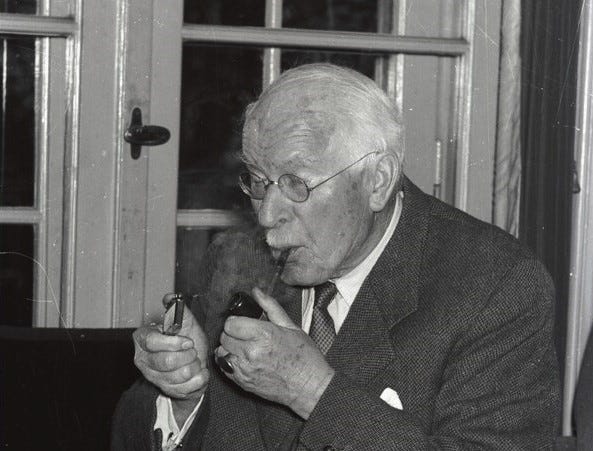
Evil is that which obstructs meaningful vitality. It may show itself differently in each case. That which is above by reason of its charity, suppresses that, which is below; then the lower craves what is above. — Carl Jung, Conversations with C.G.Jung, Page 40.
Good and evil are something of which the deepest qualities are unknown to us when we speak of it. But where do we have this idea that we know what is good and what is bad? We are all, after all, only limited human beings and we don’t know in any measure what is right in one or another case. We know it only abstractly.
“The acceptance of oneself is the essence of the whole moral problem and the epitome of a whole outlook on life. That I feed the hungry, that I forgive an insult, that I love my enemy in the name of Christ — all these are undoubtedly great virtues. What I do unto the least of my brethren, that I do unto Christ. But what if I should discover that the least among them all, the poorest of all the beggars, the most impudent of all the offenders, the very enemy himself — that these are within me, and that I myself stand in need of the alms of my own kindness — that I myself am the enemy who must be loved — what then?” — Carl Jung
Duality
Jung called the opposing forces the light and the shadow of the psyche. The light symbolizes the conscious and socially recognized features of human personality, while the shadow stands for the unconscious and commonly unaccepted aspects. If we have a really strong identification in one direction, the reflection of that is going to be equally strong. For the ego, it is dangerous to realize that the shadow is also part of ourselves. We try to create a barrier of protection around our ego identifications. The main way that we do this is through judgment. We end up judging ourselves internally if we express a certain trait and we try to repress that away from our awareness and keep ourselves from expressing it. We also start judging other people for having a similar trait.
Archetypes
Jung proposed the existence of archetypal symbols within the collective unconscious. An archetype is a common symbol or structure that is inherent to the human psyche, something that resides in the collective unconscious and something that comes in similar forms throughout various cultures and time periods. Symbols do not represent objects in the physical world but rather indicate something about the unconscious or psychic elements of the patterns. Some of these include the “hero” and the “villain” that reveal the good and evil sides of the human psyche.
Jung saw evil not merely as a destructive or malevolent force but as a necessary part of the human psyche. Evil, in his view, could serve as a catalyst for personal transformation. It could prompt individuals to confront their inner conflicts and lead to greater self-awareness and growth. Jung explored the concept of projection, wherein individuals project their own unconscious conflicts, including their shadow elements, onto others they perceive as “evil.”