
Carbon-14 Dating: Unlocking the Secrets of the Past
What is Carbon-14 Dating, and How Does it Determine the Age of Archaeological Artefacts?
During an archaeological dig, a mummy is found in the desert and an archaeologist says that the man lived more than 3,000 years ago.
If I gave you 50 claps, it means I read your story in its entirety and liked it.
But how can scientists know the age of objects or human remains?
What methods do they use, and how do these methods work? Well, one of the methods is carbon 14 dating.
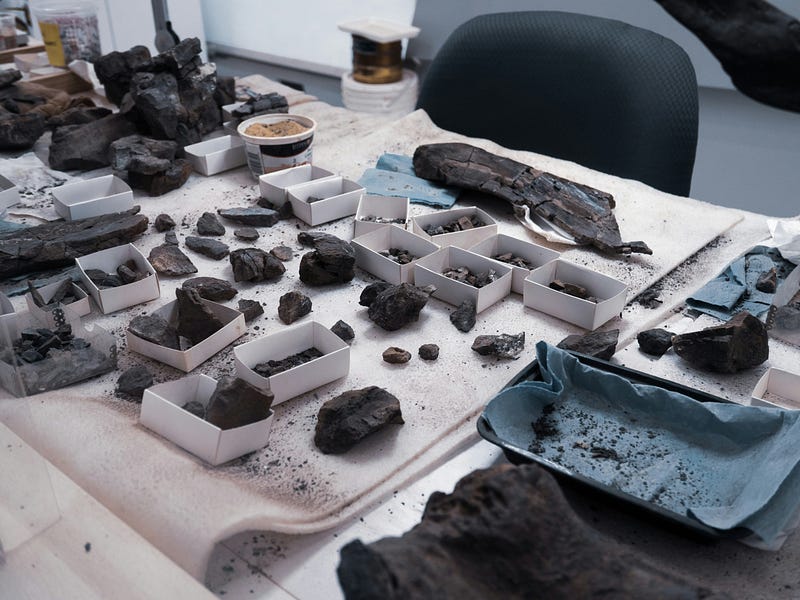
Carbon-14 dating is a way of determining the age of certain archaeological artefacts of biological origin that are up to 50,000 years old. It is used to date objects such as bones, human tissues, wood, and plant fibres used in human activities in the relatively recent past.
How carbon 14 is created
Every day, cosmic rays enter the Earth’s atmosphere in large quantities. To give an example, each person is hit by about half a million cosmic rays every hour.
It is not at all uncommon for a cosmic ray to collide with another atom in the atmosphere and create a secondary cosmic ray in the form of an energized neutron. These energized neutrons, in turn, end up colliding with nitrogen atoms.
When the neutron collides, a nitrogen 14 atom (with seven protons and seven neutrons) transforms into a carbon 14 atom (six protons and eight neutrons) and a hydrogen atom (one proton and no neutrons).
Carbon 14 is radioactive and has a half-life of about 5,700 years.
Carbon 14 in living beings.
Carbon-14 atoms created by cosmic rays combine with oxygen to form carbon dioxide, which plants naturally absorb and incorporate into their fibres through photosynthesis.
As animals and humans eat plants, they end up ingesting carbon 14 as well. The ratio of normal carbon (carbon 12) to carbon 14 in the air and in all living beings remains constant almost all the time.
Perhaps one in every trillion carbon atoms is a carbon-14 atom. Carbon-14 atoms are always decaying, but they are replaced by new carbon-14 atoms, always at a constant rate. Right now, your body has a certain percentage of carbon-14 atoms in it, and all living plants and animals have the same percentage as you.
Dating a fossil
As soon as an organism dies, it stops absorbing new carbon atoms. The ratio of carbon 12 to carbon 14 at the time of death is the same as in other living organisms, but carbon 14 continues to decay and is no longer replaced.
In a sample, the half-life of carbon 14 is 5,700 years, while the amount of carbon 12, on the other hand, remains constant. By looking at the relationship between carbon 12 and carbon 14 in the sample and comparing it to the relationship in a living being, it is possible to determine the age of something that lived in the past in a very precise way.
The formula used to calculate the age of a sample using carbon-14 dating is:
t = [ ln (Nf/No) / (-0.693) ] x t1/2
where In is the natural or Neperian logarithm, Nf/No is the percentage of carbon 14 in the sample compared to the amount in living tissues and t1/2 is the half-life of carbon 14 (5,700 years).
Therefore, if you had a fossil with 10% carbon 14 compared to a living sample, the fossil would have:
t = [ln (0.10)/(-0.693)] x 5,700 years
t = [(-2.303)/(-0.693)] x 5,700 years
t = [3.323] x 5,700 years
t = 18,940 years old
As the half-life of carbon 14 is 5,700 years, it is only reliable for dating objects up to 60,000 years old.
However, the principle used in carbon-14 dating also applies to other isotopes. Potassium 40 is another radioactive element found naturally in your body and has a half-life of 1.3 billion years. In addition to it, other radioisotopes (A radioisotope or radioactive isotope is an atom that has excess nuclear energy, making it unstable.) useful for radioactive dating include uranium 235 (half-life = 704 million years), uranium 238 (half-life = 4.5 billion years), thorium 232 (half-life = 14 billion years) and rubidium 87 (half-life = 49 billion years).
The use of different radioisotopes allows the dating of biological and geological samples to be done with a high degree of precision.
Is the carbon-14 dating technique reliable?
Yes, it is a very reliable technique. However, radioisotope dating may not work as well in the future. Anything that died after the 1940s, when nuclear bombs, nuclear reactors, and open-air nuclear testing began to cause changes, will be harder to date accurately.
To find out more, access the SEARA da Ciência link.
Main source: HowStuffWorks website


