avatarDark Energy Articles

Free AI web copilot to create summaries, insights and extended knowledge, download it at here

4911

Abstract

n’s burning rays. They become active only in the late afternoon when the temperature drops. They then go foraging and graze into the night.</p><p id="128e">These unique rodents are quite selective about their food. They mainly feed on grass, aquatic vegetation (mainly water hyacinths), seeds, the bark of young trees, and occasional fruits. During the rainy season, their diet is limited to 3, at most 6, plant species. They obtain food using massive incisors that grow throughout their lives.</p><p id="424e">Capybaras can reproduce throughout the year, but their peak activity occurs at the beginning of the rainy season. Females reach sexual maturity after 18 months of life. During the mating season, males release a musky scent (a yellowish substance with a distinctive odor from glands on their snouts) to attract potential mates. The pregnancy lasts for 5 months, and a litter can consist of up to 8 young, born with open eyes and a full set of teeth. The mother nurses them for up to 4 months. Occasionally, other females in the herd may also take part in caring for the young.</p><figure id="1040"><img src="https://cdn-images-1.readmedium.com/v2/resize:fit:800/1*It7gq4vHifjOe-AgkNG_iA.jpeg"><figcaption>[Photo by <a href="https://www.pexels.com/photo/photo-of-3-capybara-standing-near-wooden-branch-and-grass-160583/">Pixabay</a>]</figcaption></figure><h1 id="b8c3">Capybara Tail</h1><p id="d8ae">The world’s largest rodent is characterized by a robust body structure, a large head with a square snout, and short but powerful limbs. The front limbs have four toes, while the hind limbs have three. Their coarse fur (yellow-brown on the belly and brown on the back) is short and somewhat sparse, providing inadequate protection against sunlight. To prevent skin burns, the animals roll in the mud. It’s worth mentioning that capybaras have sweat glands, which is not a common feature among rodents.</p><p id="f29f"><b>It is often claimed that capybaras don’t have a tail. This is not true. These animals do have a tail, but it is vestigial, as the actual tail has disappeared through evolution.</b></p><figure id="1b5f"><img src="https://cdn-images-1.readmedium.com/v2/resize:fit:800/1*65oXeQF7bVeNbPhcshIzWA.jpeg"><figcaption>[Photo by Rudi Hantono from <a href="https://www.pexels.com/photo/a-capybara-on-a-rock-11332392/">Pexels</a>]</figcaption></figure><h1 id="af06">Incredible Abilities of Capybaras</h1><p id="f3f7">One of the distinctive features of capybaras is the placement of their eyes, nostrils, and ears high on their heads. This has its rationale. Capybaras feel comfortable in aquatic environments, and thanks to this specific trait, they can utilize well-developed senses of sight, hearing, and smell even when almost completely submerged.</p><p id="5597">Their adaptation to aquatic life is also evident in other mechanisms. While diving, they can close their noses and ears, holding their breath for up to five minutes. A webbed membrane between the toes of their front and hind limbs facilitates swimming. Long claws don’t serve a defensive purpose, but they enable capybaras to move efficiently in marshy and muddy areas.</p><p id="a358"><b>On land, they may seem awkward and slow</b>. It’s true that they usually move slowly, but that doesn’t mean they cannot run. On the contrary, when a capybara needs to flee, it turns out to be a true sprinter, reaching speeds of about <b>30 km/h</b>, but only for short distances.</p><figure id="4c2b"><img src="https://cdn-images-1.readmedium.com/v2/resize:fit:800/1*8jbv6FJTUOHZNNG3D77nOg.jpeg"><figcaption>[Photo by Rutpratheep Nilpechr from <a href="https://www.pexels.com/photo/photo-of-a-capybara-6477263/">Pexels</a>]</figcaption></figure><h1 id="8b74">Capybara and Relationships with Other Animals</h1><p id="1f90">Why is the capybara so adept in water? This has a reason. These animals have not developed any defensive mechanisms, making them easy prey for predators. Natural enemies include birds (especially harpy eagles, black vultures, and black-collared hawks) and cats (primarily ocelots, jaguars, and cougars). In moments of danger, capybaras escape into the water and remain submerged as long as possible.</p><p id="99c7">However, this is not a foolproof strategy, as there are also many dangers in the aquatic environment. Piranhas and anacondas pose threats, but most individuals meet their end in the jaws of caimans.</p><p id="c1c8">It’s worth mentioning that there are non-antagonistic interactions between capybaras and some bird species, mainly related to obtaining food. Small birds (especially rufous horneros) search the rodents’ fur for parasites. Others perch on the capybaras’ backs, scouting for prey.</p><figure id="48e9"><img src="https://cdn-images-1.readmedium.com/v2/resize:fit:800/1*5coBAqxs9txUPnUuN047NQ.jpeg"><figcaption>[Photo by Tim Gomes from <a href="https://www.pexels.com/photo/brown-cow-on-g

Options

reen-grass-field-4315288/">Pexels</a>]</figcaption></figure><h1 id="5b55">Dark Sides of Capybaras</h1><p id="6add">Capybaras are gentle, non-aggressive creatures, but this characteristic has a dark side. These animals are not very protective parents.<b> In the event of a predator attack, they don’t defend their young, so immature and still clumsy individuals often fall victim to carnivores.</b></p><p id="846f">At times, these impressive rodents encroach on human-inhabited areas, especially when their natural habitats shrink. In such cases, they can cause damage to crops, and due to the size of their herds, the losses can be substantial.</p><p id="3587">Another unpleasant thing that cannot be overlooked — <b>capybaras are coprophagic.</b> This means they may feed on their own feces. This way, they maximize the use of nutrients and replenish the bacterial flora.</p><figure id="c6f0"><img src="https://cdn-images-1.readmedium.com/v2/resize:fit:800/1*ekFp9W2pkfWz2Oer5I-gtg.jpeg"><figcaption>[Photo by Rutpratheep Nilpechr from <a href="https://www.pexels.com/photo/capybara-in-water-6477262/">Pexels</a>]</figcaption></figure><h1 id="f9fa">How long do capybaras live?</h1><p id="983b">In their natural environment, capybaras typically live up to 4–5 years on average. This is primarily due to the long list of natural predators these animals face. In captivity, they can survive for up to 10 years.</p><p id="19bc"><b>Hold on a moment… in captivity? </b>Yes, because capybaras can be tamed and bred. Even though it’s an exotic animal, regulations in many countries allow for this possibility.</p><figure id="b0b2"><img src="https://cdn-images-1.readmedium.com/v2/resize:fit:800/1*W2-JZJsnGQVU8I97HDXy8A.jpeg"><figcaption>[Photo by Mehmet Turgut Kirkgoz from <a href="https://www.pexels.com/photo/man-in-a-hat-holding-a-capybara-11481201/">Pexels</a>]</figcaption></figure><h1 id="0368">How much does a capybara cost? Domestic breeding</h1><p id="569a">However, it’s important to realize that if treated as a domestic pet, a capybara becomes one of the most demanding animals to maintain. These charming rodents, in their natural habitat, live in herds, and that’s how they should live in captivity. <b>The absolute minimum is two (preferably three) individuals.</b> Solitude proves to be a significant stress factor for capybaras, impacting their health.</p><p id="d0c4">The enclosure must have at least 50 square meters (for a pair), and the same space must be provided indoors. It’s essential to remember that external conditions are not favorable for these animals in the winter. They must have access to a water reservoir with a surface area of at least 20 square meters and a depth of 3 meters. Shaded areas should not be missing in the enclosure.</p><p id="5249"><b>Capybaras also have high dietary requirements.</b> The staple of their diet in captivity is hay. Fruits and vegetables should also be included in their menu, along with a special vitamin C granulate, as the animal’s body does not produce enough of this micronutrient.</p><p id="4bd3"><b>The cost of one individual ranges from 1,500 to 3,000 dollars. </b>To meet the herd needs of these animals, it’s best to buy one male and two females. Therefore, one must be prepared for a significant expense.</p><div id="f737" class="link-block"> <a href="https://readmedium.com/nanoplastics-found-in-bottled-water-impact-on-organ-penetration-4df820e9f99c"> <div> <div> <h2>Nanoplastics Found in Bottled Water: Impact on Organ Penetration</h2> <div><h3>Nanoplastics are even smaller than microplastics, which allows them to pass through the intestines and lungs directly…</h3></div> <div><p>medium.com</p></div> </div> <div> <div style="background-image: url(https://miro.readmedium.com/v2/resize:fit:320/1*j0T7HnQ1s5pQv9ZeKDSIiQ.jpeg)"></div> </div> </div> </a> </div><h1 id="b1b9">Attention all readers!</h1><p id="bb38"><b><i>As content creators on Medium.com, we face minimal compensation for our hard work. If you find value in my articles, please consider supporting me on my “<a href="https://www.buymeacoffee.com/oconnel">Buy Me a Coffee</a>” page. Your small contributions can make a big difference in fueling my passion for creating quality content. Thank you for your support!</i></b></p><figure id="1057"><img src="https://cdn-images-1.readmedium.com/v2/resize:fit:800/0*Pm9TOr-5svmNuuXB.png"><figcaption><a href="https://www.buymeacoffee.com/oconnel">https://www.buymeacoffee.com/oconnel</a></figcaption></figure><figure id="71ef"><img src="https://cdn-images-1.readmedium.com/v2/resize:fit:800/0*KJc52P2X8j4VSRWK.png"><figcaption><a href="https://www.buymeacoffee.com/oconnel">https://www.buymeacoffee.com/oconnel</a></figcaption></figure></article></body>

Capybara — facts about the rodent that became a meme hero. Can it be kept at home?

Rodents are primarily associated with small mammals. However, it’s important to note that this category includes some truly large species. While the European beaver, is quite impressive, it falls short in size and weight compared to the record holder. The title of the largest rodent is held by the capybara — a relative of the popular guinea pig. It is the size of a large dog and has a very distinctive appearance. Some find it charming, while others find it amusing. Where does the capybara live, and what is its lifestyle? I list some interesting facts about these extraordinary rodents below.
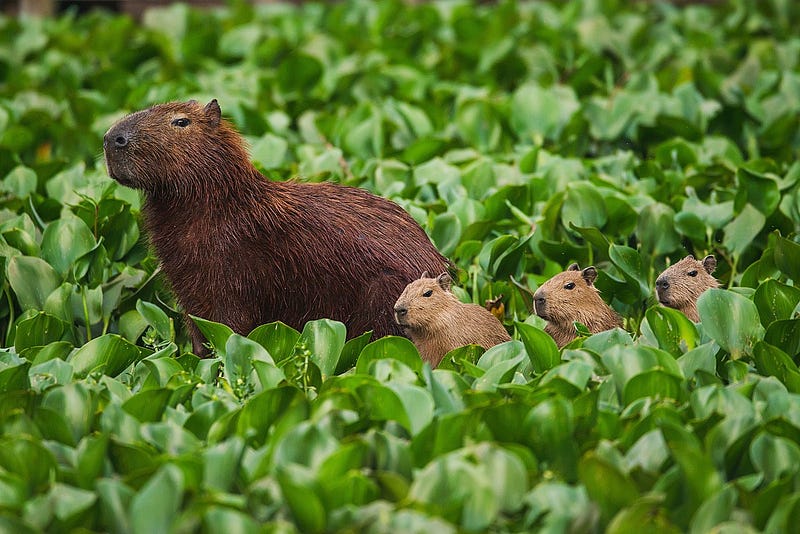
[Photo: Clodomiro Esteves Junior, CC BY-SA 4.0, via Wikimedia Commons]

The capybara (Hydrochoerus hydrochaeris) is a rodent belonging to the cavy family, the same family as the popular guinea pig, or domestic cavy. Its name comes from the Tupi tribe language and means “grass eater.” The Latin name, on the other hand, translates to “water pig.” How did this unique designation come about?

It’s the result of a mistake. In 1766, Carl Linnaeus described this species, classifying it into the pig family. It’s easy to understand the error of the Swedish naturalist, as capybaras indeed resemble pigs more than the average rodent in terms of appearance. These animals reach a length of 107 to 130 cm and a height at the withers of 50 to 64 cm. The average weight of a capybara is 35–65 kg. Average, because record holders clearly exceed these averaged values. The heaviest known female reached a whopping 91 kg!
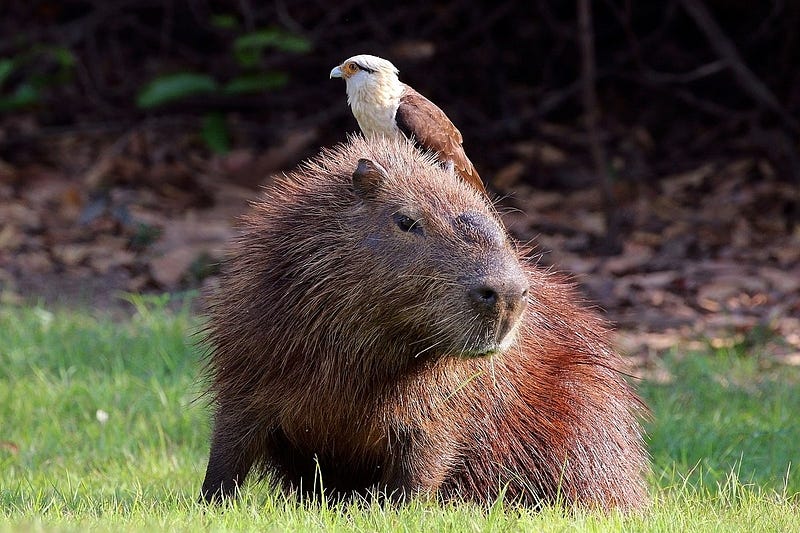
[Photo: Charles J. Sharp, CC BY-SA 4.0, via Wikimedia Commons]

Where do capybaras live?

Capybaras are found in South America. They can be encountered in an area stretching from Panama through western Colombia, Venezuela, Brazil, Ecuador, Peru, and Paraguay, all the way to the northern part of Argentina. They also inhabit Bolivia, Uruguay, and Guyana.

The habitats of these animals are located in grassy areas, providing access to bodies of water. They prefer marshy areas, riverbanks, wet meadows, and mangrove forests, rich in vegetation and offering year-round access to water. They are often found in pastures as well. Capybaras choose them not only for food and water access but also because people ensure that the meadows where cattle graze are protected from predators, making the large rodents feel safe there.

It’s worth mentioning, however, that these animals also occur in drier areas. This includes mainly llanos formations and alluvial plains. These places are characterized by high environmental variability. During dry periods, small water reservoirs dry up, as does the grassy vegetation. The animals lose not only access to food but also their natural protection against predators. To survive, capybara herds must migrate toward major rivers.

[Photo by Sabrina Martins from Pexels]

Capybara’s lifestyle

Capybaras are semi-aquatic animals. They live in open spaces, near bodies of water or watercourses. Unlike many other rodents, they do not dig burrows. On land, they primarily seek refuge in tall grass. They live in herds ranging from 10 to 30 individuals. During dry periods, when animals migrate toward water and food-rich areas, individual groups join together to form larger herds, consisting of about 100 animals. Only a few individuals (up to 10% of the population) lead a solitary lifestyle.

Capybaras communicate using specific sounds. Their vocal repertoire includes squeaks, whistles, and chattering. Thanks to glands located near the anus, they can also communicate through scent signals.

A capybara’s day follows a specific pattern. In the morning, the animals rest in the water. As the temperature rises, they move to shallower areas or roll in the mud, protecting their skin from the sun’s burning rays. They become active only in the late afternoon when the temperature drops. They then go foraging and graze into the night.

These unique rodents are quite selective about their food. They mainly feed on grass, aquatic vegetation (mainly water hyacinths), seeds, the bark of young trees, and occasional fruits. During the rainy season, their diet is limited to 3, at most 6, plant species. They obtain food using massive incisors that grow throughout their lives.

Capybaras can reproduce throughout the year, but their peak activity occurs at the beginning of the rainy season. Females reach sexual maturity after 18 months of life. During the mating season, males release a musky scent (a yellowish substance with a distinctive odor from glands on their snouts) to attract potential mates. The pregnancy lasts for 5 months, and a litter can consist of up to 8 young, born with open eyes and a full set of teeth. The mother nurses them for up to 4 months. Occasionally, other females in the herd may also take part in caring for the young.

[Photo by Pixabay]

Capybara Tail

The world’s largest rodent is characterized by a robust body structure, a large head with a square snout, and short but powerful limbs. The front limbs have four toes, while the hind limbs have three. Their coarse fur (yellow-brown on the belly and brown on the back) is short and somewhat sparse, providing inadequate protection against sunlight. To prevent skin burns, the animals roll in the mud. It’s worth mentioning that capybaras have sweat glands, which is not a common feature among rodents.

It is often claimed that capybaras don’t have a tail. This is not true. These animals do have a tail, but it is vestigial, as the actual tail has disappeared through evolution.
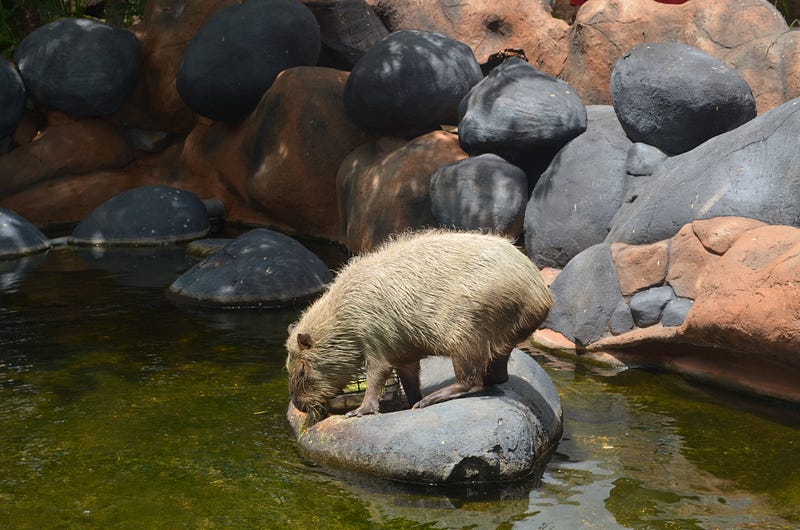
[Photo by Rudi Hantono from Pexels]

Incredible Abilities of Capybaras

One of the distinctive features of capybaras is the placement of their eyes, nostrils, and ears high on their heads. This has its rationale. Capybaras feel comfortable in aquatic environments, and thanks to this specific trait, they can utilize well-developed senses of sight, hearing, and smell even when almost completely submerged.

Their adaptation to aquatic life is also evident in other mechanisms. While diving, they can close their noses and ears, holding their breath for up to five minutes. A webbed membrane between the toes of their front and hind limbs facilitates swimming. Long claws don’t serve a defensive purpose, but they enable capybaras to move efficiently in marshy and muddy areas.

On land, they may seem awkward and slow. It’s true that they usually move slowly, but that doesn’t mean they cannot run. On the contrary, when a capybara needs to flee, it turns out to be a true sprinter, reaching speeds of about 30 km/h, but only for short distances.
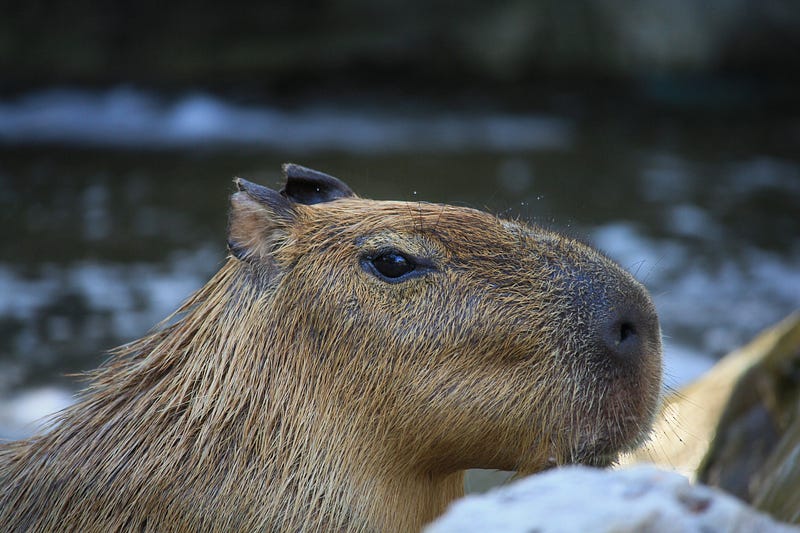
[Photo by Rutpratheep Nilpechr from Pexels]

Capybara and Relationships with Other Animals

Why is the capybara so adept in water? This has a reason. These animals have not developed any defensive mechanisms, making them easy prey for predators. Natural enemies include birds (especially harpy eagles, black vultures, and black-collared hawks) and cats (primarily ocelots, jaguars, and cougars). In moments of danger, capybaras escape into the water and remain submerged as long as possible.

However, this is not a foolproof strategy, as there are also many dangers in the aquatic environment. Piranhas and anacondas pose threats, but most individuals meet their end in the jaws of caimans.

It’s worth mentioning that there are non-antagonistic interactions between capybaras and some bird species, mainly related to obtaining food. Small birds (especially rufous horneros) search the rodents’ fur for parasites. Others perch on the capybaras’ backs, scouting for prey.
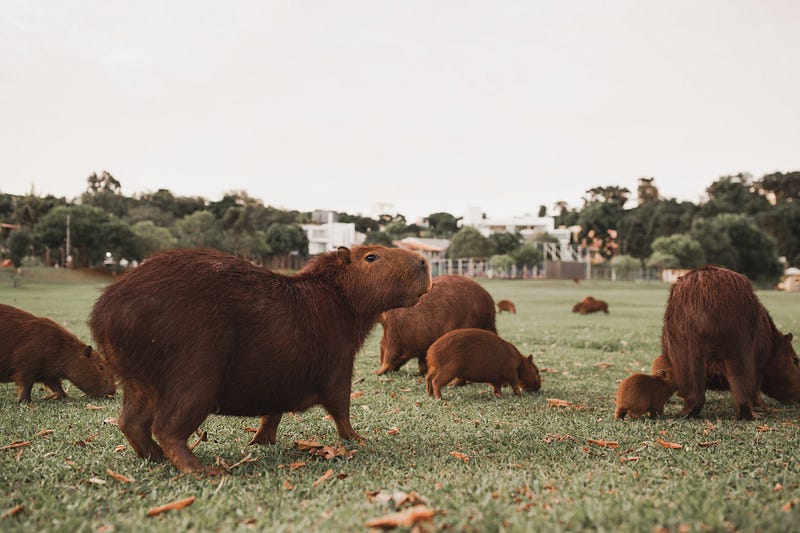
[Photo by Tim Gomes from Pexels]

Dark Sides of Capybaras

Capybaras are gentle, non-aggressive creatures, but this characteristic has a dark side. These animals are not very protective parents. In the event of a predator attack, they don’t defend their young, so immature and still clumsy individuals often fall victim to carnivores.

At times, these impressive rodents encroach on human-inhabited areas, especially when their natural habitats shrink. In such cases, they can cause damage to crops, and due to the size of their herds, the losses can be substantial.

Another unpleasant thing that cannot be overlooked — capybaras are coprophagic. This means they may feed on their own feces. This way, they maximize the use of nutrients and replenish the bacterial flora.
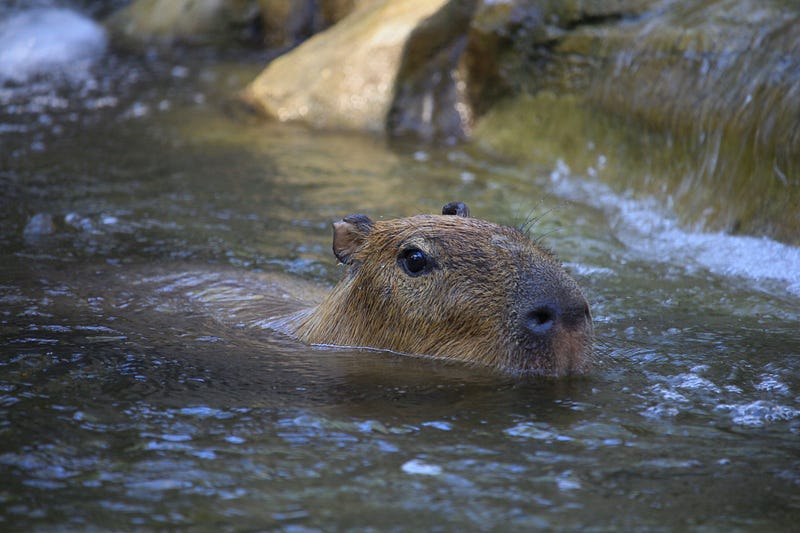
[Photo by Rutpratheep Nilpechr from Pexels]

How long do capybaras live?

In their natural environment, capybaras typically live up to 4–5 years on average. This is primarily due to the long list of natural predators these animals face. In captivity, they can survive for up to 10 years.

Hold on a moment… in captivity? Yes, because capybaras can be tamed and bred. Even though it’s an exotic animal, regulations in many countries allow for this possibility.
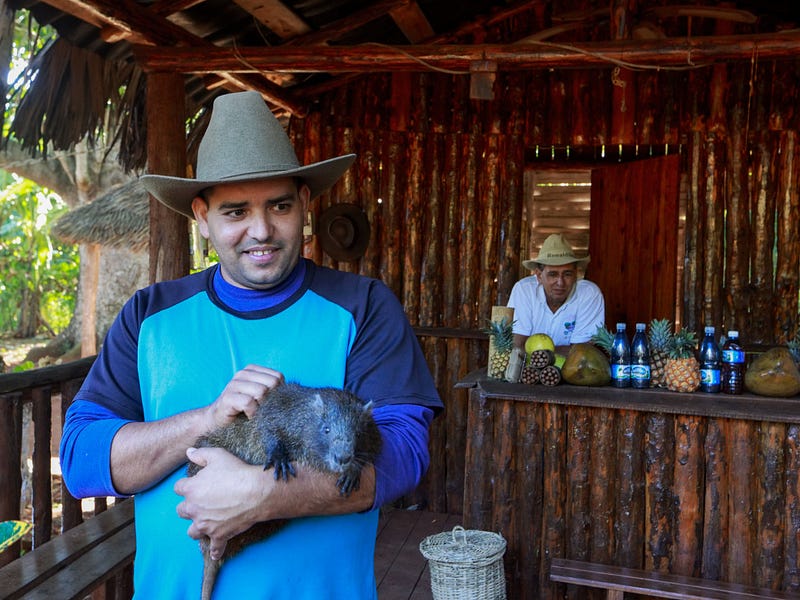
[Photo by Mehmet Turgut Kirkgoz from Pexels]

How much does a capybara cost? Domestic breeding

However, it’s important to realize that if treated as a domestic pet, a capybara becomes one of the most demanding animals to maintain. These charming rodents, in their natural habitat, live in herds, and that’s how they should live in captivity. The absolute minimum is two (preferably three) individuals. Solitude proves to be a significant stress factor for capybaras, impacting their health.

The enclosure must have at least 50 square meters (for a pair), and the same space must be provided indoors. It’s essential to remember that external conditions are not favorable for these animals in the winter. They must have access to a water reservoir with a surface area of at least 20 square meters and a depth of 3 meters. Shaded areas should not be missing in the enclosure.

Capybaras also have high dietary requirements. The staple of their diet in captivity is hay. Fruits and vegetables should also be included in their menu, along with a special vitamin C granulate, as the animal’s body does not produce enough of this micronutrient.

The cost of one individual ranges from 1,500 to 3,000 dollars. To meet the herd needs of these animals, it’s best to buy one male and two females. Therefore, one must be prepared for a significant expense.

Attention all readers!

As content creators on Medium.com, we face minimal compensation for our hard work. If you find value in my articles, please consider supporting me on my “Buy Me a Coffee” page. Your small contributions can make a big difference in fueling my passion for creating quality content. Thank you for your support!

https://www.buymeacoffee.com/oconnel
Science
Animals
Nature
Life
Life Lessons
Recommended from ReadMedium