avatarChristopher P Jones

Free AI web copilot to create summaries, insights and extended knowledge, download it at here

4288

Abstract

akes up one thread. The other is implied by the anatomy of the music itself, beginning with the tuning of the instrument and completing with the songs that are played.</p><h1 id="6fdb">Personal Improvement</h1><figure id="7a4b"><img src="https://cdn-images-1.readmedium.com/v2/resize:fit:800/1*KK2qPCS8o1GbF8w2lqOAPg.jpeg"><figcaption>Allegory of Music (1649) by Laurent de La Hyre. Oil on canvas. 105.7 × 144.1 cm. The Metropolitan Museum of Art, New York, U.S. Image source <a href="https://www.metmuseum.org/art/collection/search/436836">The Met</a></figcaption></figure><p id="b9a5">Musical instruments — always in need of tuning — became an apt symbol for the calibration necessary in life as a whole. This painting, by the French artist Laurent de La Hyre, eloquently captures the reverence given to the fine-tuning of a musical instrument. The allegorical figure of Music delicately adjusts the tightness of the strings on her grand instrument — a theorbo (a type of lute) — symbolising the pursuit of balance through her patient alterations.</p><p id="d409">Notice the nightingale sitting behind her, a well-known songbird, hinting at the parity between the music of nature and music made by humans through practice and theory. Positioned on the table before her are a violin, flageolets (or recorders), and an open book of music, embodying the diverse facets of musical expression.</p><p id="f783">As the de La Hyre painting suggests, the learning of music has long been recognised as an integral component of a well-rounded education, a belief rooted in ancient times.</p><p id="c200">In Baldassare Castiglione’s seminal work, <i>The Book of the Courtier</i> (1528), the Italian author emphasises the indispensable role of music in shaping a refined courtier.</p><blockquote id="16c6"><p>“Gentlemen, I must tell you that I am not satisfied with our courtier unless he is also a musician and unless as well as understanding and being able to read music he can play several instruments.”</p></blockquote><figure id="f965"><img src="https://cdn-images-1.readmedium.com/v2/resize:fit:800/1*FwdFA_0kzWWiftSQKFRclg.jpeg"><figcaption>The Music Lesson (c. 1662–1664) by Johannes Vermeer. Oil on canvas. 74.1 × 64.6 cm. Royal Collection, London, UK. Image source <a href="https://commons.wikimedia.org/wiki/File:Johannes_Vermeer_-_Lady_at_the_Virginal_with_a_Gentleman,_'The_Music_Lesson'_-_Google_Art_Project.jpg">Wikimedia Commons</a></figcaption></figure><p id="1ebe">Turning to Johannes Vermeer’s <i>The Music Lesson</i>, we see a female pupil engaged in such a tuition. She stands at a virginal, a box-shaped keyboard instrument not too dissimilar to a harpsichord.</p><p id="98e8">Vermeer expertly adds ambiguity to the scene: in the mirror above the pupil’s head we can see she has turned slightly towards the man, who, with his mouth slightly open, may be singing along.</p><p id="2074">Musical cooperation in this case may also suggest a romantic concert too, since in 17th-century Dutch art the theme of love was often portrayed through the symbolism of musical collaboration.</p><h1 id="1732">Performance</h1><p id="8352">If the previous set of paintings expressed the virtues (and intimacy) of a musical education, then these ones explore the visceral and seductive pleasures derived from musical performance.</p><figure id="d0d8"><img src="https://cdn-images-1.readmedium.com/v2/resize:fit:800/1*Z4LDi5eRQNpPH8B6bMv6fg.jpeg"><figcaption><i>Sappho and Alcaeus (</i>1881<i>) by </i>Sir Lawrence Alma-Tadema. Oil on panel. 104.14 × 154.94 cm. The Walters Art Museum, Baltimore, U.S. Image source <a href="https://commons.wikimedia.org/wiki/File:Sir_Lawrence_Alma-Tadema,_R.A.,_O.M._-_Sappho_and_Alcaeus_-_Google_Art_Project.jpg">Wikimedia Commons</a></figcaption></figure><p id="49cf">Lawrence Alma-Tadema’s painting <i>Sappho and Alcaeus</i> shows a concert in which the Mycenaean prince Alcaeus performs to the Greek poet Sappho. He plays a stringed kithara to a select audience, with the Aegean Sea in the background stretching into the distance.</p><p id="7ebd">Sappho’s attention to the performance tells us how much the music has enraptured her. Gazing towards him with her arm resting on a cushion before her — which bears a laurel wreath destined for the performer’s he

Options

ad — the open-air concert suggests pleasure and enchantment in equal measure.</p><figure id="abfb"><img src="https://cdn-images-1.readmedium.com/v2/resize:fit:800/1*h61LiXbpTOdNi7GOjzbFiQ.jpeg"><figcaption>Spanish Dancer (El Jaleo) (1882) by John Singer Sargent. Oil on canvas. 232 × 348 cm. Isabella Stewart Gardner Museum, Boston, Massachusetts, U.S. Image source <a href="https://commons.wikimedia.org/wiki/File:EL_JALEO-SINGER.jpg">Wikimedia Commons</a></figcaption></figure><p id="53b5">Exploring a different musical tempo, John Singer Sargent’s painting <i>Spanish Dancer</i> captures a Spanish Romani dancer in full expressive flow. Her spot-lit performance is accompanied by a band of flamenco musicians lined up against the rear wall.</p><p id="b797">At three and a half metres wide, Sargent’s painting is expansive. He spent a year planning with preliminary sketches, allowing the execution of the painting to happen quickly and with rapid brushstrokes — much in keeping with the flare and briskness of the performance itself.</p><figure id="7e43"><img src="https://cdn-images-1.readmedium.com/v2/resize:fit:800/1*UAmPgu1cDPNPi1F7608s6g.jpeg"><figcaption>The Can-Can (1889) by Georges Seurat. Oil on canvas. 170 × 141 cm. Kröller-Müller Museum, Otterlo, Netherlands. Image source <a href="https://commons.wikimedia.org/wiki/File%253AGeorges_Seurat%252C_1889-90%252C_Le_Chahut%252C_Kr%C3%B6ller-M%C3%BCller_Museum.jpg">Wikimedia Commons</a></figcaption></figure><p id="39c4">Painted in the same decade as Sargent’s painting, Georges Seurat employed his much-less-rapid “pointillist” technique to depict a troupe of Can-Can dancers performing to a French music-hall orchestra.</p><p id="21a8">The effect here is different: snappy realism is displaced by a stylised study of the life and exuberance of the popular 19th-century Parisian entertainment, where petticoats and high kicks move in rhythm to the baton of the conductor.</p><figure id="9be7"><img src="https://cdn-images-1.readmedium.com/v2/resize:fit:800/1*mY9cKXr2KwXydWTihic7Pg.jpeg"><figcaption>Orchestra Musicians<i> (</i>1872–76<i>) by Edgar Degas. Oil on canvas. 69 </i>×<i> 49 cm. </i>The Städel Museum, Frankfurt, Germany. Image source <a href="https://commons.wikimedia.org/wiki/File:Edgar_Degas_-_Orchestra_Musicians_-_Google_Art_Project.jpg">Wikimedia Commons</a></figcaption></figure><p id="4b19">A similar composition can be found in Degas’ <i>Orchestra Musicians</i>. In the painting, we once more see a view from the orchestra pit, but this time at a ballet performance.</p><p id="5974">Degas’ striking canvas — dividing the composition into two distinct parts — puts us firmly in the locus of the musicians. Here we rub shoulders with the cellist and violinist, illuminating the atmosphere of the setting, with the tight-knit interplay between music and the performance.</p><p id="3c6d">Depictions of music captured in these artworks tell us much about the profound physical relationship we have with music: the shape and size of the instrument being played, the body’s relationship with rhythm and tempo, as well as the intellectual and emotional response to the melody.</p><p id="40d2">Art possesses the ability to direct our attention to dimensions of music that extend beyond the realm of sound alone. In this regard, painting emerges as a powerful counterpart — with a wealth of insights to offer about the multifaceted nature of the art of music.</p><figure id="8317"><img src="https://cdn-images-1.readmedium.com/v2/resize:fit:800/1*igQbKCOI4qGLg6JzYP7H9w.png"><figcaption></figcaption></figure><p id="df58">If you liked this, you may also be interested in my book <a href="https://www.chrisjoneswrites.co.uk/great-paintings-that-tell-stories/"><i>Great Paintings That Tell Stories</i></a><i>, </i>an examination of some of art’s most enthralling images.</p><h1 id="b1e3">Would you like to get…</h1><p id="6e73">A free guide to the <i>Essential Styles in Western Art History</i>, plus updates and exclusive news about me and my writing? <a href="https://www.chrisjoneswrites.co.uk/sign-up-art/">Download for free here</a>.</p><h1 id="e6cc">Join me…</h1><p id="f85e">On <a href="https://www.instagram.com/greatpaintingsexplained/">Instagram</a> for more great paintings on the go!</p></article></body>

Captivating Moments of Music in Art

Painted masterpieces that explore popular musical themes used by artists
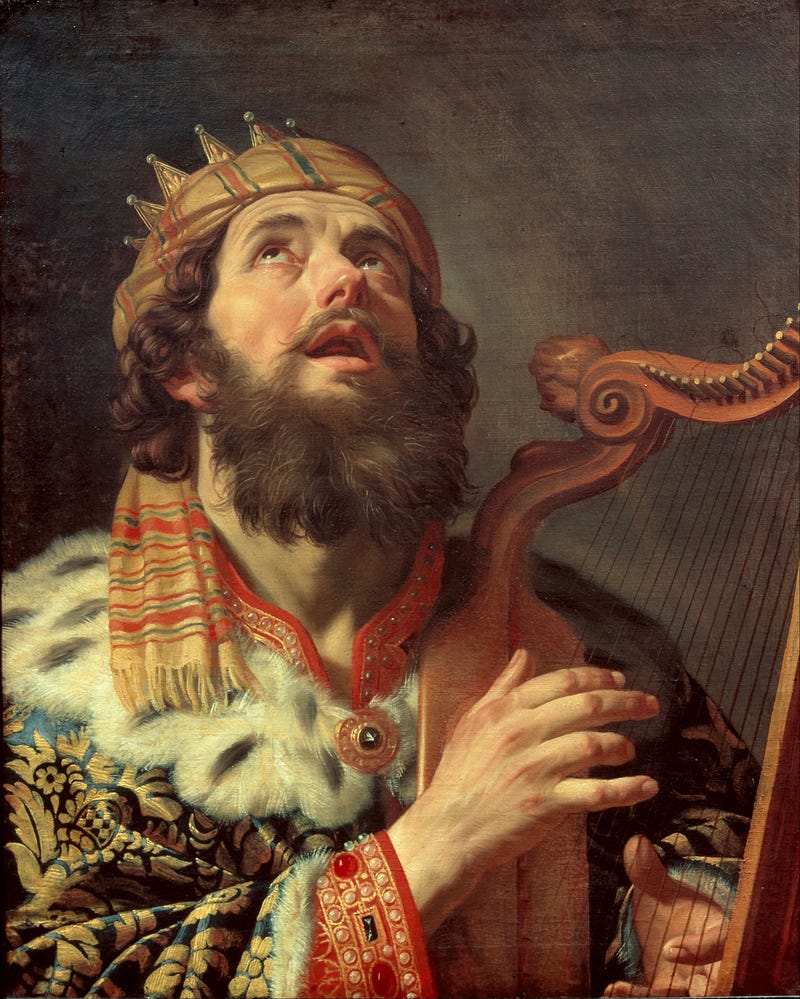
King David Playing the Harp (1622) by Gerrit van Honthorst. Oil on canvas, 81 × 65 cm. Centraal Museum, Utrecht, Netherlands. Image source Wikimedia Commons

Music has always been a popular subject of paintings, thanks to the ability of artists to describe the meaningful, irresistible and often passionate connection we share with music.

What art can do is draw our attention to aspects of music that lie outside of the audioscape itself: the ambience, the setting, the way music features in our lives and its effect on the listener.

In this regard, painting has much to teach us…

Enchanting Harmony
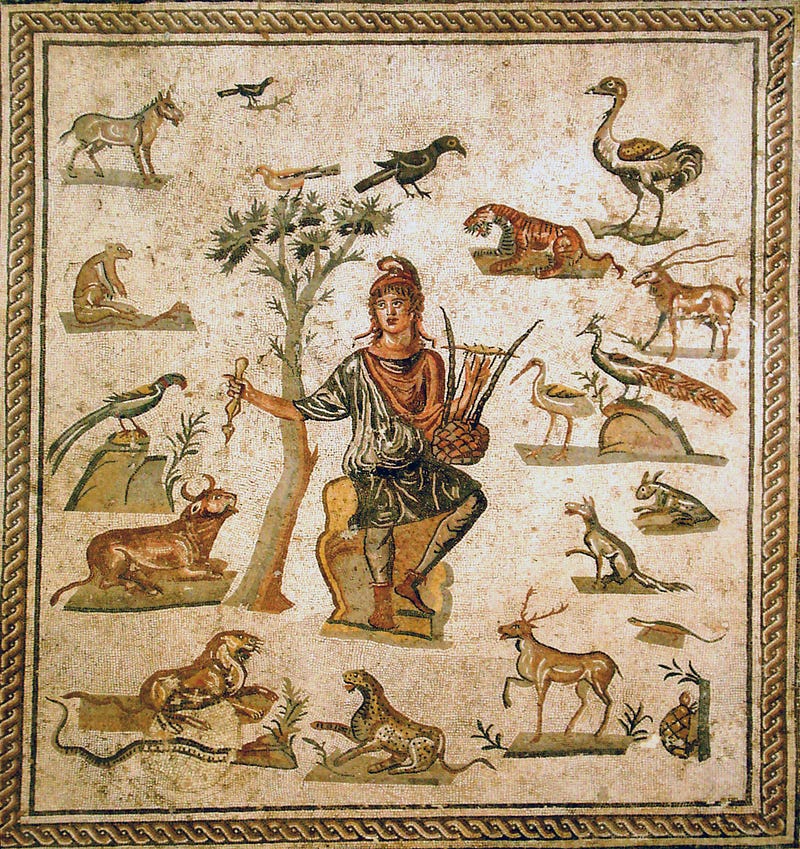
Ancient Roman floor mosaic showing Orpheus charming the animals with his music. Originally from Palermo, now in the Museo archeologico regionale di Palermo. Image source Wikimedia Commons

If we reach back to antiquity, one of the first musicians was the Greek Orpheus. So talented was he that almost everyone who heard him sing and play fell in love with him, including Eurydice — who would become his tragic lover.

The ancient Roman mosaic shown above depicts Orpheus sitting beneath a tree playing his stringed lyre, taming the animals with his music, wild and domestic alike. The beauty of his music was said to even charm the trees and rocks, and here the entranced animals draw close to him, blithely unaware of each other.

King David Playing the Harp (1622) by Gerrit van Honthorst. Oil on canvas, 81 × 65 cm. Centraal Museum, Utrecht, Netherlands. Image source Wikimedia Commons

The figure of Orpheus sometimes echoes depictions of David, the shepherd boy who became the king of Israel. As a young man, David showed courage by killing the giant Goliath; just as popular in art was another aspect of his personality, that of a skilled musician.

As Gerrit van Honthorst captures in his rhapsodic painting King David Playing the Harp, David’s playing was poetic, so much so that when he performed before Saul, the elder’s melancholy was swept away by David’s sweet-sounding music.

The elevated position of David’s eyes and voice proposes the divine element of his melody, as well as the cherub’s head which listens at the helm of the harp.
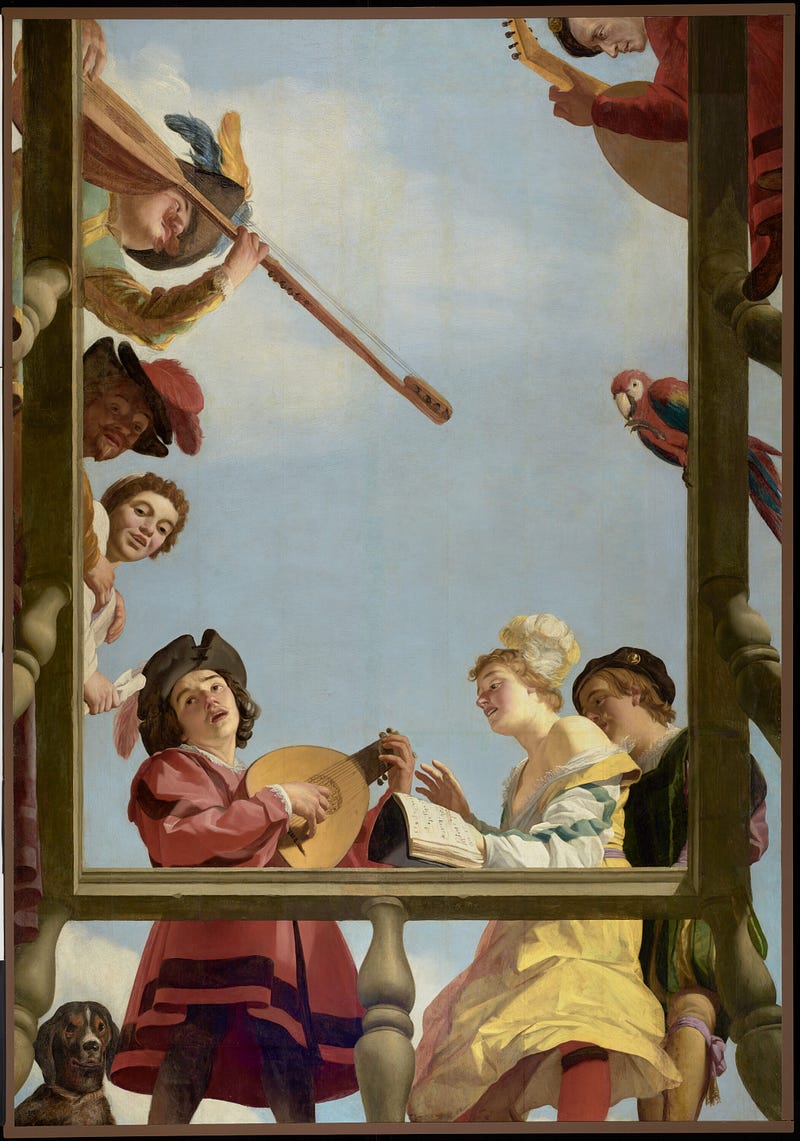
Musical Group on a Balcony (1622) by Gerrit van Honthorst. Oil on panel. 309.9 × 216.4 cm. Getty Center, Los Angeles, California, U.S. Image source Getty Museum

Both David and Orpheus reveal a notable strand in the meaning of music in art. For when music is played — artists tell us — that it can induce peace and accord.

Such euphony beams down on us from above in another painting by Honthorst, this time Musical Group on a Balcony. As we look skyward, so the revellers peer down on us (including a pliant macaw and a dog), with musicians gathered around a balustrade forming an allegory of musical harmony.

Music in this case stands for concord and unity. The convivial aspect of music — of players, singers, listeners and dancers — makes up one thread. The other is implied by the anatomy of the music itself, beginning with the tuning of the instrument and completing with the songs that are played.

Personal Improvement
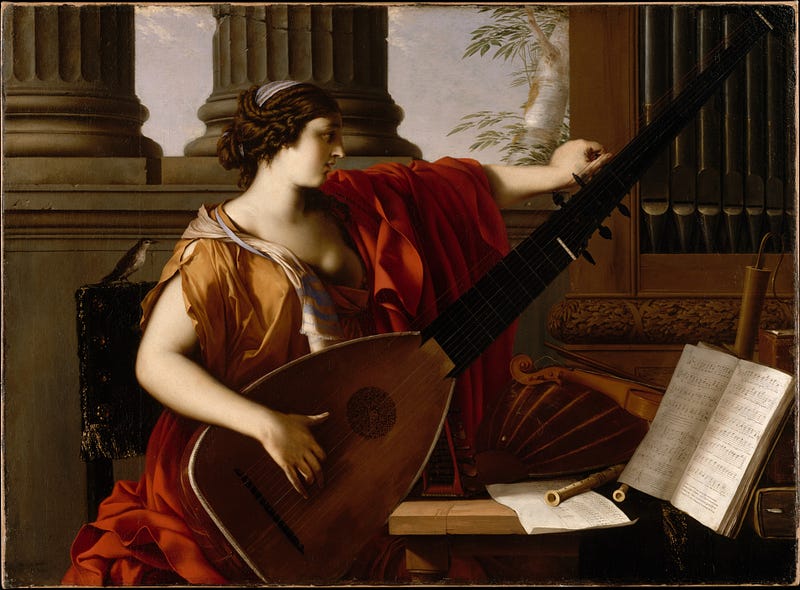
Allegory of Music (1649) by Laurent de La Hyre. Oil on canvas. 105.7 × 144.1 cm. The Metropolitan Museum of Art, New York, U.S. Image source The Met

Musical instruments — always in need of tuning — became an apt symbol for the calibration necessary in life as a whole. This painting, by the French artist Laurent de La Hyre, eloquently captures the reverence given to the fine-tuning of a musical instrument. The allegorical figure of Music delicately adjusts the tightness of the strings on her grand instrument — a theorbo (a type of lute) — symbolising the pursuit of balance through her patient alterations.

Notice the nightingale sitting behind her, a well-known songbird, hinting at the parity between the music of nature and music made by humans through practice and theory. Positioned on the table before her are a violin, flageolets (or recorders), and an open book of music, embodying the diverse facets of musical expression.

As the de La Hyre painting suggests, the learning of music has long been recognised as an integral component of a well-rounded education, a belief rooted in ancient times.

In Baldassare Castiglione’s seminal work, The Book of the Courtier (1528), the Italian author emphasises the indispensable role of music in shaping a refined courtier.

“Gentlemen, I must tell you that I am not satisfied with our courtier unless he is also a musician and unless as well as understanding and being able to read music he can play several instruments.”
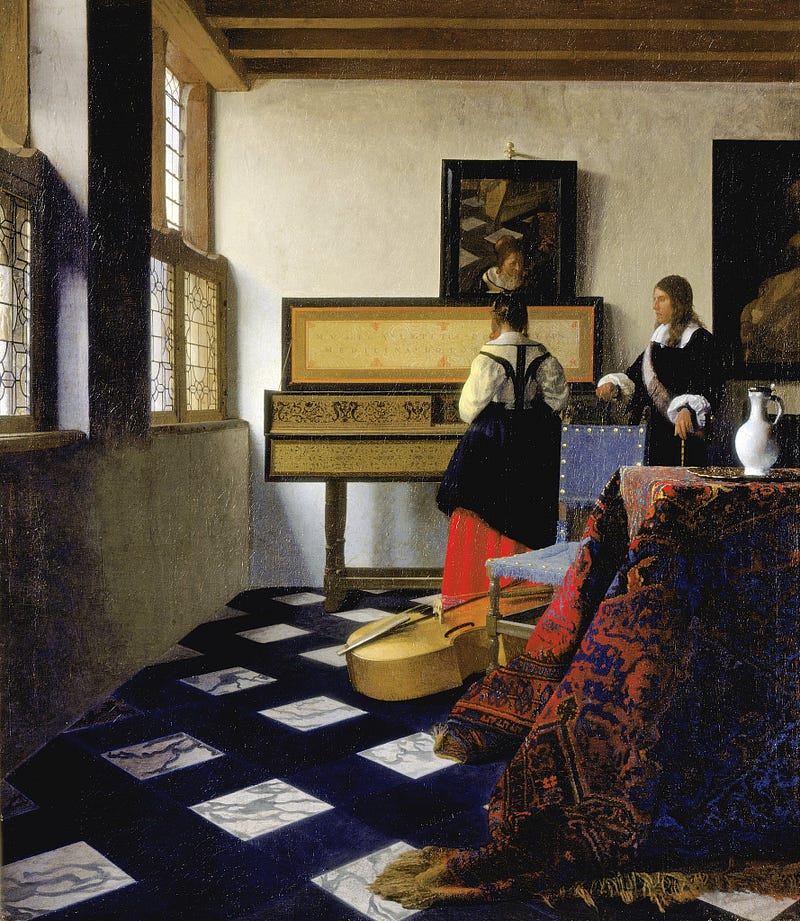
The Music Lesson (c. 1662–1664) by Johannes Vermeer. Oil on canvas. 74.1 × 64.6 cm. Royal Collection, London, UK. Image source Wikimedia Commons

Turning to Johannes Vermeer’s The Music Lesson, we see a female pupil engaged in such a tuition. She stands at a virginal, a box-shaped keyboard instrument not too dissimilar to a harpsichord.

Vermeer expertly adds ambiguity to the scene: in the mirror above the pupil’s head we can see she has turned slightly towards the man, who, with his mouth slightly open, may be singing along.

Musical cooperation in this case may also suggest a romantic concert too, since in 17th-century Dutch art the theme of love was often portrayed through the symbolism of musical collaboration.

Performance

If the previous set of paintings expressed the virtues (and intimacy) of a musical education, then these ones explore the visceral and seductive pleasures derived from musical performance.
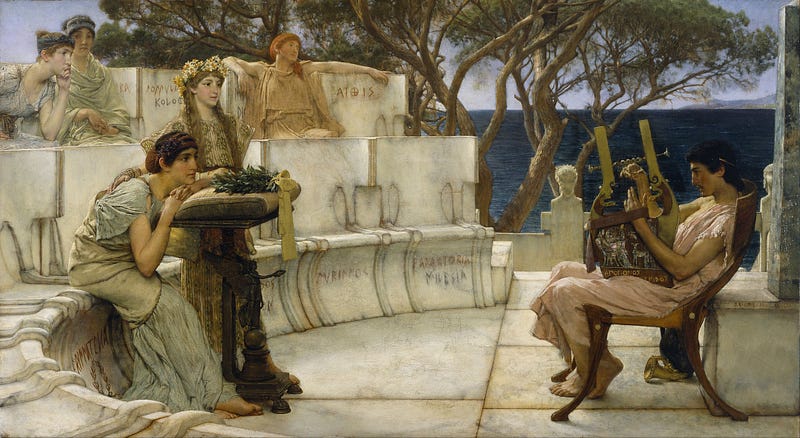
Sappho and Alcaeus (1881) by Sir Lawrence Alma-Tadema. Oil on panel. 104.14 × 154.94 cm. The Walters Art Museum, Baltimore, U.S. Image source Wikimedia Commons

Lawrence Alma-Tadema’s painting Sappho and Alcaeus shows a concert in which the Mycenaean prince Alcaeus performs to the Greek poet Sappho. He plays a stringed kithara to a select audience, with the Aegean Sea in the background stretching into the distance.

Sappho’s attention to the performance tells us how much the music has enraptured her. Gazing towards him with her arm resting on a cushion before her — which bears a laurel wreath destined for the performer’s head — the open-air concert suggests pleasure and enchantment in equal measure.
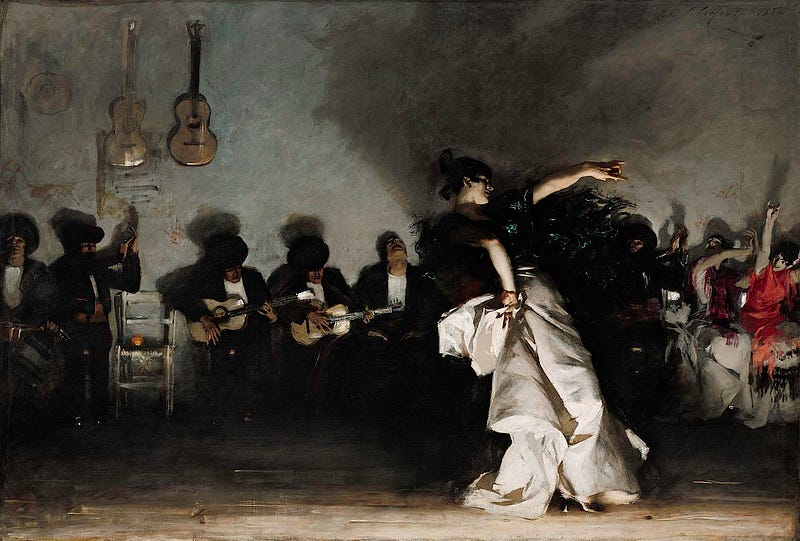
Spanish Dancer (El Jaleo) (1882) by John Singer Sargent. Oil on canvas. 232 × 348 cm. Isabella Stewart Gardner Museum, Boston, Massachusetts, U.S. Image source Wikimedia Commons

Exploring a different musical tempo, John Singer Sargent’s painting Spanish Dancer captures a Spanish Romani dancer in full expressive flow. Her spot-lit performance is accompanied by a band of flamenco musicians lined up against the rear wall.

At three and a half metres wide, Sargent’s painting is expansive. He spent a year planning with preliminary sketches, allowing the execution of the painting to happen quickly and with rapid brushstrokes — much in keeping with the flare and briskness of the performance itself.
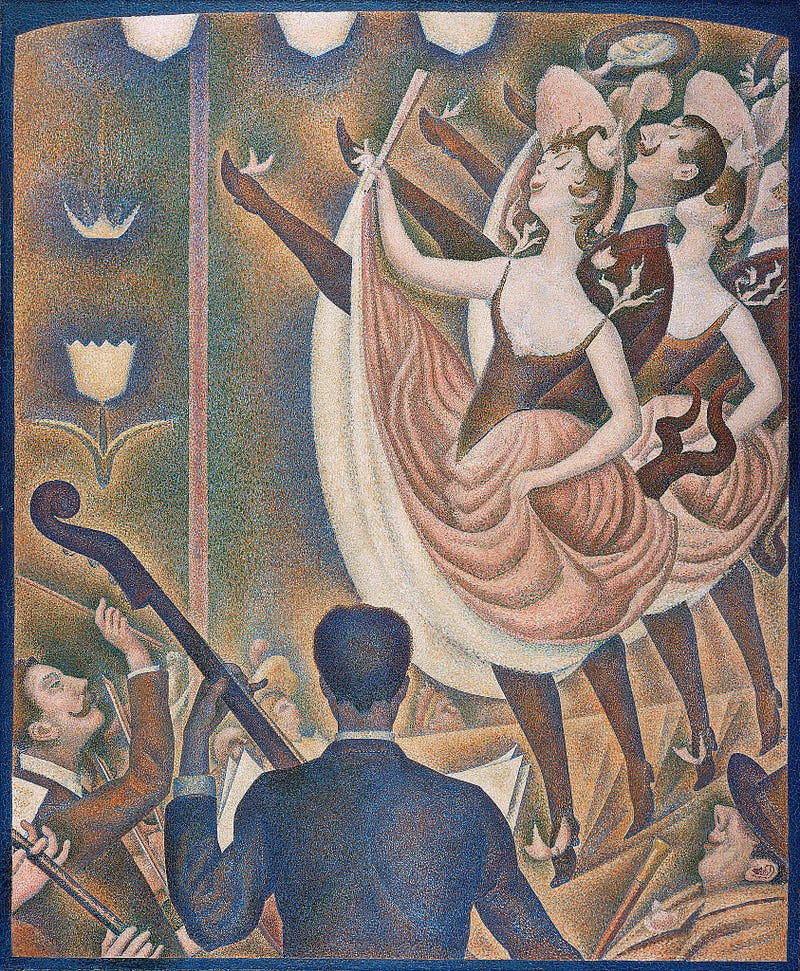
The Can-Can (1889) by Georges Seurat. Oil on canvas. 170 × 141 cm. Kröller-Müller Museum, Otterlo, Netherlands. Image source Wikimedia Commons

Painted in the same decade as Sargent’s painting, Georges Seurat employed his much-less-rapid “pointillist” technique to depict a troupe of Can-Can dancers performing to a French music-hall orchestra.

The effect here is different: snappy realism is displaced by a stylised study of the life and exuberance of the popular 19th-century Parisian entertainment, where petticoats and high kicks move in rhythm to the baton of the conductor.
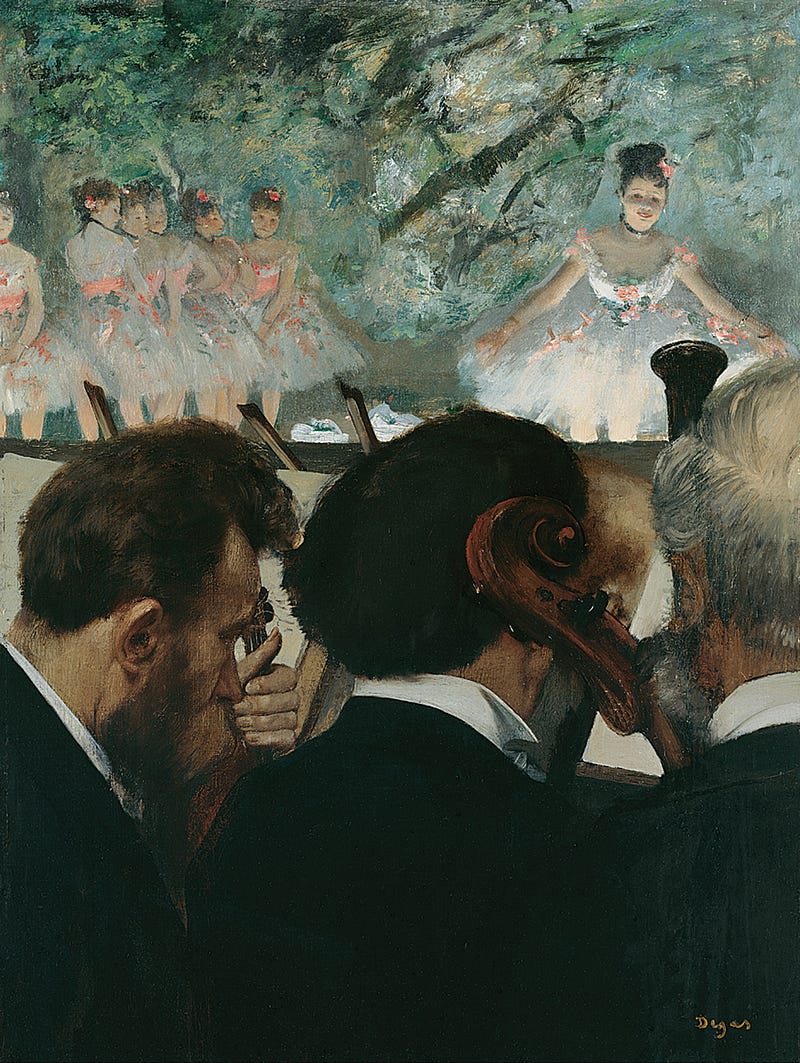
Orchestra Musicians (1872–76) by Edgar Degas. Oil on canvas. 69 × 49 cm. The Städel Museum, Frankfurt, Germany. Image source Wikimedia Commons

A similar composition can be found in Degas’ Orchestra Musicians. In the painting, we once more see a view from the orchestra pit, but this time at a ballet performance.

Degas’ striking canvas — dividing the composition into two distinct parts — puts us firmly in the locus of the musicians. Here we rub shoulders with the cellist and violinist, illuminating the atmosphere of the setting, with the tight-knit interplay between music and the performance.

Depictions of music captured in these artworks tell us much about the profound physical relationship we have with music: the shape and size of the instrument being played, the body’s relationship with rhythm and tempo, as well as the intellectual and emotional response to the melody.

Art possesses the ability to direct our attention to dimensions of music that extend beyond the realm of sound alone. In this regard, painting emerges as a powerful counterpart — with a wealth of insights to offer about the multifaceted nature of the art of music.

If you liked this, you may also be interested in my book Great Paintings That Tell Stories, an examination of some of art’s most enthralling images.

Would you like to get…

A free guide to the Essential Styles in Western Art History, plus updates and exclusive news about me and my writing? Download for free here.

Join me…

On Instagram for more great paintings on the go!

Art
Music
Art History
Culture
Creativity
Recommended from ReadMedium