
Capturing the Elusive: A Long-Lost Bird Emerges in a Camera Lens After Two Decades
Scientists from Texas have made an extraordinary discovery. In the Democratic Republic of Congo, they found a species of bird that has been considered lost for two decades.
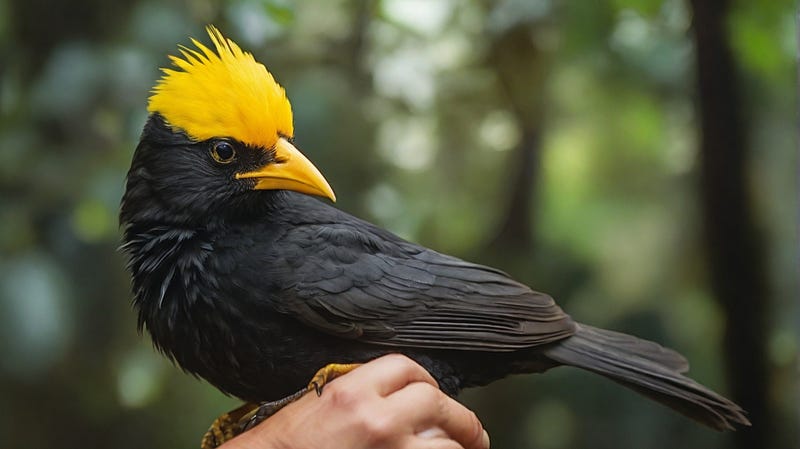
Prionops alberti is a species of bird from the vanga family. It has black plumage covering almost its entire body and bright yellow feathers on its head, resembling a helmet. It belongs to the genus Prionops, which comprises seven or eight species in total. They are found only in Sub-Saharan Africa. This genus was first defined in 1816 by the French ornithologist Louis Jean Pierre Vieillot in his publication “Analyse d’une nouvelle ornithologie élémentaire.”
Scientists rediscovered the lost bird.
The species P. alberti was identified only in 1933. The discovery was made by Henri Schouteden, an ornithologist from Belgium, during his work at the Royal Museum for Central Africa. The yellow-headed helmet-shrike is a very rare and endemic species to this region.
A few years ago, the American Bird Conservancy declared this species as “lost” because no one had seen it for nearly 20 years. Scientists from the University of Texas at El Paso decided to embark on a journey to the Democratic Republic of Congo in search of this elusive creature. During an expedition lasting over a month and a half, they managed to capture its first photograph in two decades in the vicinity of the Itombwe mountain range.
Over 120 km to reach the location.
The team sent the photographs to the American Bird Conservancy. Dr. Cameron Rutt carefully examined and analyzed them, confirming that the bird in the photos was indeed P. alberti.
“Encountering this bird was a stunning experience. We knew the animals could occur here, but I wasn’t prepared for how spectacular and exceptional they would look in person,” said Dr. Michael Harvey, an ornithologist at the University of Texas at El Paso.
The expedition team also included Dr. Eli Greenbaum, a professor of biological sciences at the University of Texas. The team also included ornithologist Matt Brady, as well as a group of Congolese researchers from the Centre de Recherche en Sciences Naturelles, including Dr. Chifundera Kusamba, Robert Kizungu Byamana, and Chance Bahati Muhigirwa.
The scientists conveyed that to reach the location where they found the birds, they had to trek on foot for up to 120 km. The team encountered the lost animals while exploring the misty forests at the foot of the mountains.
“The birds were quite noisy and formed groups right in the middle of the forest,” Professor Harvey said.
Species and region conservation.
“This bird is endemic to the western slopes of the Great Rift Valley in Central Africa. It is a region largely inaccessible due to war and security issues, but recently, visiting it has become more feasible,” added the researcher.
The team reported that during the entire expedition, approximately 18 birds were found at three different locations.
“This raises hope that perhaps this species still has a relatively healthy and non-endangered population in the remote forests of the region. However, mining activities, logging, and deforestation for agriculture may lead to population issues for these birds. We are in discussions with other researchers and conservation organizations about further efforts to protect the region,” the ornithologist added.
Interestingly, the rediscovery of P. alberti is not the only success of the El Paso team. They also managed to find Arthroleptis hematogaster, a species of frog from the Arthroleptidae family. This amphibian was also considered a lost species because it hadn’t been seen since the 1950s.
Attention all readers!
As content creators on Medium.com, we face minimal compensation for our hard work. If you find value in my articles, please consider supporting me on my “Buy Me a Coffee” page. Your small contributions can make a big difference in fueling my passion for creating quality content. Thank you for your support!


