
Capitate
The big little bone in your body

Today’s New York Times Spelling Bee letters:
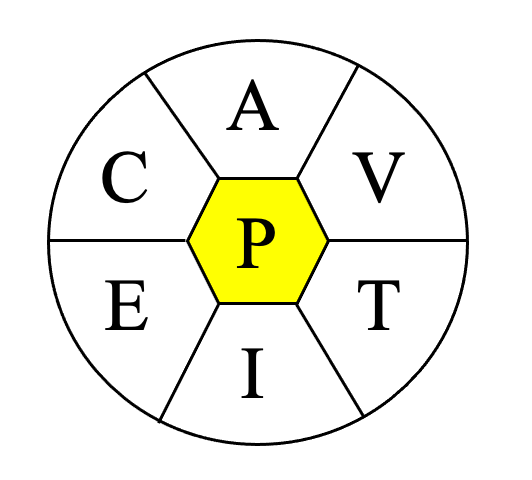
A, C, E, I, T, V, and center P (all words must include P)
Merriam-Webster says…
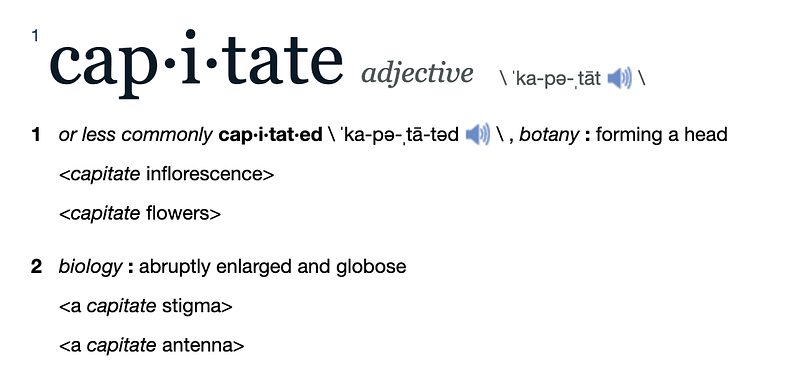
…and…
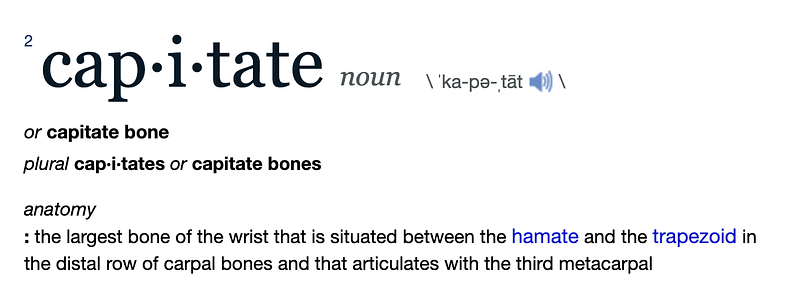
Silly little dictionary! Don’t you know that capitate can’t possibly be a word if The New York Times says it ain’t?
For a complete list of rejected words, check out the Spelling Bee Master.
What’s your favorite dord* from today’s puzzle?
My Two Cents
We here at Silly Little Dictionary! are always looking for new ways to entice people to read our articles. So today we used a word that sounds like it has to do with the head, mentioned a bone in the subtitle, and posted a close-up picture of a flower. Don’t worry, we’ll connect the dots for you.
English is a wonderfully weird language in many ways. One is the fact that some words you can remove the prefix to create an antonym, while others don’t allow you to do that. So, for example, unruffle means “to become calm”, while the prefixless ruffle means “to disturb” or “to agitate”. That works well. However, this wasn’t the case with unflappable (meaning “marked by assurance and self-control”). There was no such thing as flappable… until 1968. That’s when someone decided to back-form it. The term trended and eventually became an official entry in the dictionary (meaning “easily upset”). Those of you who watched the TV show Scrubs may remember Michael J. Fox’s take on the word, here in the first five seconds:
Anyhoo, decapitate –– to remove the head of someone or something–– is one word that does not become its opposite when the prefix is dislodged. You can’t capitate someone by attaching a head to them. Well, maybe if you’re Dr. Frankenstein you can. But the rest of us are not allowed.
And now, to keep you reading beyond this point, by the end of today’s article we will prove that people can be decapitated and still live.
Adjective
Humans and other animals aren’t the only ones that have ovaries; so do plants. In their case, the ovary is the large basal part of the pistil, or female organ of a flower. The ovary serves two main purposes. It contains the ovules,— or plant “eggs”, if you will–– that when fertilized will eventually become seeds. Also, the ovary itself ends up transforming into the fruit that will protect said seeds. Collectively these are known as the gynoecium a word composed from the Ancient Greek words gune, meaning “woman” or “female”, and oîkos, which means “house”.
The ovary has a vertical extension, called style, that ends in an appendage known as the stigma. Together these three elements are referred to as the pistil.
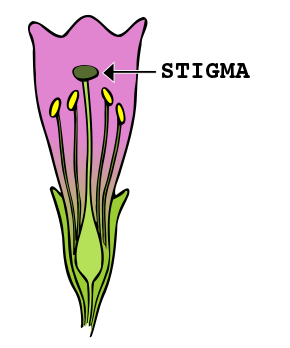
The stigma is the the part that is pollinated, and is where the pollen germinates. The shape of the stigma has a lot of variations, one which is known as capitate and resembles the head of a pin. As in the above illustration. This is what the dictionary was talking about in its second meaning of the adjective form, “abruptly enlarged and globose” with the example “a capitate stigma”.
As for the second example given, “a capitate antenna”… well, it brings to mind those trucks with tennis balls at the top of their radio antennas. Like this one…

…for which you’ll have to supply your own car. You may have seen them our there on the road. If you haven’t, ask someone who was a kid three or four decades ago. I always wondered why people did that, and decided to include this topic in my intensive 15-minute research for today’s article. Turns out it’s a good way to protect the coat of paint on your car if the antenna it has is very long and flexible. Also, it can help you find your vehicle in a crowded parking lot.
Then there’s the technical explanation that “a tennis ball attached to a radio transmitter adds capacitive effects, causing a resonating wavelength movement and a variation in the standing wave ratio (SWR) at that frequency on a formerly adjusted antenna.” Yeah, I didn’t understand a word of that, either. However, if any expert on tennis balls or antennas is reading this article and wishes to clarify this matter for us, they can feel free to do so in the comments section.
Noun
The amazing human wrist is known as the carpus by physicians and people who want to show off their Latin skills. The online Britannica sums up the explanation of its bones as follows:
In humans there are eight, arranged in two rows. The bones in the row toward the forearm are the scaphoid, lunate, triangular, and pisiform. The row toward the fingers, or distal row, includes the trapezium (greater multangular), trapezoid (lesser multangular), capitate, and hamate. The distal row is firmly attached to the metacarpal bones of the hand. The proximal row articulates with the radius (of the forearm) and the articular disk (a fibrous structure between the carpals and malleolus of the ulna) to form the wrist joint.
The capitate is the largest of those eight bones, and its name comes from the Latin capitātus, or “having a head”. I think whoever named it had an overactive imagination. You tell me if you think this bone has a head:
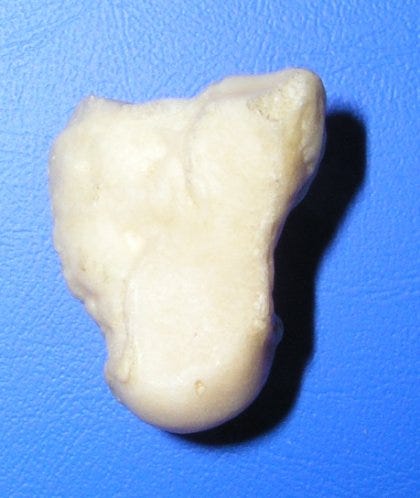
Looks like a dulled shark tooth to me. In Spanish, the bone is simple known as hueso grande, or “big bone”. Which shows an underactive imagination.
Here’s another picture, showing the capitate as seen on the back of the right hand:
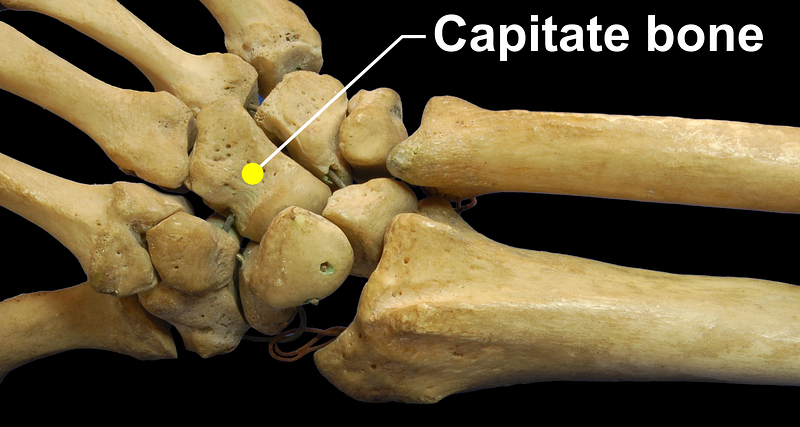
This large small bone articulates mainly with the middle digit, which was featured in yesterday’s article. What a wonderful coincidence! The capitate is rarely involved in wrist fractures because it is well-protected by the other wrist bones, as you can see.
Now, I know this subject matter can be rather tedious, so here is a cool animation of the capitate spinning around:
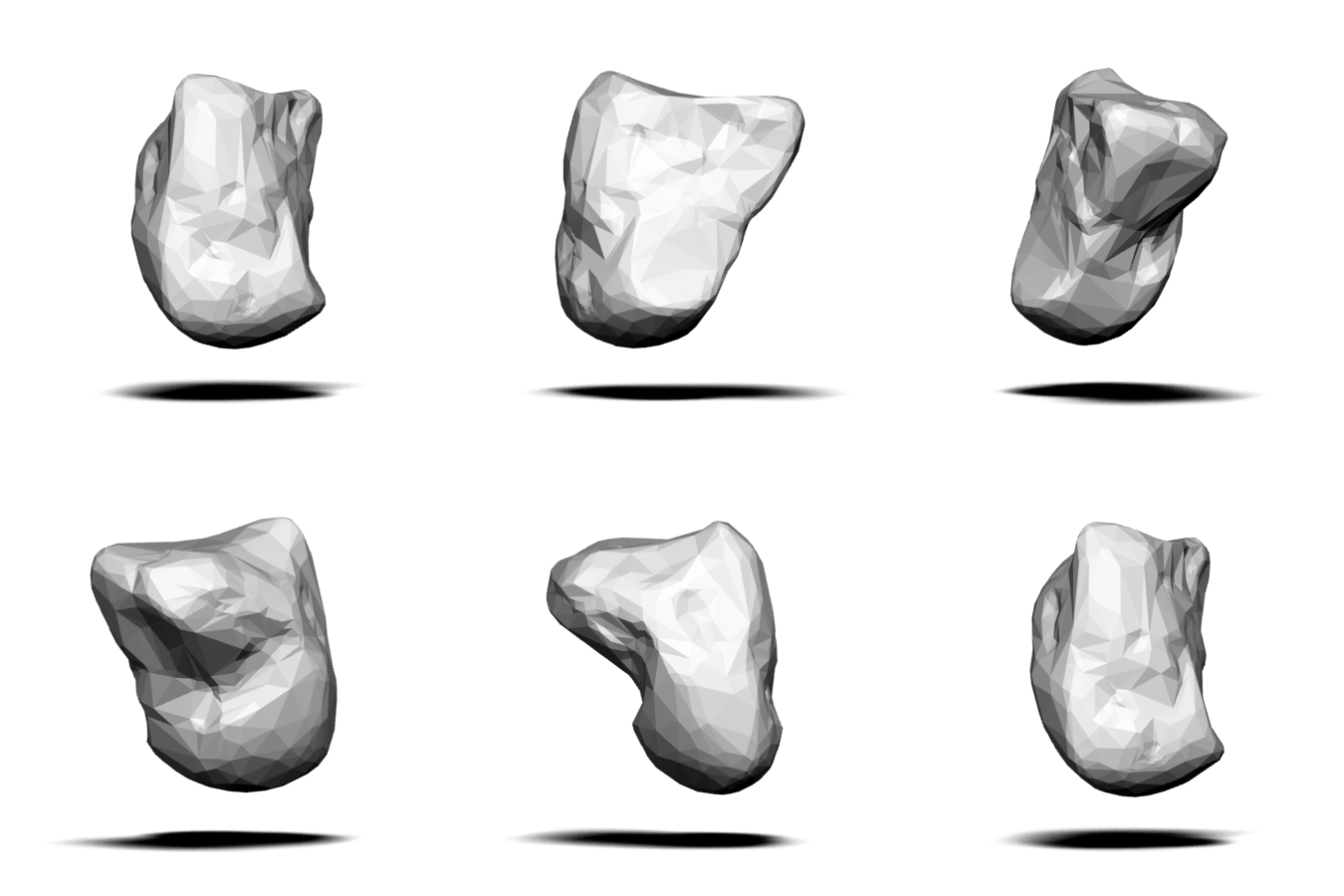
As you can see, it makes for a pretty nifty top. They don’t sell these on Amazon, but if you’d really like one, I guess you could… decapitate yourself! Yes, it’s a terrible dad joke, but it also proves what I claimed earlier: that people can survive decapitation.
And finally, no discussion about wrist bones ––or any bones for that matter–– is complete without Herman Munster singing his top forty radio hit:
Now you know. Next time someone tells you they broke their wrist, ask them if their capitate is okay. They’ll probably think you’re just making fun of them, though… because the editors of the Spelling Bee decided that capitate is a dord*.
You can check out my previous entry on another dord* here:
*What the heck is a dord, you ask? Here’s the answer: