
Capital Market Evolution 1914–1956
This series “Capital Market Evolution” is sponsored by Teamo “Where Teamwork Matters”, see on Open Collective and is part of the project Smart “Master” Contract for Equity Distribution, we truly believe that we should understand our past to build our economic future more wisely.
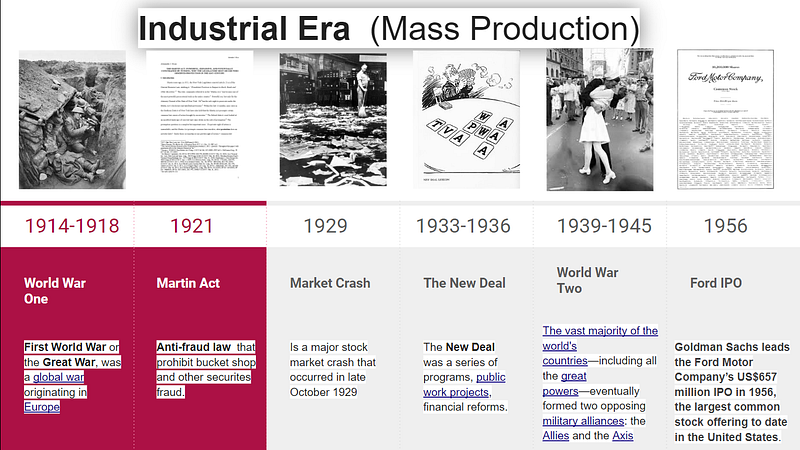
Ironically just after the creation of the Fed, World War 1 the “Great War” broke out, what happens next is the beginning of the end of the Gold standard.
Impact of World War I
Governments with insufficient tax revenue suspended convertibility repeatedly in the 19th century. The real test, however, came in the form of World War I, a test which “it failed utterly” according to economist Richard Lipsey.[5]
By the end of 1913, the classical gold standard was at its peak but World War I caused many countries to suspend or abandon it.[20] According to Lawrence Officer the main cause of the gold standard’s failure to resume its previous position after World War I was “the Bank of England’s precarious liquidity position and the gold-exchange standard.” A run on sterling caused Britain to impose exchange controls that fatally weakened the standard; convertibility was not legally suspended, but gold prices no longer played the role that they did before.[21] In financing the war and abandoning gold, many of the belligerents suffered drastic inflations. Price levels doubled in the US and Britain, tripled in France and quadrupled in Italy. Exchange rates changed less, even though European inflations were more severe than America’s. This meant that the costs of American goods decreased relative to those in Europe. Between August 1914 and spring of 1915, the dollar value of US exports tripled and its trade surplus exceeded $1 billion for the first time.[22]
Ultimately, the system could not deal quickly enough with the large balance of payments deficits and surpluses; this was previously attributed to downward wage rigidity brought about by the advent of unionized labor, but is now considered as an inherent fault of the system that arose under the pressures of war and rapid technological change. In any case, prices had not reached equilibrium by the time of the Great Depression, which served to kill off the system completely.[5]
For example, Germany had gone off the gold standard in 1914, and could not effectively return to it because War reparations had cost it much of its gold reserves. During the Occupation of the Ruhr the German central bank (Reichsbank) issued enormous sums of non-convertible marks to support workers who were on strike against the French occupation and to buy foreign currency for reparations; this led to the German hyperinflation of the early 1920s and the decimation of the German middle class.
The US did not suspend the gold standard during the war. The newly created Federal Reserve intervened in currency markets and sold bonds to “sterilize” some of the gold imports that would have otherwise increased the stock of money.[citation needed] By 1927 many countries had returned to the gold standard.[17] As a result of World War I the United States, which had been a net debtor country, had become a net creditor by 1919.
After the WW1 everything was in place for an unprecedented economic boom, at the center stage of this economic boom was a bitter rivalry at the New York located stock exchange between the Consolidated Stock Exchange of New York and the NYSE. The NYSE board often accuse the CSEN to be a cover-up for bucket shop, by 1921 Congress by the Martin Act Anti-fraud law that prohibits bucket shop and other securities fraud widely considered to be the most severe blue sky law in the country.[2]Passed in 1921, it grants the Attorney General of New York expansive law enforcement powers to conduct investigations of securities fraud and bring civil or criminal actions against alleged violators of the Act.
The first open-end mutual fund with redeemable shares was established on March 21, 1924, as the Massachusetts Investors Trust, but was not a factor into the 1920–1929 bull run because they represent only 5% of the market at that time.
The New Deal
The New Deal was a series of programs, public work projects, financial reforms, and regulations enacted by President Franklin D. Roosevelt in the United States between 1933 and 1936. It responded to needs for relief, reform, and recovery from the Great Depression. Major federal programs included the Civilian Conservation Corps (CCC), the Civil Works Administration (CWA), the Farm Security Administration (FSA), the National Industrial Recovery Act of 1933 (NIRA) and the Social Security Administration (SSA). They provided support for farmers, the unemployed, youth and the elderly. The New Deal included new constraints and safeguards on the banking industry and efforts to re-inflate the economy after prices had fallen sharply. New Deal programs included both laws passed by Congress as well as presidential executive orders during the first term of the presidency of Franklin D. Roosevelt.
The programs focused on what historians refer to as the “3 Rs”: relief for the unemployed and poor, recovery of the economy back to normal levels and reform of the financial system to prevent a repeat depression.[1] The New Deal produced a political realignment, making the Democratic Party the majority (as well as the party that held the White House for seven out of the nine presidential terms from 1933 to 1969) with its base in liberal ideas, the South, traditional Democrats, big city machines and the newly empowered labor unions and ethnic minorities. The Republicans were split, with conservatives opposing the entire New Deal as hostile to business and economic growth and liberals in support. The realignment crystallized into the New Deal coalition that dominated presidential elections into the 1960s while the opposing conservative coalition largely controlled Congress in domestic affairs from 1937 to 1964
World War 2
World War II (often abbreviated to WWII or WW2), also known as the Second World War, was a global war that lasted from 1939 to 1945. The vast majority of the world’s countries — including all the great powers — eventually formed two opposing military alliances: the Allies and the Axis. A state of total war emerged, directly involving more than 100 million people from over 30 countries. The major participants threw their entire economic, industrial, and scientific capabilities behind the war effort, blurring the distinction between civilian and military resources. World War II was the deadliest conflict in human history, marked by 50 to 85 million fatalities, most of whom were civilians in the Soviet Union and China. It included massacres, the genocide of the Holocaust, strategic bombing, premeditated death from starvation and disease, and the only use of nuclear weapons in war.
Under the Bretton Woods international monetary agreement of 1944, the gold standard was kept without domestic convertibility. The role of gold was severely constrained, as other countries’ currencies were fixed in terms of the dollar. Many countries kept reserves in gold and settled accounts in gold. Still they preferred to settle balances with other currencies, with the American dollar becoming the favorite. The International Monetary Fund was established to help with the exchange process and assist nations in maintaining fixed rates. Within Bretton Woods adjustment was cushioned through credits that helped countries avoid deflation. Under the old standard, a country with an overvalued currency would lose gold and experience deflation until the currency was again valued correctly. Most countries defined their currencies in terms of dollars, but some countries imposed trading restrictions to protect reserves and exchange rates. Therefore, most countries’ currencies were still basically inconvertible. In the late 1950s, the exchange restrictions were dropped and gold became an important element in international financial settlements/
After the Second World War, a system similar to a gold standard and sometimes described as a “gold exchange standard” was established by the Bretton Woods Agreements. Under this system, many countries fixed their exchange rates relative to the U.S. dollar and central banks could exchange dollar holdings into gold at the official exchange rate of $35 per ounce; this option was not available to firms or individuals. All currencies pegged to the dollar thereby had a fixed value in terms of gold.
Ford IPO
Goldman Sachs leads the Ford Motor Company’s US$657 million IPO in 1956, the largest common stock offering to date in the United States. Sidney Weinberg, a long-time friend and informal advisor to the Ford family, becomes one of Ford Motor’s first outside directors. The Ford IPO was the culmination of the end of the WW2 and the impact of the New Deal that boost public investor again into the public stock market.
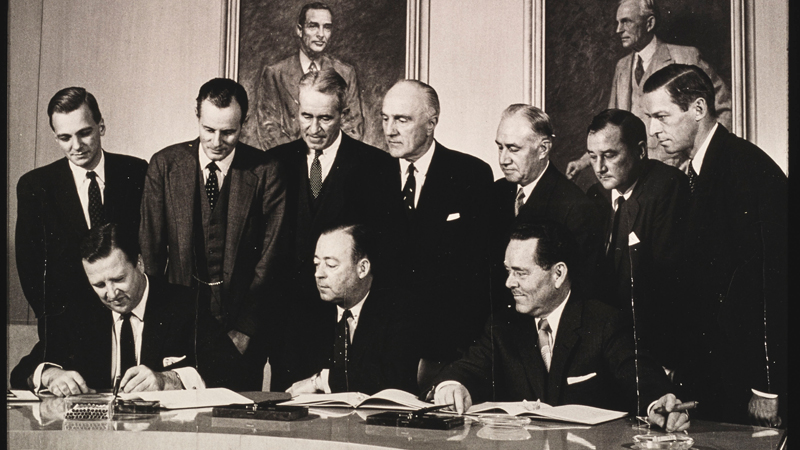
Ford famously said he’d dismantle the company’s factories “brick by brick” before letting speculators trade its stock. But things changed after the elder Ford died in 1947 — and by 1954, the company’s largest shareholder was ready to push for a public offering
ARC: During this era, we did assist to the end of the gold standard, this event is kinda similar to the end of the bitcoin protocol standard namely the Nakamoto Consensus, both system did struggle for the same reason “scalability”, layer two solutions like lightning network are great but like for the Bretton Woods international monetary agreement of 1944, the writing is on the wall, eventually crypto fiat aka “Proof of Stake” would widely be accepted at every crypto exchange .
I truly believe that we will revive the roaring twenties with the emergence of securities token offerings (STOs). We do need a New Deal 2.0 for the gig economy before this could happen, current regulation doesn’t favor stock ownership for the working class which is a great injustice. This time we don’t need to wait for an economic depression to craft the New Deal 2.0 for the gig economy, “The government has no idea how many gig workers there are, and that’s a problem”.
Thanks for reading, please leave a comment, the community feedback is really appreciated if you would like to contribute to Teamo collective you can join me at [email protected]. I’m looking for sponsors to bring the capital market evolution series to the next level, you can contribute via Open Collective, just mention for the Capital Market Evolution series in the donation comment section.


