
Canicross: Keep Fit and Have Fun with Your Dog
Are you struggling to find the time for your own exercise and your dog walk? Do you crave time for yourself and your dog? Would you like an activity that exercises your dog mentally as well as physically?
If you answered yes to any of the above, it sounds like running with your dog could be for you. Running with our dogs is a fantastic way to spend some quality time together, combine our own exercise and the dog walk, and increasing the bond with our special K9. Some of my most joyful and present moments have been watching the sheer happiness emanating from my dogs, as they glide over the trail with me.
I have previously co-founded and chaired a very successful canicross club in Scotland. My enthusiasm and passion for running with dogs are infinite, after all, it combines three of my main loves; running, dogs, and the great outdoors. Whilst I would encourage everyone to give it a go. I would love to provide a bit of guidance, for the benefit of your dog’s health and wellbeing.
So, let’s have a look at some of the most frequently asked questions, consider if canicross is for you and your dog, and if so, discuss how you can get started.
What is canicross?
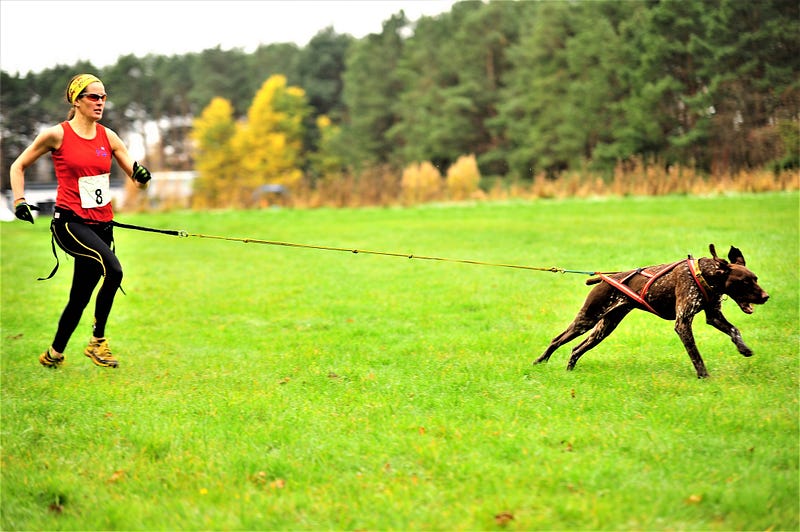
In essence, canicross is running in tow with your dog. The dog wears a special running harness, the runner wears a belt, and you are connected with a bungee line. The dog runs ahead of you and is taught to provide a pull, this results in a squeal-out loud, fun experience, almost like you are wakeboarding on land, powered by your dog!
Can any dog canicross?
Whilst some dogs are better suited to canicross than others, in reality, most healthy dogs can canicross. I would always recommend that you seek approval from your vet. Furthermore, consider your dog's age and stage of growth.
In the UK dogs can not canicross in most clubs, and certainly not participate in canicross races until they are at least 1 year old. This is to ensure their growth plates are fully developed. Excessive exercise in a dog’s early years can lead to health issues. Developing this idea further, for larger breeds, I would recommend waiting at least a year and a half before you canicross (or even free run) with them.
I am yet to meet a dog that didn’t love to canicross, but I’m sure they are out there. Listen to your dog, if he doesn’t want to run canicross style, don’t make him. If he has good recall and you are in a suitable area, perhaps free running is more suited to him?
I’ve said most healthy dogs can canicross and some are better suited than others. There are some dogs, which should not be run with, due to their physical form. These are brachycephalic (short-nosed) breeds, such as pugs, French bulldogs, Boston terriers, and English bulldogs. Their short noses can cause breathing difficulties, these difficulties are exacerbated with exercise. If you are running with a brachycephalic dog, please proceed with extreme caution.
Excessive exercise in a dog’s early years can lead to health issues
What equipment do I need?
The right equipment is really important for both your and your dog's comfort. Firstly, the human wears a belt. My preference is a belt that sits on the hip and not around the waist and is held in place by leg loops. The belt will come with some sort of connection at the front to attach the bungee line to. My preference here is a quick release attachment.
A bungee line is used to attach to the human’s belt and in turn, connect to the dog’s harness. The lines come in a variety of lengths including a shorter one suitable for parkrun. My preference here is a line with a simple loop in the material to attach to the belt, as opposed to any sort of metal carabiner or clasp. My rationale being, if the line comes unattached somehow, it may ping into your dog's leg, causing serious injury at worst and pain at best. If you do use a carabiner, make sure it has a locking mechanism.
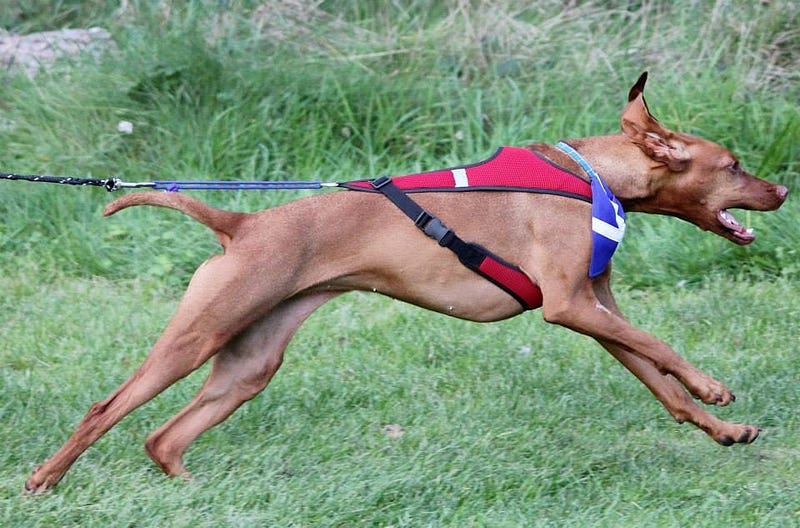
Finally, your dog will need a harness. Be sure to use a harness that is tailored to running. Canicross harnesses are specifically designed to prevent any restrictions in terms of forwarding movement or breathing. Many walking harnesses are not suitable for canicross, namely any anti-pull harness or harnesses of similar design to the Julius K9 harnesses, which obstruct the forward movement.
For more information on equipment check out K9 Trail Time and Howling Dog Alaska.
Where can I canicross?
The type of terrain you run on with your dog is important. This applies both to canicross and free-running your dog. Roads and tarmac are a big no I’m afraid, and running on hard surfaces can result in joint damage. According to Dr. Scott Levin, a sports medicine expert and orthopedic surgeon “Trails are going to take away a lot of stress from the impact that you’d normally get running on harder surfaces,” whilst this refers to humans it can equally be applied to dogs.
For any horse riders out there, my rule of thumb is simple, I would never run a dog on terrain I wouldn’t canter a horse on. For the benefit of those who don’t horse ride; you want a forest trail, sandy trail, woodland tracks, a surface with a bit of give and spring in it.
How do I train my dog to canicross?
Think back to your basic obedience training. Clear and concise instruction, consistency, positive reinforcement, patience, and repeat. Teaching a dog to canicross uses exactly the same principles. I find canicrossing a dog alongside an experienced canicross dog is the best way to teach them. This way they learn to pull with an experienced dog alongside them who they take confidence from. However, I appreciate not everyone has a ready-made experienced canicross dog on hand. That said, there are canicross groups and clubs popping up all over the world. Have a look, and see if there is one near to you. They will be able to provide in-person guidance and support and very often allow you to try different pieces of equipment before you find what is right for you and your dog.
Remember to introduce your dog to canicross gradually and build up gently, it’s meant to be a fun experience for you both, not the cause of any stress or anxiety.
Decide what commands you want to use and stick to them. Also, be conscious of the tone you use. Traditionally mushers use “gee” and “haw” for the right and left commands. It’s entirely up to you if you use these terms or stick with “right” and “left”. In the early days, you may need to move your body and gently guide your dog via his line, in the direction you want to go, along with the directional command. Your dog will soon learn his left from his right and your friends will think he’s a genius!
You will need a command to encourage your dog to move forward, “hike on” is most commonly used here, and is also used to divert a dog’s attention from a distraction on your path. You may also hear canicrossers using “hike hike hike hike” to encourage a dog to pick up the pace. Top tip, if you want more energy and pace from your dog, you need to demonstrate this in your tone. To do this, adopt a higher pitch to convey more energy. You may feel foolish, but I promise your dog will respond as desired.
The type of terrain you run on with your dog is important
It’s super important to have a slowdown, wait, and back command. If you want your dog to slow down a simple “steady” or “whoa” in a low, calm voice should do the trick. The wait command is really beneficial at the start of runs or races if your dog is prone to over excitement and tries to launch himself into his run prematurely. Getting your dog to stand still and “wait” helps alleviate potential stress. As for the “back” command; there may be times when you don’t want your dog pulling you, perhaps there is a steep downhill section, by using the command “back” and bringing your dog to heel will allow you to run down a hill in full control (just remember to scoop up the loose line and hold it in your hand so you don’t trip over it).
It is immensely important to praise your dog. If you give him a command and he executes it, a simple “yes” or “good boy” is appropriate. A final note on the training aspect here, don’t talk too much or too little to your dog. He needs direction from you, but not incessant chatter, or he will switch off his listening ears. A trick I learned, which seems to work very well, is immediately prior to giving him a command, say his name, then give the command. This gets his attention and has him standing by, as it were, for the next part. Such as “Zaccy, right,” “Zaccy, steady,” “Zaccy, hike hike hike.”
Do I need to feed my dog anything differently?
As you increase the exercise levels of your dog, you may want to increase his food intake, his nutrition is important, it is advisable to seek expert advice on this. The key thing is to leave enough time between feeding your dog and exercising him, (at least an hour, ideally longer) similarly do not give your dog a big meal immediately after a run. This also applies to water intake, whilst you want to ensure your dog is hydrated, do not allow him to gulp down a large quantity of water either before or after a long run. Of course, let him drink, but little and often is key. If your dog needs to drink mid-run, please facilitate this, but again, don’t allow him to drink gallons of water and then continue to run. This advice around feeding and drinking in and around running is to avoid bloat which can have fatal consequences.
Can I run with my dog in all weather conditions?
In short, no! Dogs are not great in high temperatures, they sweat through their paws and pant to cool down. Even in the UK, it is often too hot to canicross dogs in the summer. The general rule of thumb is if the temperature in degree Celcius multiplied by the humidity is over 1000 then it is too hot to canicross your dog. So for instance, 16 degrees Celcius with 70% humidity is 1,120, which would make it unsuitable to canicross. I appreciate all dogs cope differently in high temperatures, just remember when canicrossing they are working hard and keep going to please you. There is a real risk of heatstroke if dogs are canicrossed in unsuitable temperatures.
Zac; my big German Pointer, overheats very quickly and I have to be careful with him. Whereas, my late Princess Jasper; a lovely Vizsla, coped very well in the heat. Often in the summer, I free run my dogs in woodlands, which have a flowing river. This allows my dogs to stop and start as they please, have a sniff, wander in the river as it suits them, and simply be dogs, joining me on their own terms, on a lovely trail run without the intensity of canicross.
Some final thoughts
I hope you have lots of fun keeping fit with your dog. In my opinion, there really is nothing better than running along beautiful trails with your best friend. You may not want to canicross, you may simply want to free run with your dog, and that’s equally beautiful (sometimes more so). This article is as relevant to free running with your dog, as it is to canicrossing.
Do have lots of fun. Do use appropriate equipment. Do build up gradually and make it a positive experience for your dog. Do check their paws and legs after a run. Do check if there are any local canicross clubs you can get involved in. Do reach out to me if you have any questions. Do be respectful of other path users.
Don’t run your dog attached to a collar, inappropriate harness, or a halti. Don’t run your dog when he is too young. Don’t force your dog to do anything he doesn’t want to do. Don’t give your dog a big meal before you run. Don’t run your dog on hard surfaces. Don’t allow your dog to lunge at other runners or dogs. Don’t run your dog in inappropriate temperatures.
Many thanks for reading, I would love to hear your own stories of running with your dog, the places you go together, and the way in which running together has strengthened your bond.

You just read another post from In Fitness And In Health: a health and fitness community dedicated to sharing knowledge, lessons, and suggestions to living happier, healthier lives.
If you’d like to join our newsletter and receive more stories like this one, tap here.