
Canadians are Paying to Send Messages of Hate to Russians
And I’m NOT here for it.
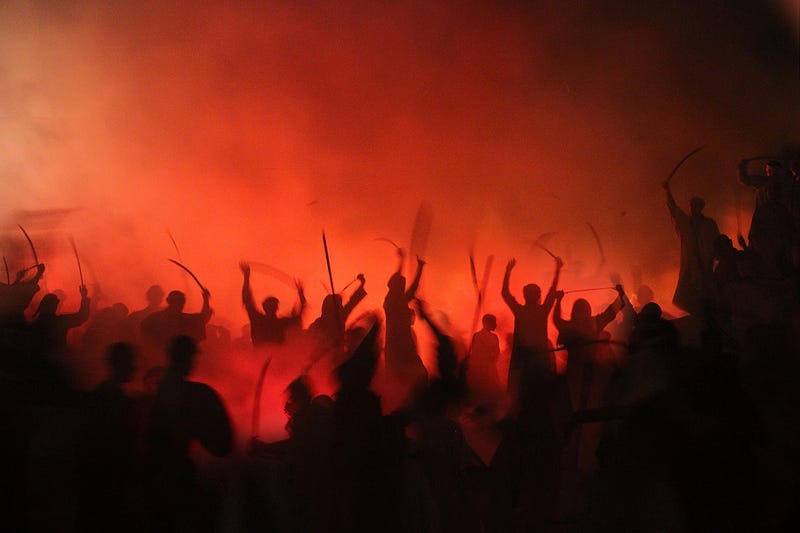
The proverbial saying that “all’s fair in love and war” describes the hateful sentiment that in the case of love or of war, we are permitted to forget the rules of human decency.
We’re permitted to ignore the probability of causing harm to fellow beings. Indeed, we are permitted to cast off any thought, feeling, or niggling doubt about the morality of our actions because the cases of love and war are deemed so extreme that any action can be justified.
This is how human lives are shattered beyond repair. We need to do better.
This morning I came across this news article describing a fundraising campaign regarding the conflict between Ukraine and Russia.
Canadians (and other countries, though the article was about Canadians) are donating money in exchange for being able to dictate a message to be written onto Ukrainian rockets before they are fired toward Russian targets.
According to the website facilitating all of this, each type of shell is worth a different amount, from $150 for a 155 mm artillery piece to $700 for an M982 Excalibur with GPS guidance.
After donating, you’re sent a photo of your message on the shell of your choosing or a video of it being fired. For $2000 you will receive a video of a VOG-17 grenade with your chosen text/picture being dropped by a drone.
The website claims: “we guarantee that your signed VOG will hit a soldier. Soldiers will redo it until they get a hit on video.”
So, not only are they paying to send messages of hate, but they may also be paying to watch someone die in a foreign country. I find all of this deeply disturbing.
I hope it won’t be perceived as wildly offensive in this climate to say that I’m not “rooting for” Ukraine in this conflict. That doesn’t mean I’m cheering for Russia.
It means that I acknowledge that as someone on the other side of the ocean from this conflict, I’m not informed enough to have a rigid, absolute opinion on who is the “bad guy” and who is the “good guy” here.
Instead, my opinion revolves around privileging peace over war, supporting personal safety regardless of geographic location or citizenship, and it revolves around the belief that we shouldn’t ever blame the choices of a few on a larger identifiable group.
In 2009, Chimamanda Ngozi Adichie recorded a Ted Talk entitled “The Danger of a Single Story” which discusses how the media and literary portrayals of an identifiable group of people can cause harm when the presenters don’t offer multiple and diverse perspectives on the story.
At best we end up with misunderstandings and stereotypes, but at worst we can end up with prejudice, hate, and even violence against a person or people who are so much more than one story or one version of events.
I don’t believe I’ve been given enough different and true perspectives of the situation between Ukraine and Russia to be able to make any judgment of the soldiers and civilians involved.
Even those who would argue that soldiers choose to be soldiers and therefore they’re fair game are dangerously stripping down a complex situation. When being in the military is a paid job, soldiers might not be in a position where they can afford to give up a paid job.
We have no idea who they may be trying to support with their wages or what other doors may have been closed to them due to a thousand unknowable bio-psycho-social-economic factors. Blaming soldiers for war is like blaming students when their school is revealed to have been perpetuating systemic racism.
They’re caught in something vast which they didn’t create and they’re doing the best they can to make it out alive. And all of that is assuming that only career soldiers, never civilians or children, are impacted by weapons of war and that’s clearly false.
Although we’ve had months of coverage of this conflict in our (Canadian) media, we’ve been told the same basic story the whole time: Ukraine = good, Russia= bad.
And I see many Canadians internalizing this oversimplified narrative. They demonstrate this by arranging accommodation for specifically Ukrainian refugees in their towns, by displaying blue and yellow flags or stickers or pins.
Now they demonstrate this by paying money to write messages like “Liam from Canada says F**k you Putin” and “From Canada with love” onto weapons of war which are directed at Russian soldiers and whose sole purpose is to end human life.
I don’t know Liam, but I would tell him that the chances of that particular piece of equipment ending Putin’s life are pretty slim. It’s much more likely for it to kill and maim other victims.
As for the second, I can’t imagine the horrors of a world in which we no longer recognize the difference between love and war. How could anyone suggest that ending a life in such a violent way could ever be an act of love?
Support for war comes in many forms: The supply of weapons and of ammunition. The willingness of citizens to become soldiers and go into battle. Training, uniforms, tactical gear, and food to sustain those soldiers. An enemy who also has all of those things and is willing to engage in warfare.
And money. All of the above require money. Wars would not happen without these elements, so if ending war is the goal, there are other ways.
Support for war also comes from the belief that it can be justified and that all is, indeed, fair in love and war. I think it is one thing to have a “support our troops” bumper sticker and another level to send care packages with socks or cookies in an effort to boost morale.
It’s a step too far for citizens of an uninvolved country to pay to send messages of hate to just one side of a conflict I don’t believe they can truly understand.
We all agree that Hitler made some very harmful choices, but can we honestly say that every single German citizen alive in the early 1940s was a “bad” person and deserved to be bombed to death?
No. To do so would be unfair, hateful, and inaccurate. There were many true stories about Germans in 1942, not only the story about Hitler’s vendetta. As Adichie reminds us, it is dangerous to believe that there is only one true story about a people.
I have love for all the individuals who are being negatively impacted by this ongoing conflict, regardless of their nationality. Writing messages of hate onto instruments of destruction breeds nothing but more hate and more destruction.
These are not the kind of messages anyone should be sending and as a Canadian I am appalled that they would come from a country that is supposed to have an international reputation for kindness and acceptance. We must do better.
What do you think? Is your country sending messages of hate to Russia? Do you think this is justified? What possible repercussions do you see from this campaign? Thank you for reading.


