
Can Your Dreams Hold You Back?
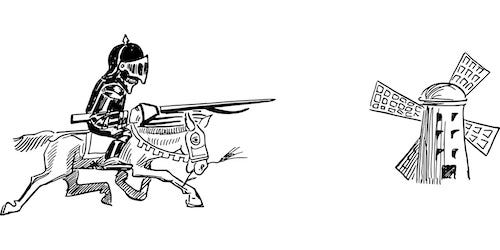
We worship the idea of following our dreams. But what if they take you down hopeless paths and keep you from evolving?
I love turning ideas on their heads.
The flashes of insight I jot down often go along the lines of: “This is what people say, but what if the opposite is true (too)?” Or: “This is what I feel or believe, but what if I looked at things from an opposite perspective (too)?”
That’s where Don Quixote tilting at his windmills comes in.
Don Quixote and Dreaming the Impossible Dream
Even people who have never read the 17th-century Spanish novel that gave the world this unforgettable character (and invented the novel as a literary form) are familiar with him.
The skinny would-be knight on his old horse, with his short fat sidekick Sancho Panza, traveling the world in search of chivalrous adventures that will bring him honor in an age that no longer believes in chivalry.
Or, if not, they know the famous song from the Broadway musical The Man of La Mancha: “To dream the impossible dream…. / This is my quest / To follow that star / No matter how hopeless / No matter how far…”
Our personal growth and leadership development passion (or, may I say, industry) has of course latched onto the song, the character, and Don Quixote’s commitment to an ideal as something we need to emulate in order to be successful and fulfilled in life.
It’s amazing how pervasive this message about the importance of pursuing your dreams is, especially in contemporary American culture, and how it’s so deeply embedded that its truth seems utterly self-evident to most of us.
We look up to people who have devoted themselves to impossible dreams. We urge people of all ages to “follow your passion”. We throw ourselves into dream jobs into which we pour all our energy, to the neglect of other aspects of life. We plot and plan as thoroughly as any old-fashioned matchmaker to find the dream mate to spend our life with.
We bankrupt ourselves buying the dream house that we can’t realistically afford. We aspire to supporting the dream of our kids’ success to the point where we smother them with enriching activities that will supposedly get them ahead.
We commit ourselves to extreme systemic dreams of political utopias (of the right or the left) and ignore the hard but boring work of just making our government and public institutions work as well as they realistically can for as many people as possible.
A dream can become an obsession. It can hold you captive instead of liberating you. It can make you unhinged, or at least badly off-balance in life.
The story of Don Quixote, like all great literature, keeps giving and giving — as different perspectives develop about his character, his times, the issues raised by his quest, and his relevance to the present.
If’s facile to just set him up as an heroic example of idealism and commitment to a cause, that we can learn from and emulate.
He was also, certifiably, a madman. He really had the delusion that those windmills he saw and attacked were giants who had been created by sorcery in order to block his chivalrous ambitions. That’s called paranoia: seeing imaginary enemies everywhere.
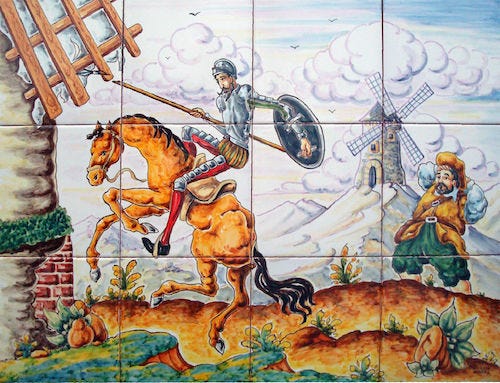
His madness also had a strong element of resistance to change.
The old feudal order — with its strict hierarchies, economic stagnancy, and the exploitation of peasants and serfs— was being replaced by a freer system of individual enterprise and labor-saving technological advances. Windmills, in fact, were a revolutionary invention that put an end to the labor of animals and humans powering treadmills.
You might even say that Don Quixote was in the grip of a backward-looking social dream of Making Feudal Europe Great Again (MFEGA) as well as a futile personal dream of making himself more significant in life than he actually was.
It’s a doomed quest. In the end, you may remember, he returns to his village, becomes ill with a fever, despondent, renounces all his chivalric fantasies, and dies.
Lost-Cause Dreams and What They Cost Us
When does an inspiring dream for the future become a lost cause that blinds us from reality and creates only misery and disappointment for us?
Dreaming of something we want to achieve personally, or see happen in the world, and working towards it, is one thing. It’s quite another to be so obsessed with it that we’re no longer able to look at it objectively or take rational steps to make it happen. And to keep pursuing it ever more fanatically as it becomes ever more unachievable.
This can happen with both individual and collective dreams.
I’m sure all of us — no matter how fortunate or unfortunate — have had personal dreams that didn’t work out.
Childhood visions of what we would grow up to be that never happened. Talents and interests that could not be pursued because of the pressures of necessity. Promising careers that were cut off. Business enterprises that did not succeed. Repeated attempts to achieve a goal resulting in failure. Passionate relationships that fell apart. The loss of a loved one cutting short a life together.
The road to lost-cause misery comes from clinging on to the thwarted dreams, and getting into the state of mind that says “I can’t be happy unless those dreams become true” or “Giving up on those dreams is a copout, and dooms me to a mediocre life of failure.”
If you look at the collective sphere, the world is and has always been full of group unhappiness due to unfulfilled dreams vis-a-vis other groups.
The lost-cause complex at that level becomes “We won’t budge an inch from our collective aspirations in order to accommodate an inch of yours.” Think about how many of our historical and current conflicts are rooted in this kind of fanatic devotion to impossible and incompatible group dreams. I like to call it “collective dream martyrdom”.
Being Seduced into Dreams That Are Not Your Own
There’s another dimension to dreams that can hold you back. It’s when you’ve developed false consciousness because the dreams you have in your mind have been created and lodged there by other people.
They’re not your dreams. They’re the dreams of your parents, your peers, your social media network, those who want to market goods to you, those who want your vote.
I’ve been there. We’ve all been there. It can take years of maturing to realize that many of the dreams that get peddled to you by the culture and society around you don’t really resonate with your deeper self.
There are many false dreams out there to seduce you into yearning for things that won’t really bring you satisfaction in life: the dreams of the popularity culture, the beauty culture, the culture of “cool”, the ambition culture, the cynicism and irony culture, the gospel of wealth culture, the populist savior culture, the self-righteous cancel culture, even the self-improvement culture.
I once ran into an unforgettable example of a person in the grip of an impossible dream he had absorbed from some of those cultural voices exploiting his vulnerable condition.
It was at the height of 1990s “dot com boom” when Silicon Valley was sizzling with opportunity and fabulous tech jobs, and the smell of wealth- making was in the air. I used to ride the Capitol Corridor train from my home near Berkeley to the Santa Clara-Great America station that was the destination for the swarms of gung-ho techies with their laptops commuting to their work and handsome salaries.
At the station, a windswept and desolate concrete area with zero charm, a sorry and unhealthy looking middle-aged man, with deep creases of worry on his face, ran a food truck. He was there every day, morning till night, doling out cups of coffee and snacks to the lively young techies. He wore a battered cap with a totally incongruous slogan on it that said “Cut Taxes”.
Naturally, this caused people to engage in conversation with him. He seemed so obviously to be someone in a precarious economic condition, for whom the social safety net (paid by taxes) would be a a life-saver. I asked him how he got health care: Medicaid. His groceries: food stamps. His truck: government small-business subsidy.
When I questioned him about the motto on his cap, he replied, without any sense of irony: “ When I become very rich someday, I don’t want to have to pay taxes.” The incongruity between his reality and his impossible self-defeating dream left me with a lump in my throat.
Dreaming the Possible Dream — And Being Able to Drop It
As with so many things in life, wisdom about our dreams is in finding a middle path between extremes — repressing those dreams or becoming a slave to them — and in distinguishing between dreams that are delusional and dreams that are realistically possible.
When Dr. Martin Luther King gave his “I Have a Dream” speech, he wasn’t talking about pie in the sky, but expressing a vision to guide concrete efforts on behalf of specific policy and value changes. When President Kennedy gave his “We Choose to Go to the Moon” speech, it was based on substantial progress already made by NASA, not vague wishful thinking.
If you look at dreams you have had, and have whole-heartedly pursued, whether you achieved them or not, you’ll notice they have usually been of the “10% inspiration and 90% perspiration” variety. You’ll probably also recognize in them the Silicon Valley truism about “ideas are a dime a dozen, it’s the execution that counts.”
I totally believe in having dreams that push your limits, take you beyond your comfort zone, bring you new experiences and accomplishments, make you grow. I love the spirit of “reaching for the stars” and “letting your reach exceed your grasp”.
I know that heady feeling of being on a high or “in the zone” when I’m focused on realizing a dream. . . and how flat life can seem at when day-to-day routine and exertion feel unrelated to any guiding dream.
I feel immense sorrow for the millions of people who, historically and in the present, have not been able (or allowed) to dream and work towards dreams. What’s the old saying from the Book of Proverbs? “Where there is no vision, the people perish.”
Being a dreamer is certainly good. But holding on to lost dreams is not.
I’ve seen too often how people can cling to dreams they have no possibility of achieving, where everything is stacked against execution. And yet they persevere, to the bitter end, never letting go, never adjusting the dream to reality, losing all joy and hope, becoming resentful, but still pursuing the same siren call of the impossible.
It’s like continuing to beat your head against a brick wall instead of trying to find out if there’s another way of moving forward with your life other than plowing through that wall.
Old dreams sometimes need to be allowed to die and be replaced by new ones. New ones that have a fighting chance of being attainable.
Instead of desperately holding on to a dream that may have nourished you in the past, wisdom is about learning how to re-invent yourself, adapt, change, pivot, grow in new directions.
Old dreams should not be allowed to become a dead weight that burdens you with feelings of loss and disappointment, or backward-looking nostalgia for a time that is no more. They should be thanked for having guided you for as long as they did, then asked to make room for new dreams.
If the dream is just plain not working — can’t make it work financially, can’t make it work where you are, can’t make it work with your family circumstances— don’t mope about it: either change the circumstances or change the dream.
Resiliency means being able to give up on a dream that has been derailed and throw yourself into another. Don’t just hang on to a job, a profession, a career, a business venture, a cause, a geographic location, a house, a standard of living, a relationship, a social circle, a family pattern, or a “way of doing things” that is pushing you out, that you can’t afford or is otherwise destroying your happiness.
It means trading in an old dream for a new one when the old one becomes more painful than helpful. Learning to always be an immigrant or a “new kid on the block” in your own life, filled with new dreams till the end. What my late husband Raphael referred on his 80th birthday as being “nostalgic for the future”.

Perhaps, in the end, the richness of our lives is less in whether we have achieved one grand dream than in the many smaller dreams we have had at different times, adapting them to what was possible, and making the best of changing circumstances.
No tilting at windmills in the spirit of lost-cause impossible dreams. Instead, the spirit of being ever open to new dreams and the hopes that come with them. As in the Broadway musical Fiddler on the Roof’s unforgettable line in the “To Life!” song: “And if our good fortune never comes / here’s to whatever comes / drink, l’chaim, to life!”
— — — — — — — — — — — — — — — — — — — — — — — — — — — — — — — — — — — —
In Karine’s Musings on This and That I write on personal experience, life lessons, wisdom, culture, language, philosophy, society, history, and whatever else crosses my mind. For my other online essays, check me out at All Things Examined, Political Engagement, The Grief and Renewal Chronicles or elsewhere on Medium. You can read my writer’s philosophy in The Idea Factory. You’re welcome to share your comments below the posts or to write me at [email protected].