
Can You Tell Me Something Really Inspiring?
Dashrath Manjih dug a mountain all alone without any Government help, and made a road to connect between two villages located on the opposite sides of a mountain in Bihar, India. — Wow!
It took him 22 years, but he did it all alone without taking any money or any donations from others. His wife helped him and brought the poor man’s lunch of just bare wheat chapatis and onions.
Is this not inspiring in this modern world where everybody is running after money,name and fame?
Excerpt as sample page from my book ‘Word of God Bhagavad Gita’
This is the real life story of Dashrath Manjhi, the man who moved a mountain, so that his village folks could reach civilization with the basic amenities of water supply, electricity, a school, and a medical centre.
It was the year 1960 and Dashrath a landless labourer lived amid rocky terrains of Gaya in Bihar, a state of India. He was regarded as the lowest of the low, and the poorest of the poor, in a caste-ridden Indian society.
A 300-foot tall mountain loomed between him and the civilization. — Like all poor men, Dashrath Manjhi, worked on the other side of the mountain. At noon, his wife Phaguni would bring his bare lunch of wheat chapatis.
As they had no road, the trek took long hours of travel over the mountain. — Dashrath tilled the fields for a landlord on the other side of the mountain. He would quarry stones.
In a few hours of strenuous physical labor, he would be tired and hungry. He would then watch and wait for his wife Phaguni.
One of those days, his wife came to him empty handed and injured. As the harsh summer sun was beating down, Phaguni tripped on the loose rocks and fell down.
Her water pot was shattered. She slid down several feet injuring her leg. Hours past noon, she limped back to her husband. He rushed to chastise her for being late for his lunch.
She said, ‘look at the mountain, and the distance I had to travel on foot to reach you.’ On seeing her tears, he took a vow to cut the mountain and make a path in the mountain for a short-cut to the other side.
He could not bear the tears of his wife. — Dashrath sold his goats, and bought a hammer, chisels and a crowbar with that money. He climbed to the top of the mountain, and started chipping away at the mountain vigorously.
Years later, he would recount, “That Mountain had shattered so many pots and claimed so many human lives. I could not bear that the mountain had hurt my wife. — If it took all my life now, I would carve a road for the village people through this mountain.”
He quit his wage based job, and his family often went without food. Then, Phaguni fell ill. The doctor was in Wazirganj, a distance of 75 kilometres, around the mountain and he was unable to make the journey, as he had no money for the bus fare.
Phaguni died but her death, further spurred Manjhi in his determination to make a road in the middle of the mountain.
It was not easy. — Unyielding, the mountain would cascade rocks at him, while he dug into the mountain. He undertook this massive and daunting work all alone, without any help from others.
He got hurt many times while breaking the rocks manually with a hammer, but he would take rest and start again.
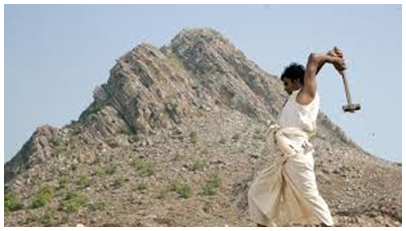
It was an impossible task to do single-handed, but he was determined. — In 1982, Manjhi finally broke through a thin wall of the remaining rock and walked out into the open space at the other side of the mountain.
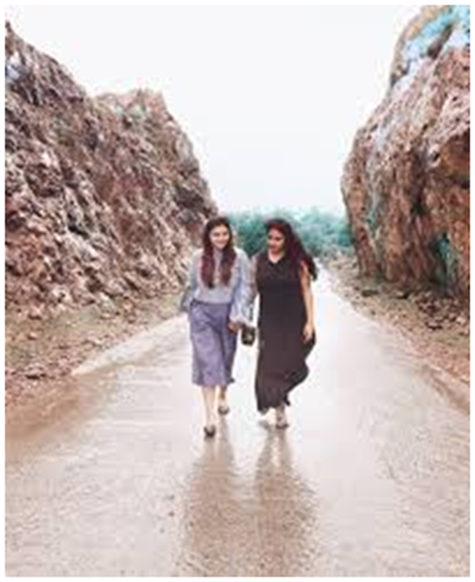
What a historic moment for Dashrath? — After 22 years, Dashrath Das Manjhi, the outcast landless labourer had conquered the mountain.
He had carved out a path 360 feet long, 30 feet wide single-handed without any assistance from any Government organization or anybody else.
Wazirganj, with the facility of a hospital, jobs, and a school, was now only 5 kilometres away from the village through this short-cut path.
People from 60 villages around this area could use this road. Children had to walk only 3 kilometres to reach the school. — Grateful, they began to call him ‘Baba’, the revered man.
But Dashrath did not stop there. He began knocking on the doors of government, asking for the road to be tarred and to be connected to the main road. He walked along the railway line all the way to New Delhi from his village as he had no money to pay for the train fare.
He submitted a petition there, for a hospital for his people, a school, and water supply. — In July 2006, ‘Baba’ went to the then Bihar Chief Minister, Nitish Kumar’s ‘Junta Durbar’.
The Minister was overwhelmed and got up to offer to the ‘Baba’ his chair, his Chief Minister’s seat; a rare honour for a man of Manjhi’s background.
The Indian government rewarded his efforts with a plot of land; Manjhi donated the land back to government for a hospital.
They also nominated him for the ‘Padma Shree’ award, but forest ministry officials fought the nomination, calling his work illegal as he had not taken approval from the department.
“I do not care for these awards, the fame and the money,” he said, “All I want is a road, a school, and a hospital for our people. They toil so hard. It will help their women and children.”
It took the government 20 years to tar this road, and this is an example of how the bureaucracy works. Self effort is the best help, when one has the determination to accomplish even a gigantic task against all odds.
On August 17, 2007, Dashrath Manjhi, the man who moved the mountain, died in a hospital. — Manjhi’s legacy, his inspiration, though lives on.
It lives on among the thousands of Indians who are making a difference to their fellowmen, fighting new battles, overcoming challenges.
A film was made on the life of ‘Manjih’ to commemorate the rare feat of determination and perseverance by this man.

The battle of Indian Mahabharata was not only fought on the grounds of Kurukshetra, but it is fought even now in the lives of human beings in our day to day living and struggle for existence.
This time, the battle of Dashrath Manjhi was with a mountain and he won the battle against all odds single-handed.
The inspiration lives on in many of us who are moving our own mountain.
Manjhi showed us that the real hero lies inside us. It is you who can rise up to meet the challenge.
Bible (Matthew) says, “Jesus said to them, because of the littleness of your faith; for truly I say to you, if you have faith even as small as a mustard seed, you shall say to this mountain, ‘Move from here to there,’ and it shall move; and nothing shall be impossible for you.”
Lord Sri Krishna says to Arjuna in Bhagavad Gita:
“ Longing for worldly success; people worship many heavenly deities; for quick is success born of actions in the human world.” (Book: Word of God Bhagavad Gita: Chapter 4 verse 12)Copyright © Ajay Gupta: — : Amazon: Ajayupta: Amazon.in: Kindle Store : Word of God Bhagavad Gita by Ajay Gupta
Self-less work without seeking the rewards of actions is pleasing to God; for quick are the results born of actions in the human world.
https://www.youtube.com/watch?v=mPz2xKxaS_o
Ajay Gupta is a former Naval officer who served onboard Indian Naval warships and aircraft. He is the author of two books ‘Word of God Bhagavad Gita’ and ‘Want to Know God: For Young and Old.’


