
Can You See the Holes?
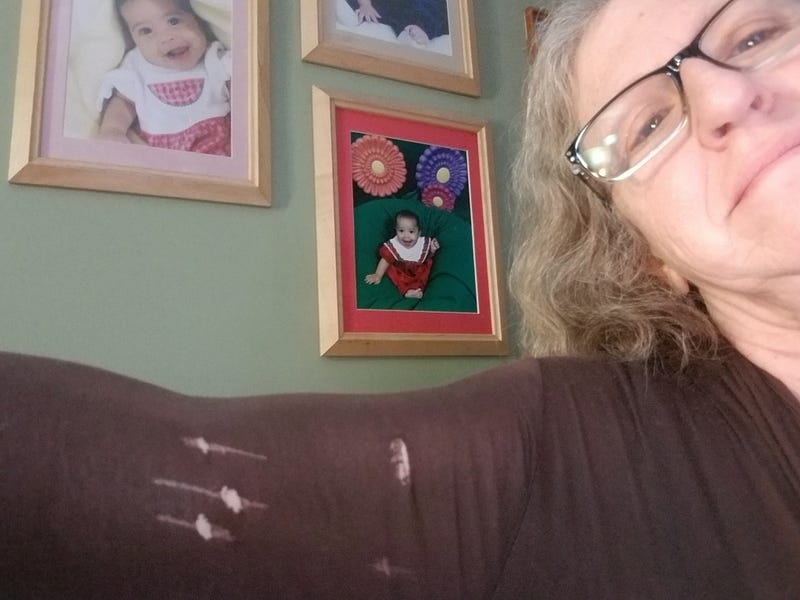
About 15 years ago, my then 4-yr-old daughter (and husband) gifted me with a long brown, flowing cotton sweater wrap for my birthday.
I loved it! I wore it often.
Through the years, with wear and tear — and possibly washing machine damage — little holes began appearing. With time the holes grew. But I continue to wear this sweater. Mostly in the privacy of my own home now, but occasionally still out and about.
The sweater doesn’t simply keep the chill off on cool nights but wraps me in the warmth of memories. Memories of my daughter’s childhood smile, her cuddles, and the moments we’d read together or lie in bed singing Chinese songs to lull her to sleep — the length of the sweater wrapping her tiny body close to mine. I cherish the memories.
But if I cling to what was, I’ll miss what’s still possible.
Off at college now, she still smiles beautifully. But no more cuddles or lullabies. Her growth into young adulthood has left holes.
I see the threads from what began years ago. She asks me to review her essays and she’s now in her fifth year of Chinese language studies! I see the threads.
But I also see the holes. The moments I wasn’t there for her because my life got complicated. The times I allowed her fierce independence to overshadow the attention she deserved from me.
I keep thinking about the holes. I know I did my best, but I’ll never be satisfied that it was good enough.
Because when we love, can we ever say, “good enough?”
And my thoughts can’t help but turn to all the other holes-not between me and my daughter, but in the world around me.
Do you see holes -
- When we can’t close schools — because too many children will go hungry without their school meals?
- When we can’t lose a job — because we’d lose our healthcare?
- When little children are slaughtered in their classrooms because an amendment written when bayonets were standard issue, guarantees a right to bear arms-even military assault rifles?
- When the men who kneel to protest oppression are accused of disrespect of our country, which guarantees protection of this very right?
- When men who fought wars to defend democracy are left to sleep on park benches — or worse yet arrested for doing so?
- When the judicial system cares more about the futures of men who physically force themselves on women than about the women whose lives have been shattered?
- When schools built to educate children, leave too many unable to read or write-sending them through the school to prison pipeline?
- When someone working full-time cannot put food on the table for their children because they aren’t paid a living wage, while the owners of their companies rake in billions — and give a few million to charity to be hailed as heroes?
- When politicians can actively suppress the right to vote for millions — protected by yet another amendment — in the name of a crime for which there’s little to no evidence?
- When innocent black men and boys are shot within seconds of being stopped for a traffic violation, while playing in the park, jogging, or walking home with Skittles in his hand?
- When we allow millions of dollars to be spent shoring up a military arsenal that we know, we hope, we pray should NEVER be used?
Do you see the holes?
Have we so wrapped ourselves in the now tattered sweater of individualism that we refuse to see the holes in the fabric of our society?
Clinging to what is the promise of an America where every person is guaranteed life, liberty, and the pursuit of happiness — do we refuse to see the holes?
Can we truly say we’ve done “good enough” with so many obvious holes? We must take responsibility for the holes and figure out how to fix them.
If we love our fellow citizens, if we are part of this human race — can we ever say, “Good enough?” Can we not see that, just like my sweater, what we have now is no longer working? Is it too late to find the threads that bind us one to another?
The non-profit sector aspires to find the threads. Food pantries, homeless shelters, and free health clinics work to plug the holes. Individuals and organizations fight for justice to right the wrongs.
But just like my daughter who has attempted to find a replacement for my now tattered sweater, we must continue the search.
We must never be satisfied that what we’ve done is “good enough.”
Originally published at http://janetmarycobb.com on October 27, 2020.


