
Can You Really Connect with Students through a Screen?
*Editor’s note: All student names have been changed.
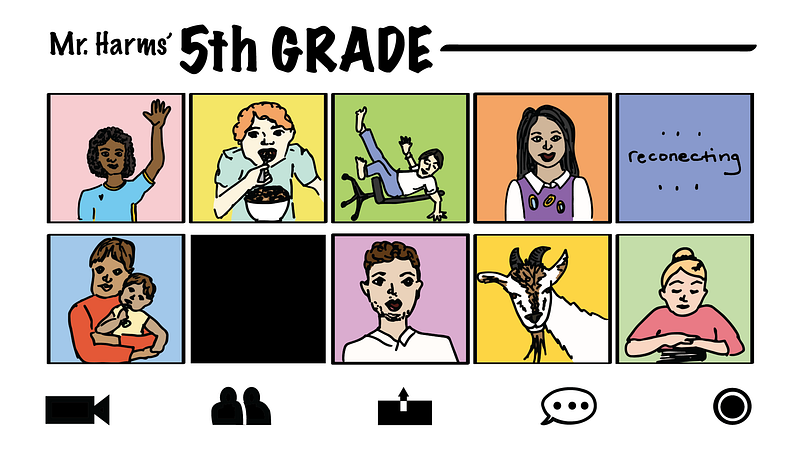
Every morning for the past two months, a little after 9, the screen of my Mac became populated with several tiny squares, soon filled by the groggy faces of my fifth-grade students. Some immediately said hello, others kept their mics muted and cameras off. Some were eating cereal, others were wiping sleep out of their just-got-up eyes. Some had TVs blaring in the background. Others were silent.
In normal times, at 9 a.m. we’d be finishing up Science and moving on to Math in our bright classroom, which means only one thing: snack time. Students would swiftly rise from their desks, seemingly famished, and walk over to their cubbies to retrieve whatever snacks their parents stored for them in their lunchboxes (or the Takis, those bastions of nutrition, they kept from the cafeteria the previous day).
It was around 9 a.m., too, that I would peel off the sticker of the Chiquita banana I packed for this exact time. Then I would place it on the edge of the desk of one of my students. “Oh my gosh, Mr. Harms!” Marta would exclaim, trying to sound annoyed. Then she’d pull out a page in her binder covered with dozens of the stickers and proudly show me how many she’d collected throughout the year.
It was a small thing, sure, but it became our thing. And if I’ve learned anything through three years of teaching, it’s that the job is mostly about creating those small, seemingly insignificant connections with the young people around you.
With Brian and Cory and Silas, it was expressing our love for UNC and blaspheming Duke at every possible turn. With Keke, it was asking her to go get papers I just printed from the copy machine (which, because of my procrastination, happened a lot). With Lily and Miguel, it was a handshake we did every time they entered the classroom in the morning. With all of them, it was saying, “Eat your vegetables, brush your teeth, and remember: Only you can prevent forest fires,” when I dismissed them every day.
Most of those things are now lost.
One of the unending effects of the coronavirus pandemic was the closure of most schools around the country, which forced students and their teachers to confront no small number of challenges. How do you ensure every student has a computer and reliable internet access? How do you evaluate learning when some students can’t log on every day because they have to watch their younger siblings while their parents work? How the heck do you make sure your Zoom room is protected?
But most important, how do you connect with your students through a screen?
“That is the exact question I just put out on Twitter this morning,” said Kendra Jarvis, our school’s digital learning facilitator, a job tailor-made to these times. “Thinking about next August, how as educators do we connect with students that we don’t have that relationship with yet? For education, relationship is such a huge part of what we do. And I think it’s the crux of what we do.”
Candace DelMastro, our school psychologist, said when people naturally became stressed as the pandemic spread, they released more cortisol hormones, which prevent clear thinking and deter creativity. Teachers had to ensure that they met their students’ basic needs — safety and comfort — first, before moving on to anything academic. Students, like the people who taught them, had a lot of questions: How long is this going to last? Do we have to wear our school uniforms on Zoom? When do we eat lunch?
“The key in the beginning of all this,” DelMastro said, “was trying to help them through that confusion.”
When schools closed here in mid-March, Jarvis sent teachers a list of best practices for virtual instruction: make sure students can see and hear you, keep things simple, don’t introduce new technology, assign less work. “There’s so many other complicated things happening,” she said, “that the academic piece doesn’t need to be complicated.”
As we navigated those first weeks, I was struck by how normal it started to feel. The familiar rhythms and tendencies of our pre-pandemic class began to permeate our digital classroom: Ethan still made everyone laugh, Carla still raised her hand to answer every question I asked, 80 percent of my students were still obsessed with TikTok (and were probably watching it as I taught).
Perhaps because of its novelty, online learning became, well, pretty fun. The Zoom chat popped off with thoroughly unnecessary observations and lots of kids typing, “Will you PLEASE stop chatting, I’m trying to pay attention!!” A group of students all changed their usernames to “Reconecting…” to make me think they weren’t there, only to be caught by their spelling error. Ethan changed his Zoom profile picture to a rotating cast of highly unflattering pictures of me he captured throughout online teaching. Yuri, after not saying a single word for two straight weeks, chimed in to roast me for teaching “in a Barbie house” because our home office was painted purple. Trevor joined class from his trampoline.
But as we relived our greatest hits before the pandemic hit — Ethan falling and rolling in the grass to finish a race as the whole class looked on; Lily trying to throw a stuffed sloth to me but tossing it into the trash can instead; Yuri falling backward out of his chair and catching, with one hand, the math trophy he knocked over as he landed — I was hit by the weight of it all: There should have been three more months of in-person school, three more months of laughs, relationships, memories.
Virtual school isn’t the same because it can’t be. I knew that glaring truth but hadn’t experienced it. Teachers did incredible things with the resources they had — one teacher, Jarvis said, conducted her class’ morning Zoom meetings from her barn, surrounded by goats and horses, while another connected her class with one in Colombia for a virtual cultural exchange — but nothing can replace rushing into school, flipping on the lights, and preparing for the incoming storm of questions and pleas and confusion and emotion. School is filled with so much life, so much action, so much humanity, that nothing, nothing, can replace it.
Last year, I gave Chiquita banana stickers to another student. Her name was Olivia and she started a collection, too: Pretty soon her laptop was covered in those conspicuous blue-and-yellow stickers. At the end of the year, Olivia wrote me a note, and at the bottom, below her signature, she had placed one of the stickers. It almost brought me to tears. It’s still on my desk at school.
This year, I won’t have that closure with Marta or any other student. Our goodbye was a few weeks ago, when we put on masks and handed our students yearbooks, artwork, and materials they left in the classroom, packed in paper grocery bags, through their parents’ car window at the front of the school. They couldn’t see our smiles as we wished them a good summer. They couldn’t bump fists one last time or say goodbye to friends going to different schools. They couldn’t know, in the 60 seconds we had in the car line, without a screen interfering, how much we care about them, how much we learned from them, how much we are going to miss them.
They didn’t know about the Chiquita banana stickers wilting on my fruit stand at home.



