
Can You Really Be That Stupid?
Contending with people’s opposing views

“We have to watch Behind the Curve.” My son told his mother and me. “It’s a Netflix documentary where they make fun of people who believe the earth is flat,” he was told by his friends.
We decide to watch it together a few days later. I did not see this Netflix movie as a mockumentary on flat-earthers. I saw it as an excellent 96-minute movie portraying opposing sides of an issue involving human beings.
Most of the movie follows Mark Sargent, one of the leading proponents of, and recruiters for, the flat Earth conspiracy theory in the United States. His YouTube Channel, Flat Earth Clues, currently houses 24 videos with over five million combined viewership.
Netflix introduces Mark, and we start learning about the movement, meet other notable proponents of this belief, and are invited to their first international conference, held in Cary, North Carolina, in 2017.
Intertwined with those stores, we meet many scientific professionals who do not believe the earth is flat. They are astrophysicists, psychiatrists, psychologists, writers, professors, and former NASA astronaut, Scott Kelly.
These professionals do not debate each claim the Flat Earther's make but openly explain their disagreements. What struck me the most is how the Director, Daniel J. Clark, uses these interviews to explain how we should handle interacting with people who have different life views than we do.
My dream would be that when people watch it, they take Flat Eartherism as an analogy to something they believe in because it’s so easy to demonize another group or another person for something they think, but you’re kind of just as guilty if you do that. — Daniel J. Clark
Instead of Flat Earthers vs. Round-Earthers, you could take two sides of any issue:
Evolution vs. Creationism Climate Change vs. Temperature Change Abortion/Euthanasia/Capital Punishment/War vs. Pro-Life Republicans vs. Democrats The Doctrine of Discovery vs. Lands Already Inhabited
So, how do we interact with those who think differently than we do?
Using shame will not work.
Caltech Physicist Spiros Michaelakis, shares a common problem with how may oppositions act toward each other. Here, he says that the problem lies with the scientific community.
Looking down on the flat-earthers. My friend said, “Sometimes, the only way to change someone’s mind is to shame them.” And I say, “I don’t think that is the last resort ever.” This is the same as saying that if a kid doesn’t get a particular subject, it’s not your fault as their teacher; it is their fault. I do not believe that.
Approaching the conversation with superiority will not work.
I have witnessed this first-hand in the religious denomination in which I used to participate. On one side, there were hyper-fundamentals, and on the other side were the more progressives.
The “hyper-fundies” would usually lash out at the progressives using Bible passages to disgrace this group. They took/take pride in their stance, leaving no room in their arguments for any disagreement.
Not much good can come from any conversation between people who view life differently when one side brings an attitude of superiority into the mix. For example, I googled, “What is the opposite of Flat-Earthers?” I found Round-Earthers and Globists. Notice the sentences for each of these
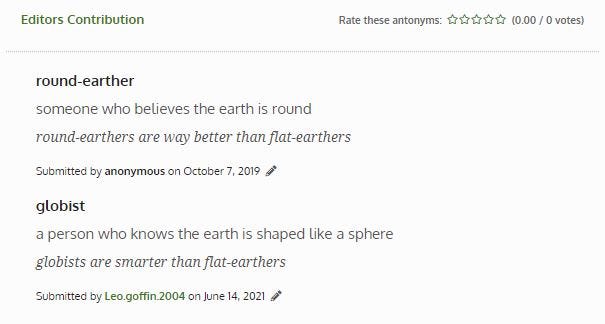
Attitude is the essential aspect of the whole conversation.
If you enter into the conversation not thinking that you are better than the person with an opposing view, you have a better chance of a meaningful discussion.
Let’s take the metaphor that argument is war. One side wins, and the other loses. If my opponent feels he’s better than me, that’s intolerable to me. So, I’ll not listen to what he says. Already when he’s talking, I’ll be planning my counterattack. — Per Espen Stoknes (Psychologist & Writer)
I’ve been in many conversations where someone will say, “We’re just going to have to agree to disagree.” Yet, this innocent phrase used with a superior attitude falls on deaf ears. When presented to me like that, this phrase is worthless.
We find identity in the things we value and the things in which we believe. They are vital to us, and we take them personally. Yet, we don’t often realize that people with opposing views do the same thing. We are all brothers and sisters in the family of humanity!
If you prick us, do we not bleed? — William Shakespeare
You just hope that they (the opposition) will meet you halfway, but often when you push them into a corner, it takes a lot of effort for them to even move one step toward you. — Spiros Michalakis
You can be respectful to those who disagree with you without compromising your beliefs.
Whether we agree on an issue or not, we can choose to acknowledge that there are two (sometimes more) sides to every idea. We can recognize that those who disagree with us have a right to their opinions. We can have meaningful conversations about what each of us believes.
I’ve never had a conversation with someone who believes the world is flat. As I watched Behind the Curve, I understood that Flat-Earthers are just human beings like myself. Not only could I have a discussion with a Flat-Earther, but I could also attend one of their international conferences and have a good time.
Need some more thoughts on Behind the Curve? Check out Peter Sweeney’s article.