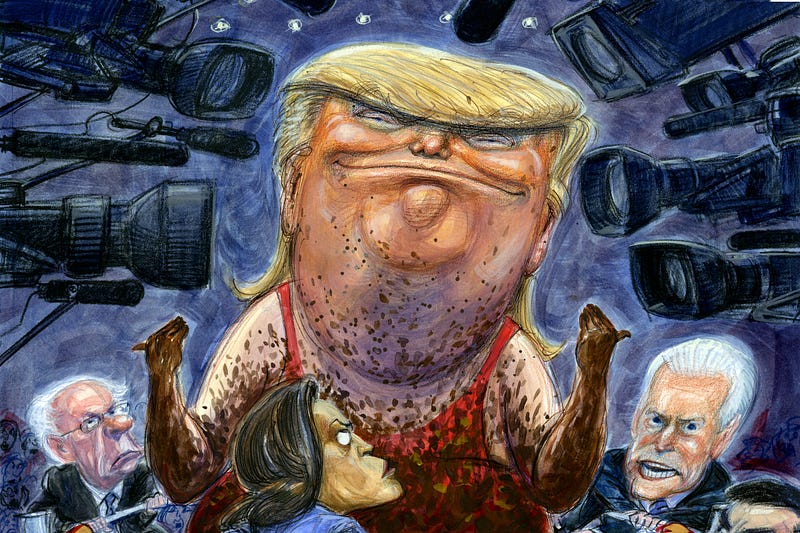
Can You Intelligently Brief An Unintelligent Person?
Apparently not, if that person is Donald J. Trump
It’s well known that President Trump doesn’t like to read. It’s even been speculated that he didn’t read his own book, The Art of the Deal, ghostwritten by Tony Schartz (who has since called it “the biggest regret of my life).
We’ve since learned that among the things Mr. Trump doesn’t read are the Daily Presidential Briefings (DPB) provided by his own intelligence experts.
Mr. Trump has been dismissive, sometimes hostile, toward his own Intelligence people.
The DPBs presented to Mr. Trump began in traditional fashion — a written memo. Mr. Trump wouldn’t read them. So in an effort to appeal to his narcissmm, the DPB’s authors began peppering the reports with his name. Damn clever approach. But that didn’t work, either.
So the briefers switched to visuals. Brightly colored charts and graphs, PowerPoints, that sort of thing, figuring that Mr. Trump wouldn’t have to read anything, he could just look at stuff.
And, according to The Hill, The briefings have been structured in a way that won’t upset Trump, not mentioning things like Russia. Or anythingn else that might rankle the President.
It’s been evident since at least 2017 that the current president does not read the intelligence briefings prepared for him on a daily basis. This was true when we first learned, via The New Yorker, of then-National Security Adviser H.R. McMaster’s attempts to brief Trump, which steadily devolved into farce.
Or as summed up in Esquire:
When Trump assumed office, N.S.C. staffers initially generated memos for him that resembled those produced for his predecessors: multi-page explications of policy and strategy. But an edict came down, — ‘Thin it out.” The staff dutifully trimmed the memos to a single page. “But then word comes back: ‘This is still too much.’” A senior Trump aide said the President is “a visual person,” and asked them to express points “pictorially.”
“Everything that needs to be conveyed to the President must be boiled down with the syntactical complexity of ‘See Jane run.’”
OUCH!
“Just as no one in the national-security apparatus harbored the delusion that the president reads things at that point, there was no reason to believe he would start doing his homework in the intervening years. He has always been the kid who didn’t do the reading. It’s easy to imagine him in eighth grade: “Gatsby, he’s a tremendous guy, big house, you’re hearing about him more and more.” He reportedly does not attend the Coronavirus Task Force meetings before he comes out to brief the press, as if to telegraph to everyone that he’s only out there to scream at reporters.”
But it now appears that the faux briefings are not just an issue of style. They are an issue of substance. And danger.
A report from the Washington Post suggests he was warned on more than 12 different occasions throughout January and February that this was going to be really fucking bad.
“The frequency with which the coronavirus was mentioned in the PDB indicates a level of attention comparable to periods when analysts tracked active terrorism threats, overseas conflicts or other rapidly developing security issues.”
But the alarms failed to register with the president, who routinely skips reading the PDB and shows little patience for even the oral summary he takes two or three times per week.
How many days until November 3rd??