
Can You Fall in Love With a Tree…?
Trees aren’t people, but they have a life force. Maybe, just maybe, I once fell in love with a Beech…
I recently read with interest Alex Rosado’s article in Coffee Times where the author described wishing she was an oak tree.
This put me in mind of a time in Ireland twenty years ago when I was training hard for the London marathon.
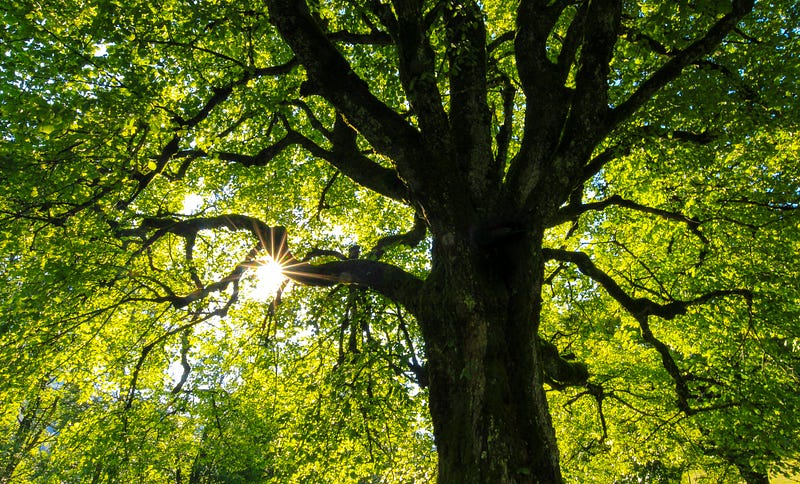
I would do incessant hill sprints in the local park until I was exhausted, and then I would wind down under the cover of a beautiful old Beech tree. After my wind-down stretches, I would sit underneath my Beech and contemplate her branches.
She seemed to reach out to me, her boughs leaning in towards me, and her twigs reaching down to caress my fingertips.
She even had a face, in the form of a gnarled trunk with two eyes and a gash of a mouth where probably she had once had an infection or infestation.
Day in, day out, as the cold sweat dried on my crimson cheeks, I would sit underneath my Beech and gaze up at her face, which would delightfully smile back at me.
As this happened, I could feel her life force coursing through her trunk. Deep rumblings of sap would reverberate in my ears as if communicating in some ancient, primeval language.
I would place my hand on her bark and sigh deeply as I communed with her.
Then I would wrap my arms around her and hug her deep, almost wishing I could be another tree in a copse beside her, our roots intertwining beneath the damp earth.
It was nonsense of course, but in a way, I was in love.
I remember the last time I sat beneath my Beech.
One Sunday late Spring afternoon the sun played on her broad bright fresh green leaves, most as broad as the palm of my hand. The bright light dappled on her trunk playing silver shimmers along her bark.
I hugged her tight and set off for London.
The next time I returned I was shocked to see that my Beech had been felled: she was trussed up in woodpiles as her evenly sawn logs were piled high waiting for the park authorities to sell her for timber or firewood.
I don’t mind telling you, I cried. Not deep sobs of grief, but gentle sniffles of remorse and regret.
Yes, I have never been in love with a tree before or since, but I loved that Beech.
It was only then, when I gazed in horror at the dead remnants of my arboreal romance, that I realized my big mistake:
I had never given her a name.