
‘Wife Guy’ Dramas and Customer Experience
What does the viral ‘Wife Guy’ post teach us about customer experience during testing times like these?

What is your perception of ‘Wife Guys’? Are they a curse upon the world? Last year, The New York Times had written an article called ‘The Age of the Internet ‘Wife Guy’. The NYT defined a Wife Guy as,
He’s not just a husband. The wife guy married a woman, and now that is his personality — perhaps even his job.
A Wife Guy post had gone viral few days back, where the guy had posted a picture of his seemingly sad wife sitting next to a fajita, unable to eat it because they were not delivered shredded cheese along with it! He even said that we could no longer blame COVID for crappy services. Is he right?
Here is a peek at the tweet.
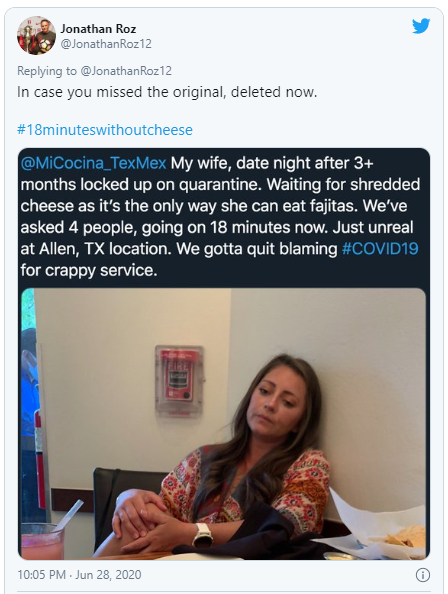
Though the original has been deleted, we were blessed with truly classic responses, Twitter never disappoints when it comes to that! Look at this one, a true gem.

But jokes apart, was our Wife Guy right? Can we continue to blame COVID for crappy services? It is not easy to maintain the standards, and as customers, we should adjust as well. But are the businesses adjusting? That’s a very important question. I don’t think we are paying any less money, if not more. But the service is not up to the mark. Should we be paying that much? But if we don’t pay, will the businesses collapse? It is like a paradox, a Catch 22 situation?
There is a concept that I learned during my post-graduate days which made a whole lot of sense to me. Let me introduce that concept for the people who have not heard about it. It is called the ‘Service Recovery Paradox’.
Service Recovery Paradox
The textbook definition is,
The service recovery paradox is a situation in which a customer thinks more highly of a company after the company has corrected a problem with their service, compared to how they would regard the company if non-faulty service had been provided.
Let me break it up for you:
Scenario 1: Our Wife Guy and his wife received fajita with shredded cheese. Happy wife and a happy Wife Guy, and a less tweet in the Twitter world!
Scenario 2: Our Wife Guy and his wife received fajita, but without any shredded cheese. So our Wife Guy calls up the help desk and complains about it. Now imagine that the business had provided a ‘Recovery’ service. It could be anything. They might have provided the shredded cheese in the next 20 minutes, or they might have provided an offer that the next meal is on them or a voucher that gives 50% off on the next order. Maybe the Wife Guy will post a tweet applauding the generosity shown by the service provider, who knows!
I will explain the Service Recovery Paradox by taking these two scenarios as examples. Service Recovery paradox explains that the Wife and the Wife Guy couple will be more satisfied during Scenario 2 than in Scenario 1. It is a little tricky, but it has to do with our psychology.
I have worked in projects for US-based clients, and we often do this, not purposefully, but we have found that whenever we have diligently provided a recovery service, our client’s trust on us has increased.
A Win-Win Situation
Our Wife Guy might have taken it a notch above for the missing shredded cheese, but the question it arises is very much relevant. We are living in a new normal, and it is not the first few days of it, we are almost half-year through this. In a highly likely scenario, we might be in this new normal for a year, or even more. How long can we blame COVID? How will the businesses survive?
I will give a small example in a few steps:
- The services offered by Businesses are below par, and they rely on COVID as a reason
- People get fed up of bad services, especially when there are no offers or incentives for the customers to cope up with sub-par services
- People refuse to buy, and they post bad ratings all over the web
- The businesses are already doing bad because of the pandemic, but now it gets worse
Who are the losers? I would say both the parties. This vicious circle could be avoided by a service recovery mechanism, in case the businesses didn’t deliver on their services. People will buy again. The money will flow in the market, and it will benefit the economy.
Here is another cycle:
- Businesses make money
- More jobs, as businesses are up again. If not more, at least the jobs are conserved
- People with jobs will continue to consume, and as the Businesses do not compromise on service quality, consumption will increase from existing customers and through word of mouth
- More money into the market
- Both the parties win
The cycle repeats itself.
Pandemic, Non-pandemic, Apocalyse, Whatever
People will think the same in all situations. They love good service. But it is not a sacrifice, but a beneficial trade when a business offers a good service to their customers. The businesses have got nothing to lose, but a lot to gain.
In these testing times, if a company goes all the way to serve you better than a company which just uses the situation as an excuse to falter on their services, which company would you support? Which company do you think will survive?
Customers First, Second and Third. While I don’t support overly dramatic Wife Guy posts, I believe that the businesses should seize the opportunity to serve their customers better. Once a loyal customer, always a loyal customer.