Can you be Mary-like today?
Abundance of Wine @ Cana
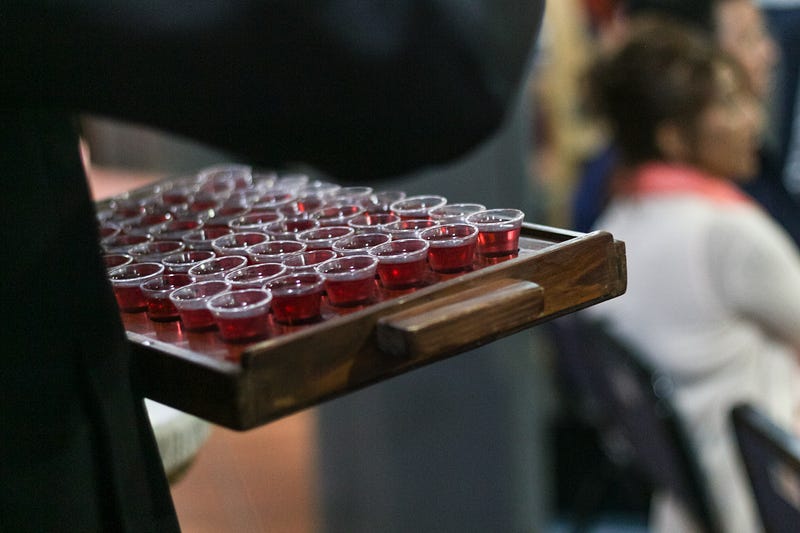
1 On the third day a wedding took place at Cana in Galilee. Jesus’ mother was there, 2 and Jesus and his disciples had also been invited to the wedding. 3 When the wine was gone, Jesus’ mother said to him, “They have no more wine.” 4 “Woman, why do you involve me?” Jesus replied. “My hour has not yet come.” 5 His mother said to the servants, “Do whatever he tells you.” 6 Nearby stood six stone water jars, the kind used by the Jews for ceremonial washing, each holding from twenty to thirty gallons. 7 Jesus said to the servants, “Fill the jars with water”; so they filled them to the brim. 8 Then he told them, “Now draw some out and take it to the master of the banquet.”They did so, 9 and the master of the banquet tasted the water that had been turned into wine. He did not realize where it had come from, though the servants who had drawn the water knew. Then he called the bridegroom aside 10 and said, “Everyone brings out the choice wine first and then the cheaper wine after the guests have had too much to drink; but you have saved the best till now.” 11 What Jesus did here in Cana of Galilee was the first of the signs through which he revealed his glory; and his disciples believed in him. (John 2, 1–11)
Let’s try to do a little exegesis on this miracle scene. As the scene is from the gospel of John, many of the expressions/words could have a special meaning; I have highlighted some of those words.
So, Mary, Jesus, and disciples are invited to a wedding. (Wedding is definitely a special occasion in the life of a couple and family, but it is very important from the context of OT; constant connection of Yahweh as the spouse of Israel and so on).
Mary sensed that wine is over and she tells Jesus that wine is over. Though it was just a statement, the reply of Jesus helps us to see an implicit request from Mary to intervene in the situation. Jesus uses the word ‘woman or gynai’ to address the mother, which I don’t think is normal even in those times to address one’s mother. But in John’s gospel, the word γύναι or gynai is used 5 times by Jesus to call someone, which are the Samaritan woman (ch 4), women caught in adultery (ch 8), Mary at the foot of the cross (ch 19) and Mary Magdalene (ch 20). So I think, John uses the word to speak of certain women who have experienced the love of Jesus or who are models of discipleship in some form. Thus, this word ‘woman’ signifies something beyond a mother-son relationship and is not derogatory in any sense.
Jesus’ reply was not an emphatic yes and the mention of the word ‘hour’ in John’s gospel speaks of the hour of glory, which is definitely connected to the passion. Jesus was there not to do any miracle at anybody’s request, but to do the will of the father.
Mary’s directive to the workers is to do as he says. This was exactly the command of Pharaoh in the book of Genesis during the famine, “Pharaoh told all the Egyptians, “Go to Joseph and do what he tells you.”. And that statement reveals the depth of the discipleship of Mary. Mary was sure that Jesus will intervene; may not be sure how he will.
Definitely there was an abundance of wine, which is a sign of the end times and the arrival of Messiah in the book of Isaiah. Bridegroom who brings the new better quality wine in abundance is definitely Jesus.
A good question that could be asked is, even after having not a great positive response from Jesus(some scholars even call it a negative response), Mary’s directive to the servants express confidence in Jesus; and she realizes that he will act in the way God wants. Where did Mary learn this art of discipleship? I don’t have a perfect answer for this, maybe treasuring and pondering things on her heart helped her (Lk 2: 19).

In the present season of COVID-19, what this miracle story teaches us? Who could take the role of Mary? What are the representatives for water and wine? I think many people (health workers, government officials, various types of volunteers, and different kinds of people working and fighting)do play the role of Mary with great courage and beauty. They do their part (like Mary) and then offer the situation for the Lord to intervene.
In terms of an immediate response, those people will remain Mary. But, in terms of a holistic response to the crisis, the entire creation would need to take up the mantle of Mary.
Mary’s deep faith and trust helped to create abundance in Cana. Jesus can do the same; probably he needs a faith-filled response of the entire creation. What is that faith-filled response of the entire creation? It may be to offer our value-systems, our developmental models, and ideals (just like water in the stone jars) to be turned to abundant wine. What will be that new creation and what is the exact shape and size of it? I don’t know….