Can You Be a Little Racist?
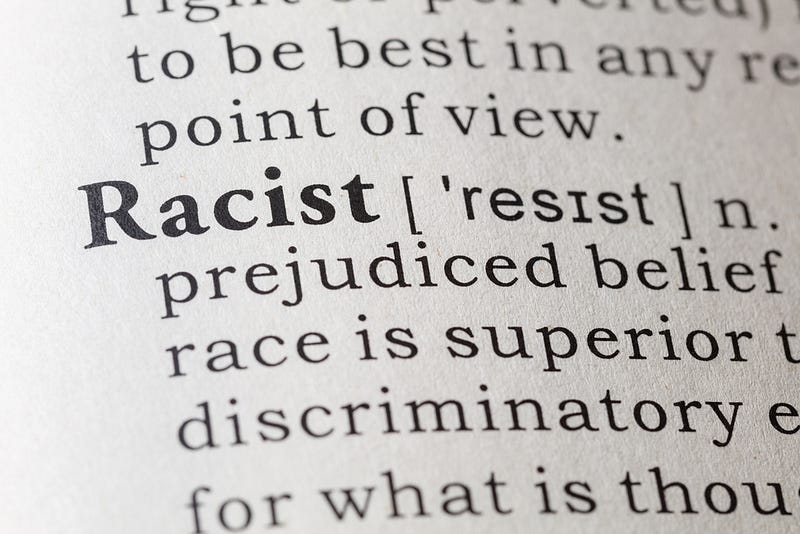
As Americans, we do not have to reach far back in our collective memories to recall incidents of racism. There’s the TikTok video on how to make a n****r produced by high school seniors that went viral across social media platforms, the white supremacist rally with tiki-torch carrying protestors in Charlottesville, and the President intentionally calling Covid19 the Chinese virus, a covert form of racism that incited discrimination against Asian Americans. Racism is alive and thriving in the USA. That’s the bad news.
The good news is that the majority of us are collectively horrified by any hint of racism that propels us back to pre-civil rights era when racist films were considered entertainment, the KKK was considered a necessary vigilante organization to maintain the dominance of whites, and it didn’t matter if your words threatened the quality of lives of people of color because their physical and psychological safety were not important.
More good news — being called a racist remains a terrible, non-desirable label. Even racists recoil at being call racists…but that brings me back to the bad news. Without a shared understanding of what characterizes a racist or an understanding of the many contemporary forms of racism (refer to the isms matrix), most people think that the racist label doesn’t apply to them. If they haven’t made a racist TikTok video or carried a tiki torch and protested the removal of confederate statues in Charlottesville, or if they don’t call Covid19 the China Virus (isn’t that just saying where the virus came from?), they’re good to go!
This denial of being racist is also manifested by today’s voters. Passive tolerance of candidates who espouse racist beliefs is not considered being complicit with or an enabler of racism. These voters don’t want to connect the dots between racist beliefs, policy making and how one governs, especially because keeping the dots unconnected is to their benefit.
Many republicans adamantly reject Trump’s “personal behaviors as racist,” yet justify their support for Trump as “endorsing republican values.” Some deny that Trump is a racist and believe that these claims are just “political correctness” or fueled by the “identity politics of the left.” Believing that only card-carrying members of the KKK are racist, racism can be conveniently filed into an untitled folder never to be opened or just put into the trash bin.
I’ve challenged many of my republican friends on this kind of thinking. In conversation we play academic gymnastics on who is racist or who is not racist. They exercise their social privilege disguised as their right as an American to disagree with me, and generously give benefit of doubt cards to even to those who have blatantly demonstrated racist behaviors, following the Trumpian line and deeming some of them as “fine people.”
They tell me that Trump doesn’t mean a lot of what he says and share stories about what their fathers, brothers, husbands, and uncles have said that sound just like Trump. I assume this revelation is supposed to make me feel better and ease the burn as it’s just friendly fire.
Ibram X. Kendi in How to Be an Anti-Racist offers a simple but empowering concept for achieving racial justice. You are either racist or anti-racist. In other words, we all have a part in creating a culture of racial equity. If we are not actively speaking out against it, we are passively allowing it to exist. There is no way to reject Trump’s “personal behaviors as a racist” and not be a little racist yourself. And being a little racist is like being a little pregnant. You either are or you’re not.
I know that stings, after all, even racist don’t like being called racist.
Understanding racism can be confusing because it is complex. Structural racism, that the Trump administration works to maintain, is invisible to many Americans, especially white Americans. Structural racism is a system of hierarchy embedded in our social, political, legal and organizational structures that keeps white dominance in place. It creates what sociologist, Eduardo Bonilla Silva calls racism without racists. These theoretical explanations do not easily lend themselves to casual conversation and require intellectual capacity, openness, and vulnerability. You have to come to terms with the fact that although you may abhor racism, you may be contributing to perpetuating its existence.
Dismantling structural racism begins first by understanding the policies, practices and systems that keep racism in place, and then acknowledging that we could be better anti-racists. It is not enough just to denounce racism and to be kind to those who are not white. Where we choose to live, who we buy services from, what organizations we support and promote, who we have within our circle of influence, who we receive our information from, who we choose to believe and not believe, and how we vote determines if we are anti-racist or not.
It goes without saying that endorsing a racist in the White House threatens racial equity and our democracy. For his supporters, this creates a cognitive dissonance that causes them to dismiss, deny, and compartmentalize their complicity in the perpetuation of racism. But we all need to be held accountable. You are either racist or an anti-racist.
Yes, exercising one’s right as an American to vote for Trump isn’t the same kind of racist act as burning a cross on someone’s yard, but the emotional tags of fearing those actions and mistrusting one’s intentions will include everyone’s best interests are the same. A vote for Trump means being a little racist.
Among my diverse group of friends, we are having this conversation sorting out our family, friends, acquaintances and co-workers along the lines of who supports Trump and who does not. It’s a different conversation than in 2016 when we generously gave out our own benefit of doubt cards, confident that fears of being a multiethnic nation would not endanger our democracy.
We were wrong. Our democracy is in danger and our 2020 conversations are now about how we protect ourselves and create psychological and physical safety for ourselves and our communities. In one such conversation, my friend Anna, who is Chinese American, asked “Do you think we can be friends anymore with someone who votes for Trump?” Since you can’t be just a little racist, we concluded the answer is probably no.